
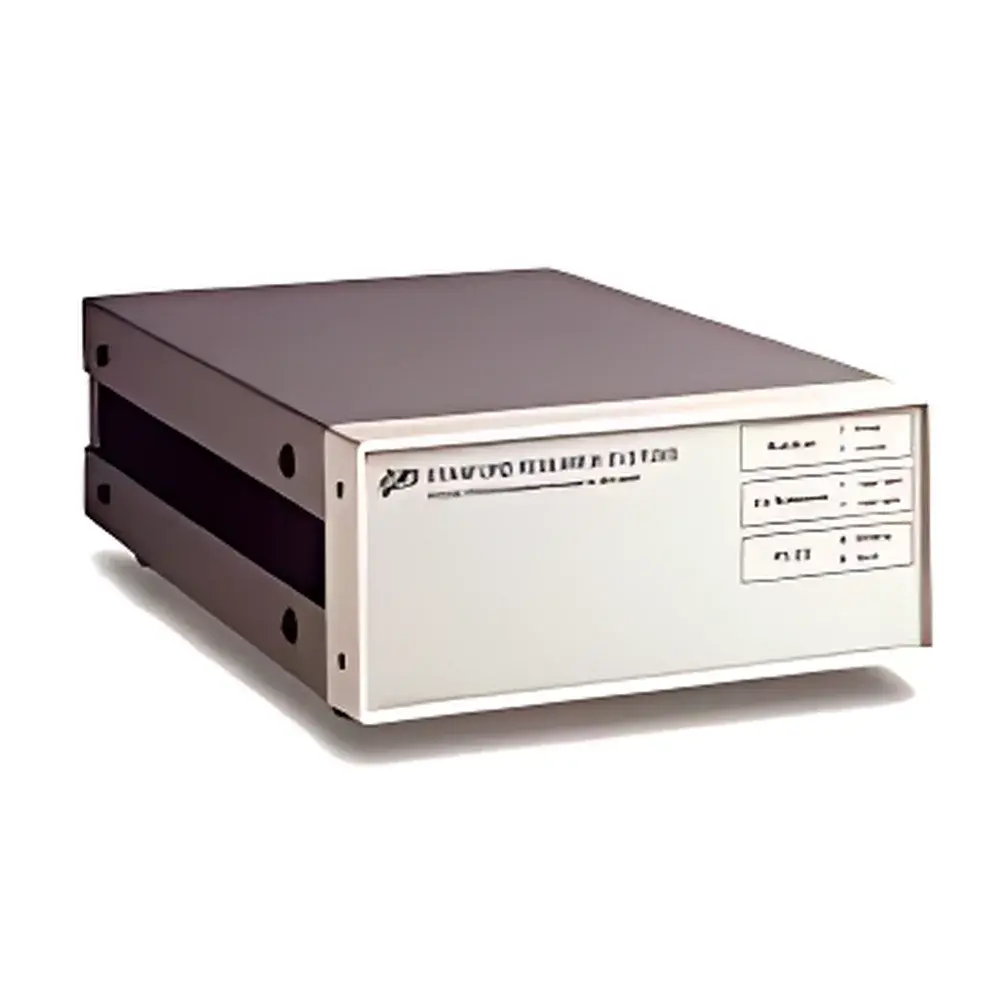
FS725 Desktop Rubidium Frequency Standard
| Brand | SRS/Stanford Research Systems |
|---|---|
| Origin | USA |
| Model | FS725 |
| Output Frequencies | 10 MHz, 5 MHz |
| Aging Rate (20-year) | < 0.005 ppm |
| Phase Noise | Ultra-low (typ. –130 dBc/Hz at 1 Hz offset) |
| Distribution Amplifier | Integrated, 22 buffered outputs |
| GPS Sync | 1 PPS input and output |
| Interface | RS-232 serial |
Overview
The FS725 Desktop Rubidium Frequency Standard is a high-stability, laboratory-grade atomic frequency reference engineered for precision timing, synchronization, and metrology applications. Based on the hyperfine transition of rubidium-87 atoms (6.834682610904324 GHz), the FS725 employs optical pumping and microwave interrogation in a compact, thermally stabilized vapor cell to generate an exceptionally stable 10 MHz output signal—traceable to primary cesium standards via long-term calibration protocols. Unlike quartz oscillators, which drift significantly with temperature and aging, the FS725 leverages atomic resonance to deliver intrinsic long-term stability and low phase noise performance critical for RF test benches, time-of-arrival measurements, coherent radar systems, and calibration laboratories requiring traceable frequency references.
Key Features
- Ultra-stable 10 MHz and 5 MHz sine-wave outputs with sub-millihertz frequency resolution and <0.005 ppm aging over 20 years—validated per IEEE Std 1139 and NIST SP 1065 guidelines.
- Low-phase-noise architecture: typical phase noise of –130 dBc/Hz at 1 Hz offset, –150 dBc/Hz at 10 Hz, and –160 dBc/Hz beyond 1 kHz—enabling high-resolution spectral analysis and low-jitter digital system synchronization.
- Integrated 22-channel distribution amplifier with individually buffered, 50 Ω terminated outputs—each delivering ±0.1 dB amplitude match and <1 ps channel-to-channel skew across full bandwidth (DC–15 MHz).
- GPS-disciplined operation mode: accepts external 1 PPS timing signals for long-term frequency correction and provides synchronized 1 PPS output with <10 ns jitter (RMS), supporting traceability to UTC(USNO) when used with certified GPS receivers.
- Full RS-232 interface (9600 baud, ASCII command set) enabling remote configuration, status monitoring, and real-time readout of internal temperature, lock status, aging compensation value, and oscillator health metrics.
- Robust thermal management with dual-stage oven control and active ambient temperature compensation—ensuring stable operation across 15–35 °C without external climate control.
Sample Compatibility & Compliance
The FS725 is designed for integration into environments governed by rigorous metrological and regulatory frameworks. It complies with FCC Part 15 Class A emissions limits and meets CE marking requirements for electromagnetic compatibility (EN 61326-1). Its frequency stability performance aligns with ISO/IEC 17025 requirements for accredited calibration laboratories, and its traceable aging specification supports adherence to ASTM E2905 (Standard Practice for Calibration of Frequency Standards). While not inherently 21 CFR Part 11 compliant, audit-ready logging of configuration changes and lock history—when paired with validated third-party data acquisition software—facilitates GLP/GMP-aligned timekeeping documentation in regulated R&D and QA/QC settings.
Software & Data Management
The FS725 operates without proprietary host software; all functions are accessible via standard terminal emulation (e.g., PuTTY, Tera Term) using documented ASCII commands. Supported queries include *IDN?, SYST:STAT?, OUTP:STAT?, and CALC:AGE?—enabling automated scripts (Python, LabVIEW, MATLAB) to log oscillator health, monitor lock integrity, and trigger alerts upon loss of atomic lock or excessive temperature deviation. Timestamped output logs can be exported for trend analysis in compliance with ISO/IEC 17025 Clause 7.7 (Uncertainty of Measurement) and internal quality procedures. No firmware updates require physical access—remote diagnostics and parameter adjustments are fully supported over RS-232.
Applications
- Primary frequency reference in metrology labs performing calibrations of synthesizers, counters, and spectrum analyzers per ANSI/NCSL Z540 and ISO/IEC 17025.
- Synchronization source for phased-array antenna systems, software-defined radios (SDRs), and multi-channel digitizers requiring sub-nanosecond timing coherence.
- Stable local oscillator in heterodyne optical interferometry, cavity ring-down spectroscopy, and quantum optics experiments where laser linewidth narrowing depends on RF reference purity.
- Backup timing reference in telecom infrastructure test beds, especially during GNSS-denied scenarios requiring holdover stability exceeding 1 × 10⁻¹² at 1 day.
- Teaching and research platform in undergraduate and graduate physics laboratories covering atomic clocks, feedback control theory, and precision measurement science.
FAQ
What is the warm-up time to full specification?
Typical warm-up to specified stability and phase noise is 5 minutes; full thermal equilibrium and optimal aging compensation are achieved within 30 minutes.
Does the FS725 support external OCXO disciplining or holdover modes?
No—the FS725 is a self-contained rubidium standard and does not accept external oscillator inputs for disciplining. Holdover performance is defined solely by its inherent atomic stability.
Can the 22 outputs drive 50 Ω loads simultaneously without impedance mismatch?
Yes—each output is individually buffered with 50 Ω source impedance and rated for continuous 0 dBm (1 mW) into 50 Ω, supporting fan-out to multiple instruments without external splitters.
Is the RS-232 interface optically isolated?
No—RS-232 communication uses standard single-ended signaling; galvanic isolation requires an external isolated USB-to-serial adapter if deployed in electrically noisy industrial environments.
How is traceability to national standards maintained?
SRS provides factory calibration certificates traceable to NIST via direct comparison with primary cesium beam standards; users may schedule recalibration every 2–3 years to maintain stated aging and stability specifications.




