
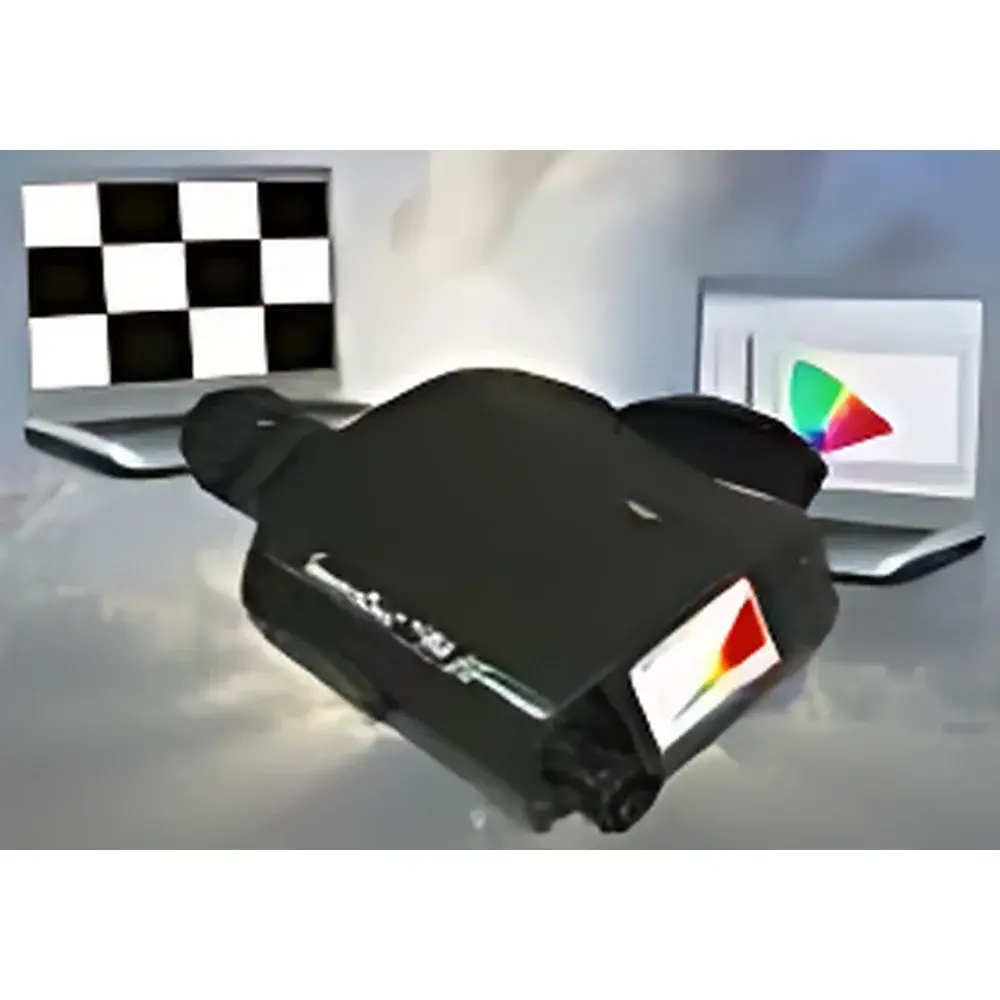
PR-680 Dual-Beam Spectroradiometer, Photometer and Colorimeter
| Brand | Photo Research |
|---|---|
| Origin | USA |
| Model | PR-680 |
| Type | Portable, Automatic |
| Luminance Range | 0.003 to 10⁸ cd/m² |
| Spectral Resolution | 0.9 nm (FWHM) |
| Wavelength Range | 380–780 nm |
| CIE Standard Observer | 2° and 10° |
| Compliance | NIST-traceable calibration, ISO/CIE-compliant spectral measurement architecture |
| Measurement Modes | Spectral Radiance, Illuminance, Luminance, Chromaticity (x,y & u’v’), Correlated Color Temperature (CCT), Dominant Wavelength, Color Rendering Index (CRI), TM-30 (Rf, Rg) |
| Data Interface | USB 2.0, RS-232, Ethernet |
| Software Compatibility | PR-680 Control Software, SpectraWin v5.0+, supports ASTM E308, CIE 15:2018, IEC 61747-1, ISO 13406-2, VESA FPDM 2.0 |
Overview
The PR-680 Dual-Beam Spectroradiometer, Photometer and Colorimeter is a high-precision, portable optical measurement instrument engineered for laboratory-grade photometric, radiometric, and colorimetric characterization of displays, lighting systems, and reflective/transmissive materials. Based on a dual-beam optical architecture with real-time reference compensation, the PR-680 eliminates drift-induced errors common in single-beam spectrometers—ensuring long-term stability and measurement reproducibility across variable ambient conditions. Its core optical engine integrates a 512-element linear CCD array with a high-fidelity Czerny-Turner monochromator, delivering 0.9 nm spectral resolution (FWHM) over the full visible spectrum (380–780 nm). The system operates under CIE 1931 2° and CIE 1964 10° standard observer functions, supporting full compliance with ISO/CIE spectral data reduction protocols per CIE 15:2018 and ASTM E308-23. Designed for traceability, each unit ships with NIST-traceable factory calibration certificates covering luminance, irradiance, and spectral responsivity.
Key Features
- Dual-beam optical design with integrated reference channel for real-time background and detector drift correction
- Minimum measurable luminance of 0.003 cd/m²—optimized for OLED, microLED, and low-brightness display evaluation
- Full spectral acquisition in <1.5 seconds; rapid single-wavelength mode enables dynamic response time measurement when synchronized with external triggers (e.g., oscilloscopes or pattern generators)
- Simultaneous support for photopic, scotopic, and melanopic spectral weighting functions (CIE S 026/E:2018)
- Onboard memory stores up to 1,000 spectra; internal non-volatile storage retains calibration coefficients and user-defined measurement configurations
- Rugged magnesium alloy housing rated IP52 for dust resistance and limited moisture exposure—suitable for cleanroom, production floor, and field deployment
Sample Compatibility & Compliance
The PR-680 accommodates a broad range of sample geometries via interchangeable lens attachments (standard f/1.2 objective, telephoto, and near-field probes) and optional integrating spheres (for total flux and transmittance measurements). It meets critical industry requirements for display metrology including VESA FPDM 2.0 (Flat Panel Display Measurements), ISO 13406-2 (Ergonomic requirements for work with visual displays), and IEC 61747-1 (Liquid crystal display devices). For regulated environments, the instrument supports audit-ready operation: all measurements include embedded timestamps, operator ID fields, and raw spectral data logging—enabling full GLP/GMP traceability. Optional software modules provide FDA 21 CFR Part 11–compliant electronic signatures, audit trails, and role-based access control.
Software & Data Management
Control and analysis are performed using SpectraWin v5.0+—a Windows-based platform that supports automated test sequences, batch processing, and custom report generation (PDF, CSV, XML). The software implements full CIE color space conversions (XYZ, Yxy, L*a*b*, L*u*v*, u’v’) and advanced metrics including TM-30-20 (Rf, Rg), CRI Ra, and spectral similarity index (SSI). Raw spectral data is exportable in JIS Z 8722-compliant format for third-party analysis tools (e.g., MATLAB, Python SciPy). Firmware updates and calibration file management are handled through secure HTTPS-based device portals, ensuring version-controlled configuration integrity across multi-instrument deployments.
Applications
- Display development labs: Characterization of LCD, OLED, QD-LCD, and microLED panels—including grayscale tracking, viewing angle dependence, temporal response (ON/OFF and gray-to-gray), and flicker analysis (IEEE 1789)
- Lighting R&D: LED package validation, phosphor optimization, and spectral binning per ENERGY STAR and DLC requirements
- Automotive HMI testing: Instrument cluster, head-up display (HUD), and ambient lighting verification against UNECE R112 and ISO 15008
- Regulatory testing labs: Third-party certification for IEC/EN 62471 (photobiological safety), IEC/EN 62368-1 (audio/video equipment), and MIL-STD-3009 (avionics display standards)
- Academic optics research: Spectral reflectance/transmittance mapping of thin films, anti-reflective coatings, and metamaterials
FAQ
What distinguishes the PR-680 from the PR-670 and PR-880?
The PR-680 unifies the handheld ergonomics and rapid spectral acquisition of the PR-670 with the extended dynamic range, enhanced stray-light rejection, and advanced display metrology features (e.g., temporal synchronization, flicker index calculation) previously exclusive to the benchtop PR-880.
Can the PR-680 measure response time without an oscilloscope?
No—the instrument itself does not generate stimulus patterns. However, its TTL trigger input/output ports enable hardware-synchronized spectral capture with external signal generators or oscilloscopes, allowing precise ON/OFF and gray-level transition timing analysis.
Is NIST traceability provided for every unit?
Yes—each PR-680 ships with individual NIST-traceable calibration certificates for luminance (cd/m²), illuminance (lux), and spectral responsivity (A/W/nm), validated at three wavelengths (450, 550, and 650 nm) and covering the full operational range.
Does the PR-680 support TM-30-20 calculations?
Yes—SpectraWin v5.0+ includes full implementation of ANSI/IES TM-30-20, generating Rf (fidelity index), Rg (gamut index), color vector graphics, and spectral distortion maps directly from measured spectral power distributions.
How is data integrity maintained during field use?
All measurements embed cryptographic checksums, UTC timestamps, and instrument serial numbers. When used with SpectraWin’s secure mode, raw spectral files are digitally signed and cannot be altered without invalidating the signature—meeting ALCOA+ data integrity principles for regulated industries.




