
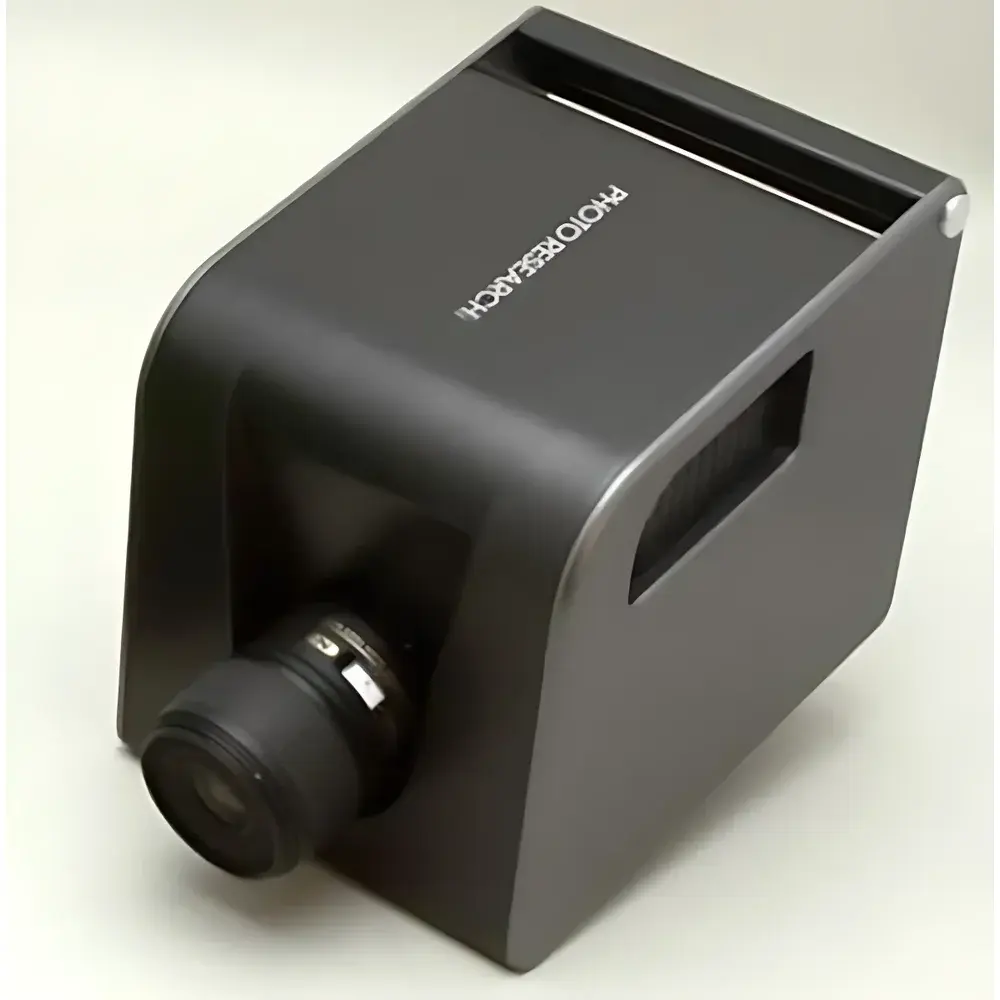
Photo Research PR-930 Imaging Colorimeter
| Brand | Photo Research |
|---|---|
| Origin | USA |
| Model | PR-930 |
| Sensor Type | Interline-cooled CCD |
| Dynamic Range | 12-bit |
| Resolution | 8 MP (3,296 × 2,472) |
| Pixel Size | 5.5 × 5.5 µm |
| Minimum Measurable Spot | 27.5 × 27.5 µm (5×5 pixel binning) |
| FOV (@ 1 | 1 Macro Lens): 18.13 × 13.59 mm |
| Luminance Range | 0.005–500 cd/m² (ND-1 to ND-3 filters optional) |
| Luminance Accuracy (A-source) | ±2% (>0.05 cd/m²), ±3% (0.005–0.05 cd/m²) |
| Luminance Accuracy (Sample) | ±1% (>0.05 cd/m²), ±2% (0.005–0.05 cd/m²) |
| Luminance Repeatability (A-source) | ≥0.2% (>0.05 cd/m²), ≥1% (0.005–0.05 cd/m²) |
| Chromaticity Accuracy (A-source) | ±0.0015 CIE x,y (>0.05 cd/m²), ±0.005 CIE x,y (0.005–0.05 cd/m²) |
| Chromaticity Accuracy (Sample) | ±0.0015 CIE x,y (>0.05 cd/m²), ±0.005 CIE x,y (0.005–0.05 cd/m²) |
| Chromaticity Repeatability | ±0.001 CIE x,y (>0.05 cd/m²), ±0.003 CIE x,y (0.005–0.05 cd/m²) |
| Interface | USB 2.0 |
| Power Input | 100–240 VAC, 50–60 Hz |
| Power Consumption | 12 V, 3.8 A (45.6 W) |
| Operating Temperature | 5–30 °C, non-condensing |
| Weight | 3.77 kg |
Overview
The Photo Research PR-930 Imaging Colorimeter is a high-precision, scientific-grade instrument engineered for spatially resolved photometric and colorimetric analysis of emissive and reflective displays, lighting systems, and optical components. Based on a thermoelectrically cooled interline CCD sensor with 12-bit dynamic range and 8 megapixel resolution (3,296 × 2,472), the PR-930 captures full-field luminance (cd/m²) and CIE 1931 chromaticity (x,y) data in a single exposure. Its optical architecture supports macro imaging at 1:1 magnification (FOV: 18.13 × 13.59 mm), enabling sub-30 µm minimum resolvable features—critical for evaluating micro-LED arrays, OLED pixel uniformity, automotive HUDs, and aerospace cockpit displays. Calibration traceability is maintained to NIST standards via factory-applied spectral responsivity correction and photometric calibration using standard A-illuminant reference sources. The system operates under controlled thermal conditions (5–30 °C, non-condensing), ensuring long-term stability of dark current and quantum efficiency.
Key Features
- Thermoelectrically cooled interline CCD sensor for low-noise, high-dynamic-range imaging (12-bit digitization)
- Sub-pixel spatial resolution down to 27.5 × 27.5 µm using 5×5 pixel binning, supporting micro-display metrology
- Integrated neutral density filter wheel (ND-1 to ND-3) for extended luminance measurement range (0.005–500 cd/m²)
- USB 2.0 interface for deterministic frame transfer and real-time acquisition synchronization
- Factory-calibrated spectral response aligned to CIE 1931 V(λ) and color matching functions (CMFs), with documented uncertainty budgets per ANSI/ISO 11664 and CIE Publication 15
- Rugged aluminum housing (3.77 kg) designed for integration into production test stations and R&D laboratories
Sample Compatibility & Compliance
The PR-930 is compatible with flat-panel displays (LCD, OLED, MicroLED), automotive interior lighting (instrument clusters, ambient lighting), avionics displays (EFIS, EICAS), signage, and backlit membrane switches. It supports automated AOI (Area of Interest) definition for region-specific photometric evaluation and complies with key industry requirements: ASTM E308-22 (computing tristimulus values), ISO/CIE 11664-1:2019 (colorimetry fundamentals), and SAE AS7753 (automotive display luminance and chromaticity testing). For regulated environments, VideoWin3 PRO software supports audit-ready operation—including user access control, electronic signatures, and configurable metadata logging—aligning with GLP and GMP documentation expectations. While not inherently 21 CFR Part 11 compliant out-of-the-box, the software architecture permits validation protocols for FDA-regulated applications upon customer-defined configuration and IQ/OQ/PQ execution.
Software & Data Management
VideoWin3 PRO is the dedicated acquisition and analysis platform for the PR-930. It provides deterministic image capture, real-time pseudo-color mapping, and automated spatial analysis routines. Core capabilities include: “Find Shapes” algorithm for autonomous detection and segmentation of emissive regions (e.g., alphanumeric characters); dynamic AOR (Area of Region) referencing with δ-offset propagation across sample batches; three-point character averaging for MIL-STD-3009 and SAE AIR4992 compliance; pass/fail decision logic based on user-defined tolerances in CIE x,y or luminance space; and PDF report generation embedding raw images, numerical tables, CIE 1931 chromaticity diagrams, and Go/No-Go status flags. All measurement metadata—including exposure time, ND filter position, calibration timestamp, and operator ID—is embedded in exported files. Data export formats include CSV, TIFF (16-bit linear), and XML for LIMS or MES integration.
Applications
- Display Mura and uniformity analysis in OLED and LCD manufacturing
- Automotive HMI validation per UNECE R118 and ISO 15008
- Aerospace display certification against DO-160 Section 21 and RTCA/DO-297
- LED array binning and wafer-level photometric screening
- Backlight unit (BLU) homogeneity assessment for notebook and tablet displays
- Research-grade spectral-spatial correlation studies in human vision science labs
FAQ
What is the minimum measurable luminance level with the PR-930?
The system achieves a lower limit of 0.005 cd/m² when using the ND-3 filter and optimized integration time, validated under A-source illumination per CIE 127:2007 Annex B.
Can the PR-930 measure both luminance and chromaticity simultaneously?
Yes—each acquired frame delivers full-resolution (3,296 × 2,472) luminance and CIE x,y values derived from spectrally corrected RGB channels, without sequential filter switching.
Is VideoWin3 PRO compatible with Windows 10/11 64-bit operating systems?
Yes—the software is certified for Windows 10 (v22H2) and Windows 11 (v23H2), requiring .NET Framework 4.8 and USB 2.0 host controller support.
How is calibration traceability maintained over time?
Each PR-930 ships with a NIST-traceable calibration certificate. Users may perform field verification using optional PR-700 series reference sources; full recalibration is recommended annually or after mechanical shock per ISO/IEC 17025 guidelines.
Does the system support custom AOI scripting?
VideoWin3 PRO includes a built-in macro language (VBScript-compatible) enabling programmable AOI definition, batch processing, and conditional pass/fail logic beyond GUI-based workflows.




