
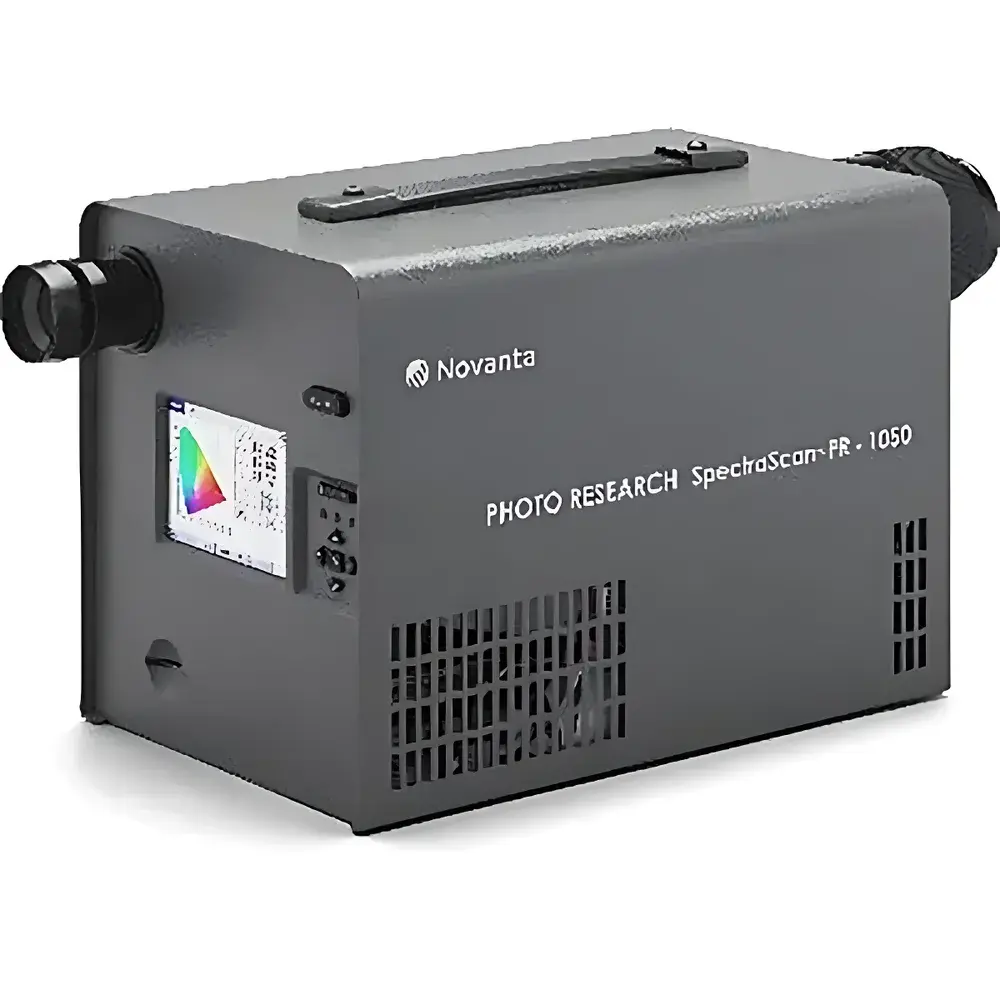
Photo Research PR1050+ Spectroradiometric Luminance Meter
| Brand | Photo Research |
|---|---|
| Origin | USA |
| Model | PR1050 |
| Dynamic Range | 500,000,000:1 |
| Spectral Bandwidth | 2, 5, or 8 nm (auto-selectable) |
| Detector | Back-illuminated CCD, 512 pixels, thermoelectrically cooled |
| Color Accuracy (CIE 1931 x,y) | ±0.0015 at 5.14E−4 cd/m² (A-source, 2856 K, 2° FOV, 8 nm BW) |
| Color Repeatability | ±0.0005 at 1.19E−2 cd/m² (A-source, 2° FOV) |
| Luminance Sensitivity | 1.71E−5 cd/m² (10:1 SNR, 2° FOV, 8 nm BW) |
| Luminance Accuracy | ±2% (NIST-traceable A-source, 5.14E−4 cd/m²) |
| Luminance Repeatability | ≤1% (NIST-traceable A-source, 5.14E−4 cd/m²) |
| Exposure Time | 7 ms – 120 s |
| Polarization Error | <0.2% (at 3.34 cd/m², 2° FOV) |
| Stray Light | <0.06% |
| Wavelength Accuracy | <0.4 nm |
| Spectral Resolution | 1 nm |
| Digital Resolution | 16-bit |
| Interfaces | USB, RS-232 |
| Apertures | 2°, 1°, 0.5°, 0.25°, 0.2°, 0.125°, 0.1°, 0.1°×1° (vertical slit), 0.5°×1.5° (horizontal slit) |
| Power | Rechargeable Li-ion battery or 90–240 VAC adapter |
| Battery Life | Up to 8 hours |
| Weight | 6.01 kg |
| Dimensions | 28.0 × 17.0 × 20.3 cm |
| Operating Temperature | 1–35 °C |
| Relative Humidity | 0–90% RH (non-condensing) |
Overview
The Photo Research PR1050+ Spectroradiometric Luminance Meter is a high-precision, field-deployable instrument engineered for absolute photometric and colorimetric characterization of self-luminous and reflective surfaces across an industry-leading dynamic range of 500,000,000:1. Built upon the proven architecture of the Photo Research 7-Series platform and refined through decades of metrological expertise in cinema, display manufacturing, and aerospace applications, the PR1050+ employs a thermoelectrically cooled, back-illuminated 512-pixel CCD detector coupled with a calibrated monochromator-based optical path. This spectroradiometric design enables direct spectral acquisition (380–780 nm) without reliance on filter-wheel interpolation or tristimulus approximation—ensuring traceable, NIST-aligned luminance, chromaticity, and spectral power distribution (SPD) measurements. Its ultra-wide dynamic range eliminates the need for mechanical neutral density filters or aperture swaps during measurement sequences, enabling seamless evaluation from deep black levels (1.71 × 10⁻⁵ cd/m²) to saturated white outputs (>106 cd/m²) under identical geometric and spectral conditions. The system supports full compliance with CIE S 026/E:2015, ISO/CIE 11664 series, and ASTM E308-22 for spectral data reduction and colorimetric computation.
Key Features
- Unprecedented Dynamic Range: Measures luminance from 1.71 × 10⁻⁵ cd/m² to 6.85 × 10⁶ cd/m² (depending on FOV and accessory) without hardware reconfiguration—critical for evaluating HDR displays, microLED emissive arrays, and AR/VR near-eye optics.
- AR/VR-Optimized Optical Pathways: Compatible with dedicated field lenses (SL-0.5X, SL-1X, LA-730, FP-730) supporting 0.1°–2° apertures and sub-millimeter spot sizes at working distances from contact to infinity; optional 3 mm, 4 mm, and 5 mm AR/VR entrance pupils enable spatially resolved measurement within constrained optical waveguides.
- Configurable Spectral Acquisition: User-selectable spectral bandwidths of 2 nm, 5 nm, or 8 nm—or automatic bandwidth optimization—ensuring optimal signal-to-noise ratio and spectral fidelity across OLED, QD-LCD, laser phosphor, and microLED emission profiles.
- High-Fidelity Photometric Traceability: Factory-calibrated against NIST-traceable standards; luminance accuracy ±2% and chromaticity repeatability ±0.0005 (CIE 1931 x,y) are verified per ISO/IEC 17025-accredited procedures and documented in supplied calibration certificates.
- Robust Field Operation: Integrated rechargeable Li-ion battery (8 h runtime), ruggedized magnesium alloy housing (IP52-rated), and dual-interface support (USB 2.0 + RS-232) ensure reliable deployment in production line, lab, and on-set environments.
Sample Compatibility & Compliance
The PR1050+ is validated for quantitative measurement of emissive and reflective targets conforming to IEC 62341-6-3 (OLED displays), IEC 63292 (microLED), SAE AS8032B (aerospace cockpit lighting), and ISO 13406-2 (visual display ergonomics). Its spectral acquisition engine supports full compliance with FDA 21 CFR Part 11 requirements when used with Photo Research’s SpectraWin™ software configured for audit-trail-enabled workflows. All calibrations are performed in accordance with ISO/IEC 17025:2017 by an A2LA-accredited laboratory, with uncertainty budgets reported for each spectral channel and photometric quantity. The instrument meets EN 61347-1 and IEC 62471 photobiological safety assessment requirements for radiant intensity and radiance evaluation of light-emitting devices.
Software & Data Management
Controlled via SpectraWin™ v6.x (Windows-based), the PR1050+ supports automated measurement sequences, multi-point spatial mapping, real-time spectral visualization, and batch export in CSV, XML, and CIE 15:2018-compliant .cie formats. The software implements GLP/GMP-compliant features including user access levels, electronic signatures, audit trails with timestamped parameter changes, and secure SD card logging with SHA-256 hash verification. Raw spectral data (380–780 nm @ 1 nm intervals) is stored unprocessed on removable SD cards, preserving full metrological integrity for retrospective analysis or third-party validation. Integration with LabVIEW™, Python (via PyVISA), and MATLAB® is supported through documented SCPI command sets and DLL APIs.
Applications
- Photometric and colorimetric validation of OLED, LCD, microLED, and Mini-LED display modules during R&D and production test.
- Calibration and uniformity mapping of automotive instrument clusters, HUDs, and avionics displays per DO-160 Section 21 and SAE J1757-2.
- Spectral radiance profiling of laser projection systems and DLP illumination engines for ANSI lumen and color gamut verification.
- AR/VR headset display characterization—including Mura analysis, angular luminance distribution (goniophotometry), and retinal illuminance estimation per ISO 15004-2.
- Quality control of backlight units (BLUs), edge-lit panels, and quantum dot enhancement films (QDEFs) using spectral peak ratio analysis and CCT stability metrics.
- Scientific research in vision science, circadian photometry, and human-centric lighting where absolute spectral radiance quantification is required.
FAQ
What spectral range and resolution does the PR1050+ support?
The PR1050+ acquires spectra from 380 nm to 780 nm at native 1 nm data intervals, with user-selectable optical bandwidths of 2 nm, 5 nm, or 8 nm to balance resolution and signal-to-noise ratio.
Is the PR1050+ compliant with FDA 21 CFR Part 11?
Yes—when operated with SpectraWin™ v6.x in validated configuration, it supports electronic records, audit trails, role-based access control, and digital signatures meeting Part 11 requirements for regulated industries.
Can the PR1050+ measure near-eye AR/VR displays without disassembly?
Yes—using optional SL-series field lenses and AR/VR-specific entrance pupils (3 mm, 4 mm, 5 mm), the system performs non-contact, spatially resolved radiance measurements inside optical combiners and waveguides at working distances as short as 46 mm.
How is calibration traceability maintained over time?
Each unit ships with a NIST-traceable calibration certificate valid for 12 months; recalibration services include full spectral responsivity verification, stray light correction, and polarization error characterization per ISO/CIE 11664-5.
Does the PR1050+ support automated production-line integration?
Yes—it provides deterministic SCPI command response times (<50 ms), hardware trigger inputs/outputs, and programmable exposure sequencing ideal for inline AOI (automated optical inspection) and binning systems.






