
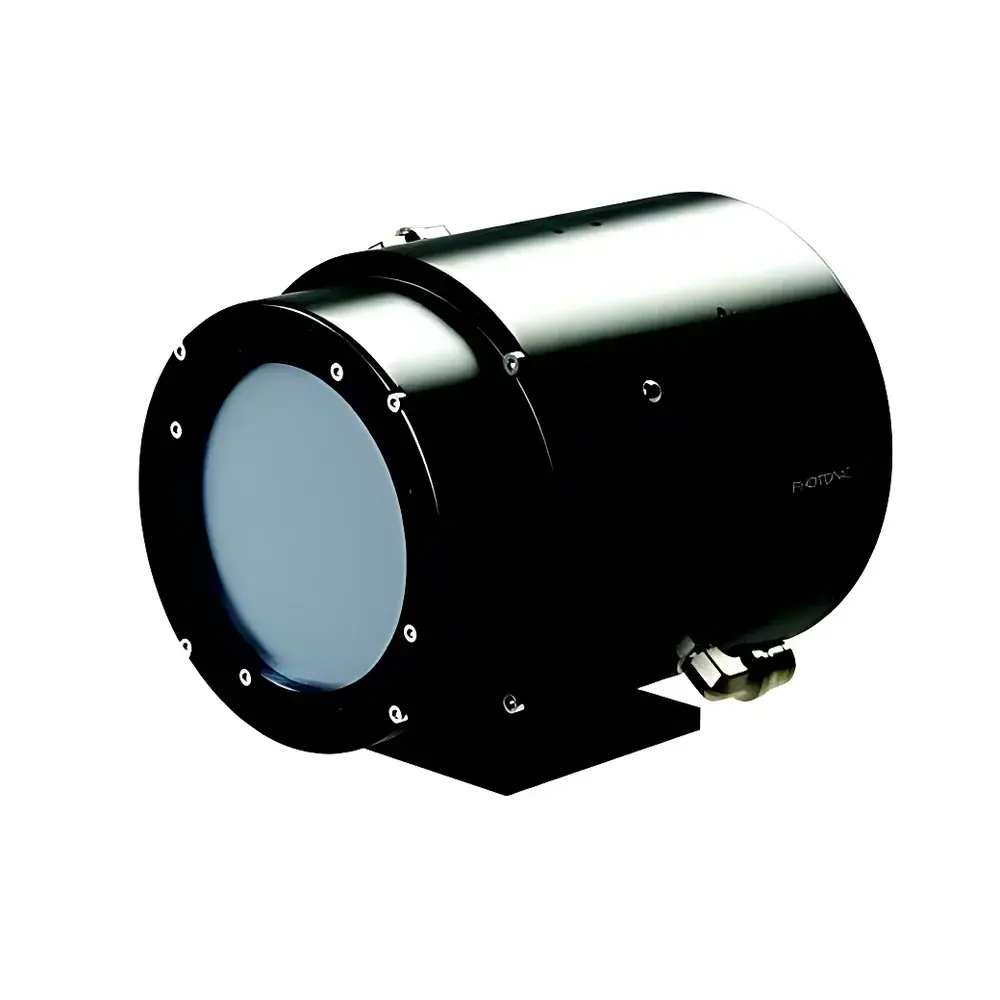
English Product Name
| Origin | United Kingdom |
|---|---|
| Distribution Model | Authorized Distributor |
| Import Status | Imported |
| Model | sCMOS_4MP |
| Pricing | Available Upon Request |
| Active Area (Single Module) | 22.5 × 22.5 mm to 95.5 × 95.5 mm |
| Multi-Module Array Configurations | 134 × 134 mm, 268 × 67 mm, 191 × 191 mm, 382 × 95.5 mm |
| Scintillator Options | Gd₂O₂S:Tb (1–55 keV), CsI:Tl (20–300 keV) |
| Pixel Array | 2048 × 2048 |
| Pixel Size | 11 × 11 µm |
| Full-Well Capacity | 80,000 e⁻ |
| Read Noise | 1.8 e⁻ rms |
| Dark Current | <1 e⁻/pixel/s |
| Quantum Efficiency (Peak) | 58% @ scintillator emission wavelength (no microlens) |
| Exposure Time Range | 50 µs – 60 s |
| Operating Sensor Temperature | −20 °C (water-cooled) |
| Bit Depth | 16-bit |
| Dynamic Range | 20,000:1 |
| Spatial Resolution | Gd₂O₂S:Tb — 25 lp/mm |
| CsI | Tl — 20 lp/mm |
| Frame Rate | 18 fps (full frame), 4.5 fps (full frame, no binning) |
| Interface | Gigabit Ethernet / GenICam-compliant |
Overview
The Andor sCMOS_4MP Large-Area X-ray Detection System is a high-performance, scientific-grade sCMOS imaging platform engineered for quantitative X-ray radiography and tomography applications requiring high spatial resolution, low noise, and precise temporal control. Built upon a back-illuminated sCMOS sensor architecture, the system delivers exceptional signal fidelity across a broad X-ray energy spectrum through optimized coupling with high-light-yield scintillators—Gd₂O₂S:Tb for soft-to-medium energy imaging (1–55 keV) and CsI:Tl for hard X-ray applications (20–300 keV). Its monolithic 2048 × 2048 pixel array, with 11 µm pitch and deep depletion design, ensures uniform quantum efficiency and minimal charge diffusion—critical for preserving modulation transfer function (MTF) in high-resolution micro-CT and phase-contrast experiments. The detector operates at a stabilized −20 °C via integrated water cooling, suppressing thermal dark current to <1 e⁻/pixel/s and enabling long-exposure acquisitions without significant background accumulation. Unlike conventional CCD or CMOS-based X-ray detectors, this system achieves true 100% duty-cycle acquisition with hardware-synchronized trigger and global shutter operation—eliminating motion artifacts in time-resolved synchrotron or pulsed-source experiments.
Key Features
- Back-illuminated sCMOS sensor with 16-bit digitization and 20,000:1 dynamic range
- Ultra-low read noise of 1.8 e⁻ rms—enabling single-photon-level sensitivity in low-dose imaging
- Full-frame frame rates up to 18 fps (with 2×2 binning) and 4.5 fps at native resolution—supporting rapid volumetric scanning
- Water-cooled thermal management maintaining stable −20 °C sensor temperature for reproducible dark current performance
- GenICam-compliant Gigabit Ethernet interface for seamless integration into existing LabVIEW, Python, or MATLAB-based acquisition frameworks
- Modular mechanical design supporting scalable multi-module tiling (e.g., 134 × 134 mm, 191 × 191 mm configurations) without optical or electronic dead zones
- OEM-ready architecture with customizable firmware, mechanical housing, and scintillator bonding options for embedded system integration
Sample Compatibility & Compliance
The sCMOS_4MP supports diverse sample geometries—from sub-micron biological specimens (e.g., iliac bone biopsies imaged at <1 µm effective resolution under 45 kV, 55 µA) to industrial PCB assemblies and composite materials. Its large active area eliminates the need for mechanical rastering in many macro-scale inspection workflows. Scintillator selection is application-driven: Gd₂O₂S:Tb provides optimal contrast for low-energy absorption imaging (e.g., soft tissue, polymers), while CsI:Tl delivers superior stopping power for high-energy sources (e.g., industrial linacs, plasma-based X-ray sources). All configurations comply with ISO 15708-2 (non-destructive testing—X-ray computed tomography) and support GLP/GMP audit trails when used with Andor’s Solis or third-party software implementing FDA 21 CFR Part 11 electronic signature and data integrity controls.
Software & Data Management
The detector is fully supported by Andor’s Solis Software Suite (v6.10+), offering real-time image preview, histogram analysis, flat-field correction, and ROI-based photon counting. For automated workflows, the GenICam interface enables direct control via HALCON, OpenCV, or custom C++/Python SDKs—including full access to exposure timing, gain, region-of-interest selection, and asynchronous acquisition buffering. Raw 16-bit TIFF or HDF5 output formats ensure compatibility with reconstruction pipelines such as TomoPy, ASTRA Toolbox, or commercial CT software (e.g., VGStudio MAX, Dragonfly). Metadata embedding (exposure time, temperature, scintillator type, binning mode) conforms to the NeXus data standard—facilitating FAIR (Findable, Accessible, Interoperable, Reusable) data practices in synchrotron and academic core facilities.
Applications
- X-ray micro-computed tomography (µCT) of geological cores, battery electrodes, and additively manufactured components
- Non-destructive evaluation (NDE) of printed circuit boards, solder joint integrity, and aerospace composites
- Propagation-based and grating-based X-ray phase-contrast imaging for soft-tissue visualization
- Beamline diagnostics and X-ray source characterization—including focal spot size measurement and coherence mapping
- Time-resolved radiography using pulsed liquid-jet X-ray sources (e.g., 50 kV, 0.8 mA, 5 µm spot size)
- Coherent diffraction imaging (CDI) and ptychography where high dynamic range and low noise are essential for iterative phase retrieval
FAQ
Is the sCMOS_4MP compatible with synchrotron beamlines?
Yes—the GenICam interface, hardware trigger synchronization, and 100% duty-cycle acquisition make it suitable for time-resolved experiments at third-generation light sources.
Can I replace the scintillator myself?
Scintillator replacement requires controlled optical coupling and alignment; it is performed by Andor-certified service engineers to maintain MTF and QE specifications.
Does the system support hardware binning for improved SNR?
Yes—2×2 binning reduces read noise contribution and increases frame rate, with full-well capacity scaling to 150,000 e⁻ per super-pixel.
What is the maximum sustainable frame rate at full resolution?
4.5 fps at 2048 × 2048 with 16-bit readout and no binning; higher rates achievable with ROI cropping or reduced bit depth.
Is FDA 21 CFR Part 11 compliance available?
When deployed with validated third-party acquisition software (e.g., Thermo Fisher Avizo, Bruker CT Analyzer) or Andor Solis in regulated environments, full audit trail and electronic signature functionality can be implemented.







