
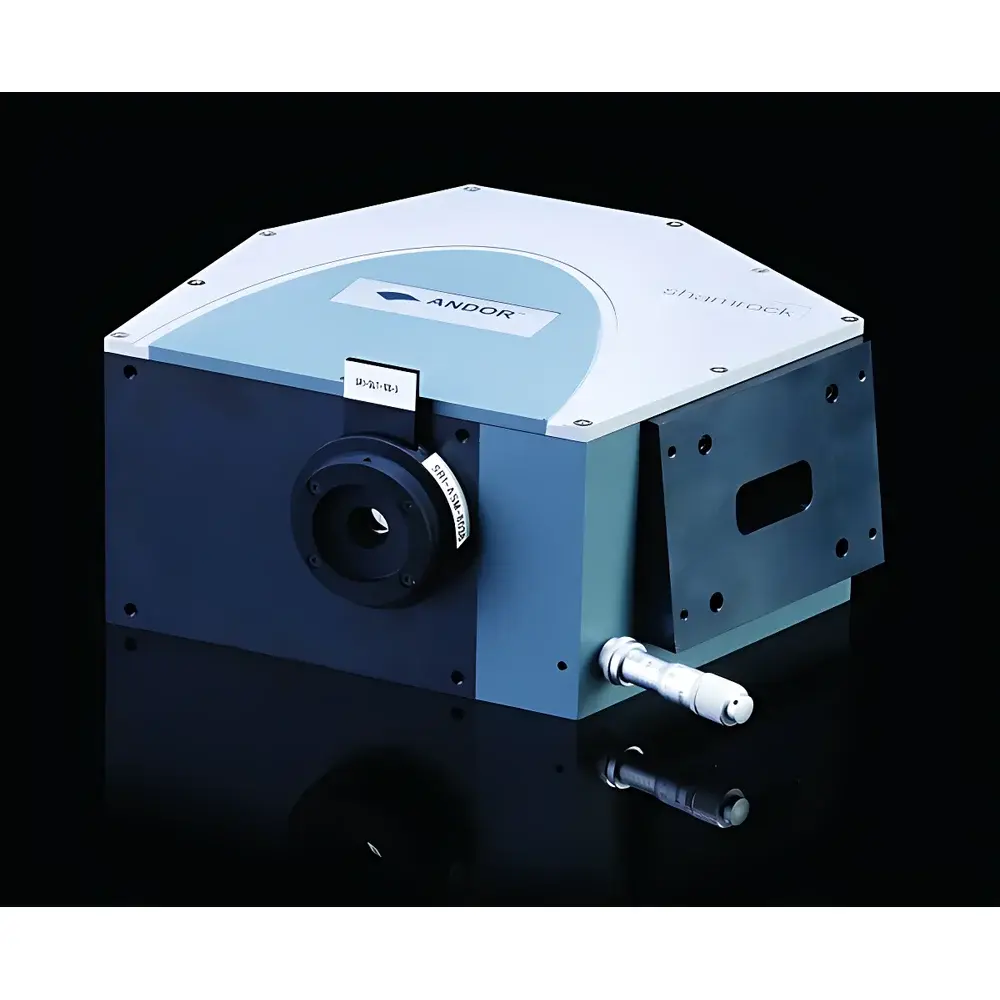
Andor SR-163 Compact Czerny-Turner Grating Spectrometer
| Brand | Andor |
|---|---|
| Origin | United Kingdom |
| Model | SR-163 |
| Optical Design | Czerny-Turner |
| Focal Length | 163 mm |
| F/# | f/3.6 |
| Wavelength Range | 300–500 nm |
| Spectral Resolution | 0.08 nm @ 2400 grooves/mm, 300 nm |
| Wavelength Accuracy | ±0.25 nm |
| Wavelength Repeatability | ±0.05 nm |
| Stray Light | ≤0.3% T |
| Dispersion | 2.0 nm/mm (with specified grating) |
| Entrance Slit Options | Multiple fixed and adjustable slit widths |
| Grating Mount | Dual-grating turret (standard), up to 3 gratings optional |
| Detector Compatibility | Full integration with Andor CCD, ICCD, and EMCCD cameras |
| Imaging Plane Dimensions | 28 mm × 10 mm |
| Grating Size | 40 mm × 40 mm |
| Coupling Options | SMA fiber port, kinematic flange, motorized shutter, dynamic slit, silver-coated optics (SR-163-SIL variant) |
Overview
The Andor SR-163 is a research-grade, compact Czerny-Turner monochromator-spectrometer engineered for high-throughput spectral acquisition in constrained laboratory environments. Its optomechanical architecture leverages a 163 mm focal length and f/3.6 aperture to deliver exceptional light-gathering capability without compromising spectral fidelity. Designed around a precision-machined optical bench and kinematically aligned mirrors, the SR-163 maintains rigorous wavefront integrity across its 300–500 nm operational range—making it particularly suited for UV–visible transmission, reflection, fluorescence, and Raman excitation profiling. Unlike conventional scanning monochromators, the SR-163 integrates seamlessly with Andor’s low-noise, deep-depletion scientific detectors (including back-illuminated CCDs, gated ICCDs, and photon-counting EMCCDs), enabling both single-wavelength selection and full-spectrum acquisition via detector readout. Its modular grating turret supports rapid interchange of ruled or holographic diffraction gratings—including 1200 g/mm and 2400 g/mm variants—allowing users to optimize resolution versus throughput based on application-specific signal-to-noise requirements.
Key Features
- Compact Czerny-Turner optical layout with 163 mm focal length and f/3.6 speed—optimized for high étendue and minimal aberration
- Dual-position manual grating turret (standard); optionally configurable for three gratings with motorized actuation
- Precision-ground 40 mm × 40 mm diffraction gratings with calibrated groove density and blaze wavelength
- Adjustable entrance slits (fixed and variable width options) for controlled spectral bandwidth and stray light suppression
- Kinematic mounting interface for reproducible alignment with Andor detectors and third-party spectrometers
- Silver-coated mirror option (SR-163-SIL) for enhanced reflectivity above 450 nm and improved UV stability
- Integrated SMA fiber coupling, vacuum-compatible flange mounts, and motorized shutter compatibility for automated workflows
Sample Compatibility & Compliance
The SR-163 supports transmissive and reflective sample configurations via standardized optical interfaces—including collimated beam input, fiber-coupled excitation, and free-space illumination paths. Its mechanical stability and thermal inertia meet ISO 10110-7 surface quality tolerances for optical components, ensuring long-term calibration retention under routine lab conditions. When paired with Andor detectors compliant with IEC 61000-4 electromagnetic immunity standards and CE-marked power supplies, the full system satisfies general-purpose laboratory instrumentation requirements per EN 61326-1. While not intrinsically certified for GMP or GLP environments, the SR-163’s wavelength repeatability (±0.05 nm) and traceable calibration protocols support audit-ready documentation when used with NIST-traceable wavelength standards (e.g., Hg/Ar emission lamps). It is routinely deployed in academic spectroscopy labs, materials characterization facilities, and OEM optical subsystem integrations where robustness, interchangeability, and metrological transparency are prioritized.
Software & Data Management
The SR-163 operates natively within Andor’s Solis™ software suite, which provides synchronized control of grating position, slit width, detector acquisition, and external peripherals (e.g., shutters, filter wheels). Solis supports full spectral calibration using polynomial fitting algorithms referenced to known emission lines, with user-defined correction tables for non-linear dispersion. All wavelength positions, exposure parameters, and hardware states are logged with timestamped metadata in vendor-neutral HDF5 format—ensuring compatibility with Python (h5py), MATLAB, and LabVIEW-based analysis pipelines. For regulated environments, Solis can be configured to enforce 21 CFR Part 11-compliant electronic signatures, audit trails, and role-based access controls when deployed on validated Windows platforms. Export options include CSV, ASCII, and FITS formats, facilitating integration into LIMS or ELN systems without proprietary dependencies.
Applications
- UV–vis absorption and reflectance spectroscopy of thin films, nanoparticles, and semiconductor layers
- Time-resolved photoluminescence decay analysis using gated ICCD detection
- Raman excitation line filtering and edge rejection in confocal microspectroscopy
- Plasma emission monitoring in process control (e.g., PECVD, sputtering)
- Calibration source characterization for radiometric and photometric transfer standards
- OEM integration into portable spectrometers, hyperspectral imaging engines, and educational teaching platforms
FAQ
What grating options are supported by the SR-163?
Standard configurations include 1200 g/mm and 2400 g/mm ruled gratings; custom holographic or blazed gratings (e.g., 600 g/mm, 300 g/mm) are available upon request and require recalibration.
Can the SR-163 be motorized for automated wavelength scanning?
Yes—the manual wavelength drive can be upgraded to a stepper-motor-controlled version (SR-163-MOT), compatible with Solis automation scripting and external TTL triggering.
Is vacuum operation possible?
The base instrument is air-filled; however, vacuum-compatible versions with stainless-steel housings and bake-out rated seals are available as custom builds (lead time applies).
How is wavelength calibration performed?
Using built-in Hg/Ar lamp references or user-supplied spectral lines; Solis performs third-order polynomial fit and stores calibration coefficients per grating/slit combination.
Does the SR-163 support fiber-optic input with numerical aperture matching?
Yes—SMA-905 ports accept standard 0.22 NA multimode fibers; optional collimating optics maintain f/3.6 throughput without vignetting.





