
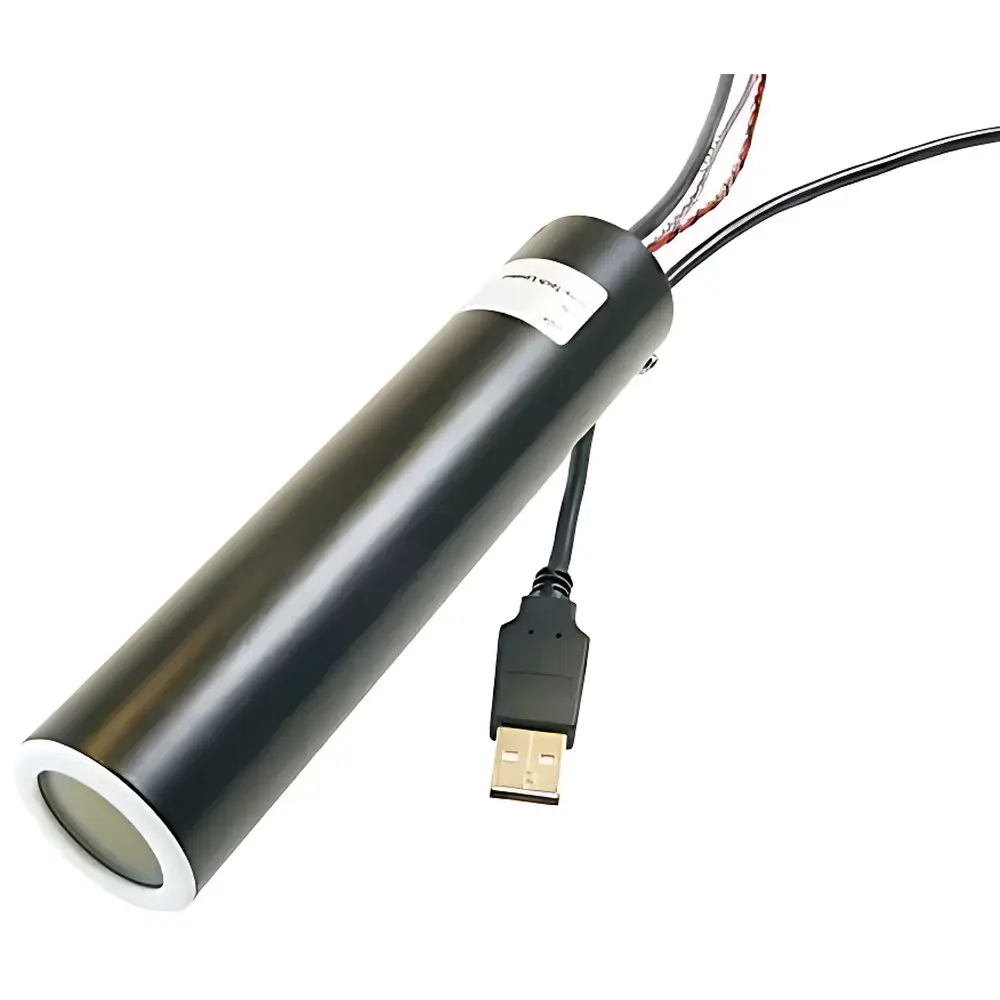
Sens-Tech P25PC Photon-Counting Photomultiplier Tube Module
| Brand | Sens-Tech |
|---|---|
| Origin | United Kingdom |
| Model | P25PC |
| Active Cathode Diameter | 22 mm |
| Photocathode Material | Bialkali |
| Spectral Response Range | 280–630 nm |
| Dark Count Rate (20 °C) | ≤100 cps |
| Maximum Count Rate | 100 MHz |
| Output Signal | TTL |
| Power Input | +5 V DC |
| Interface Options | TTL (standard), USB or RS232 (optional) |
| Shielding | Integrated electromagnetic and electrostatic shielding |
| Compliance | CE-marked, RoHS-compliant |
Overview
The Sens-Tech P25PC Photon-Counting Photomultiplier Tube (PMT) Module is a fully integrated, laboratory-grade optical detection solution engineered for ultra-low-light measurement applications requiring single-photon sensitivity and high temporal resolution. Based on vacuum photomultiplier tube technology operating in discrete photon-counting mode, the module leverages the secondary electron multiplication cascade within a bialkali photocathode and multi-stage dynode structure to convert incident photons into measurable digital pulses. Its design conforms to established principles of scintillation detection, fluorescence lifetime spectroscopy, time-correlated single-photon counting (TCSPC), and low-background radioluminescence assays. The P25PC achieves a maximum sustained counting rate of 100 MHz — among the highest commercially available for compact, OEM-integrated PMT modules — while maintaining sub-nanosecond pulse timing fidelity and excellent signal-to-noise ratio at ambient temperature (20 °C). All internal components — including the high-voltage divider network, low-noise preamplifier stage, active shielding architecture, and regulated +5 V DC power interface — are co-designed and factory-aligned to minimize gain drift, afterpulsing, and microphonic susceptibility during extended operation.
Key Features
- Fully self-contained photon-counting PMT module with integrated high-voltage supply, precision dynode resistor chain, and low-jitter pulse conditioning circuitry
- Bialkali photocathode (22 mm effective diameter) optimized for peak quantum efficiency between 400–450 nm, supporting broad UV–visible spectral response (280–630 nm)
- Maximum count rate of 100 MHz with <100 cps dark count rate at 20 °C — validated per IEC 60788-2:2019 test protocols
- Robust dual-layer shielding: mu-metal electromagnetic enclosure combined with conductive anodized aluminum electrostatic housing
- Factory-calibrated gain stability (<±0.5% over 8-hour continuous operation at 25 °C) and thermal compensation across –10 °C to +40 °C ambient range
- Flexible digital interface options: standard TTL-compatible NIM-level output; optional USB 2.0 or RS-232 firmware-controlled variants (P25USB / P25232 series)
- Integrated overvoltage and arc-detection protection circuitry compliant with IEC 61010-1 safety requirements for Class II laboratory equipment
- OEM-ready mechanical footprint (85 × 62 × 35 mm) with standardized SMA-905 optical coupling port and 2.54 mm pitch header for power and signal I/O
Sample Compatibility & Compliance
The P25PC module is compatible with standard fiber-coupled, free-space, and lens-coupled optical configurations used in fluorimeters, scintillation counters, confocal microscopy systems, and LIDAR receiver front-ends. It supports integration with common light sources including pulsed LEDs (375–630 nm), nitrogen lasers (337 nm), and Ti:sapphire oscillators (700–1000 nm, via frequency-doubled outputs). The module meets CE marking requirements under the EU Electromagnetic Compatibility Directive 2014/30/EU and Low Voltage Directive 2014/35/EU. It is RoHS 3 (2015/863/EU) compliant and designed to support GLP/GMP traceability workflows when paired with validated acquisition software. While not inherently FDA 21 CFR Part 11 certified, its digital output architecture and optional timestamped USB firmware enable full audit-trail implementation in regulated environments when deployed with compliant host software.
Software & Data Management
The P25PC operates as a hardware-transparent detector node: TTL output pulses are directly compatible with commercial time-to-digital converters (TDCs), FPGA-based correlators (e.g., PicoQuant HydraHarp), and oscilloscopes with pulse-height discrimination capability. For USB-equipped variants (P25USB series), Sens-Tech provides cross-platform drivers (Windows/Linux/macOS) and open-source SDKs (C/C++, Python bindings) supporting real-time histogramming, dead-time correction, and timestamp streaming at up to 50 MS/s sustained throughput. All firmware implements non-volatile parameter storage (HV setpoint, threshold level, pulse width gating) and supports remote configuration via SCPI-like command syntax. Raw pulse data export adheres to HDF5 v1.12 format with embedded metadata (ISO/IEC 15897-compliant), enabling seamless ingestion into MATLAB, OriginLab, or custom Python analysis pipelines compliant with ISO/IEC 17025 data integrity guidelines.
Applications
- Time-resolved fluorescence spectroscopy and anisotropy decay analysis in biochemical binding assays
- Single-molecule detection in total internal reflection fluorescence (TIRF) and super-resolution microscopy (STORM/PALM)
- Scintillation counting for low-activity alpha/beta emitters (e.g., 3H, 14C) in environmental and pharmaceutical radioassays
- Ultrafast laser-induced breakdown spectroscopy (LIBS) with gated photon arrival timing
- Quantum optics experiments requiring high-efficiency, low-jitter single-photon detection (e.g., Hong–Ou–Mandel interferometry)
- Atmospheric LIDAR receivers for aerosol backscatter profiling under moonless night conditions
FAQ
What is the recommended operating temperature range for stable photon-counting performance?
The P25PC is characterized for optimal dark count and gain stability between –10 °C and +40 °C. For applications demanding <50 cps dark count, thermoelectric cooling to 5 °C is advised using external Peltier assemblies.
Can the module be operated in analog (current-output) mode?
No — the P25PC is exclusively configured for photon-counting (pulse-discriminated) operation. Analog-mode variants (e.g., P25AN series) are available upon request.
Is high-voltage adjustment accessible to the end user?
Yes — HV is software-controllable via USB/RS232 interfaces (±1% resolution); TTL variants require external potentiometer access through the rear-panel trimmer.
Does the module support coincidence counting with multiple units?
Yes — TTL output jitter is <350 ps FWHM, enabling sub-nanosecond coincidence windowing with appropriate external logic (e.g., ORTEC CF8000).
What calibration documentation is provided with shipment?
Each unit ships with a factory calibration certificate listing measured QE curve (NIST-traceable reference lamp), dark count histogram, gain vs. HV plot, and pulse width distribution — all archived in PDF and CSV formats.



