
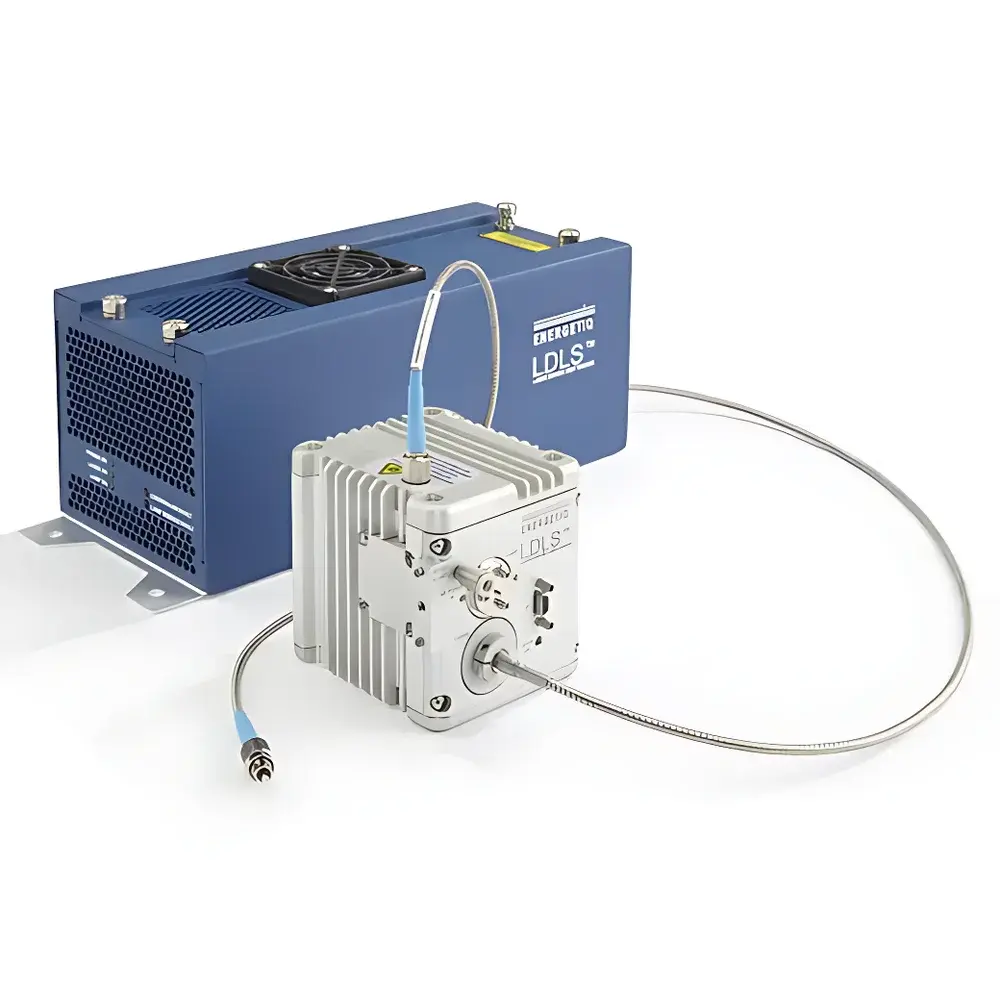
Energetiq EQ-99XFC Laser-Driven Light Source
| Brand | Energetiq |
|---|---|
| Origin | USA |
| Model | EQ-99XFC |
| Light Source Type | Laser-Driven Plasma (LDP) Broadband White Light Source |
| Output Coupling | FC Fiber-Coupled (NA 0.22) |
| Spectral Range | 190–2100 nm |
| Typical Lifetime | >9,000 hours |
| Dimensions (Lamp Head) | 82.3 × 85.7 × 76.2 mm |
| Weight (Lamp Head) | 0.7 kg |
| Power Supply Dimensions | 107 × 111 × 254 mm (excl. feet) |
| Power Supply Weight | 1.4 kg |
| Illumination Mode | External (Free-Space or Fiber-Delivered) |
Overview
The Energetiq EQ-99XFC is a high-brightness, laser-driven plasma (LDP) broadband light source engineered for demanding optical laboratory applications requiring continuous, stable, and electrode-free illumination across the deep ultraviolet to near-infrared spectrum. Unlike conventional arc lamps (e.g., deuterium, tungsten-halogen, or xenon), the EQ-99XFC utilizes a focused high-power laser to sustain a stable, high-temperature plasma in a flowing xenon gas environment—eliminating electrodes entirely. This fundamental design eliminates electrode sputtering, spectral drift, and catastrophic lamp failure mechanisms common in traditional discharge sources. The result is a spectrally smooth, spatially stable, and temporally reproducible continuum from 190 nm to 2100 nm, with enhanced deep-UV output enabled by proprietary fiber protection technology and optimized optical collection optics.
Key Features
- Laser-driven plasma architecture ensures zero electrode degradation, enabling >9,000 hours of operational lifetime under typical laboratory duty cycles.
- FC-fiber-coupled output (numerical aperture 0.22) provides standardized, alignment-free integration into spectroscopic, imaging, and metrology systems.
- Patented fiber protection mechanism minimizes solarization and hydrogen diffusion in fused silica fibers, preserving transmission below 220 nm and extending usable fiber life in UV-sensitive configurations.
- Exceptional short-term (≤0.3% RMS over 1 hour) and long-term (≤1.0% drift over 1,000 hours) radiant power stability—critical for quantitative absorbance, reflectance, and quantum yield measurements.
- Compact, fan-cooled lamp head (82.3 × 85.7 × 76.2 mm; 0.7 kg) with integrated thermal management enables benchtop deployment in space-constrained optical tables or OEM instruments.
- Ultra-clean internal construction—free of organic adhesives, epoxies, and outgassing materials—ensures low particulate generation and compatibility with ultra-high-vacuum (UHV) adjacent environments and Class 100 cleanroom installations.
Sample Compatibility & Compliance
The EQ-99XFC is designed for use with standard UV-grade fused silica optical fibers, monochromators, spectrometers, and imaging optics. Its spectral continuity and intensity profile are compatible with ASTM E308 (computing CIE tristimulus values), ISO 13406-2 (display illumination uniformity), and USP (photometric validation of UV-Vis spectrophotometers). The system operates without hazardous mercury or ozone-generating components, meeting RoHS Directive 2011/65/EU and WEEE compliance requirements. No special ventilation or UV shielding is required beyond standard laboratory safety practices for optical radiation (IEC 62471:2006 Photobiological Safety classification: Risk Group 2 for unenclosed operation).
Software & Data Management
While the EQ-99XFC operates as a standalone analog-controlled light source, it supports full integration via 0–10 V analog input for intensity modulation and TTL-compatible status monitoring (lamp-on, fault, interlock). For traceable calibration workflows, its stable output enables NIST-traceable radiometric calibration using transfer standards (e.g., FEL-type lamps calibrated per NIST SRM 2030). When deployed in regulated environments (e.g., pharmaceutical QC labs), the lamp’s deterministic lifetime, absence of consumable electrodes, and consistent spectral output support audit-ready documentation per FDA 21 CFR Part 11 when paired with compliant data acquisition software (e.g., LabVIEW™ with audit trail modules or MATLAB® Instrument Control Toolbox with logging enabled).
Applications
- High-resolution UV-Vis-NIR absorption, fluorescence, and reflectance spectroscopy—especially where spectral continuity and low-noise baselines are essential (e.g., thin-film characterization, semiconductor wafer inspection).
- Fiber-optic sensor excitation and calibration, including distributed temperature/strain sensing (DTS/DSS) systems requiring broadband coherence-free illumination.
- Monochromator and spectrograph illumination—replacing multi-lamp systems (deuterium + tungsten) with a single, maintenance-free source.
- Confocal and widefield fluorescence microscopy illumination, particularly for multicolor imaging protocols requiring stable excitation across multiple fluorophore bands.
- Optical coherence tomography (OCT) system development, where broad bandwidth and high brightness improve axial resolution in time-domain and Fourier-domain implementations.
- Accelerated lifetime testing of optical coatings, photopolymers, and UV-curable resins under controlled broadband irradiance.
FAQ
What distinguishes laser-driven plasma technology from traditional arc lamps?
Laser-driven plasma replaces thermionic electrodes with a focused laser beam to ionize xenon gas, eliminating electrode erosion, spectral flicker, and warm-up drift—resulting in superior stability and lifetime.
Can the EQ-99XFC be used with standard UV-vis spectrophotometers?
Yes—it interfaces directly with most commercial spectrophotometers via FC-fiber coupling and supports analog intensity control for dynamic range optimization.
Is deep-UV output (<220 nm) stable over time?
Yes—the patented fiber protection technology mitigates solarization, maintaining >90% of initial 190–220 nm throughput after 5,000 hours of operation under recommended cooling conditions.
Does the system require external water cooling or compressed air?
No—integrated convection and fan-assisted air cooling suffices for continuous operation at ambient temperatures up to 35°C.
How is lamp lifetime defined and validated?
Lifetime is measured as time until radiant flux drops to 80% of initial value at 365 nm under constant-current operation; validated per IEC 62717 (LED lamp lifetime methodology adapted for plasma sources).





