
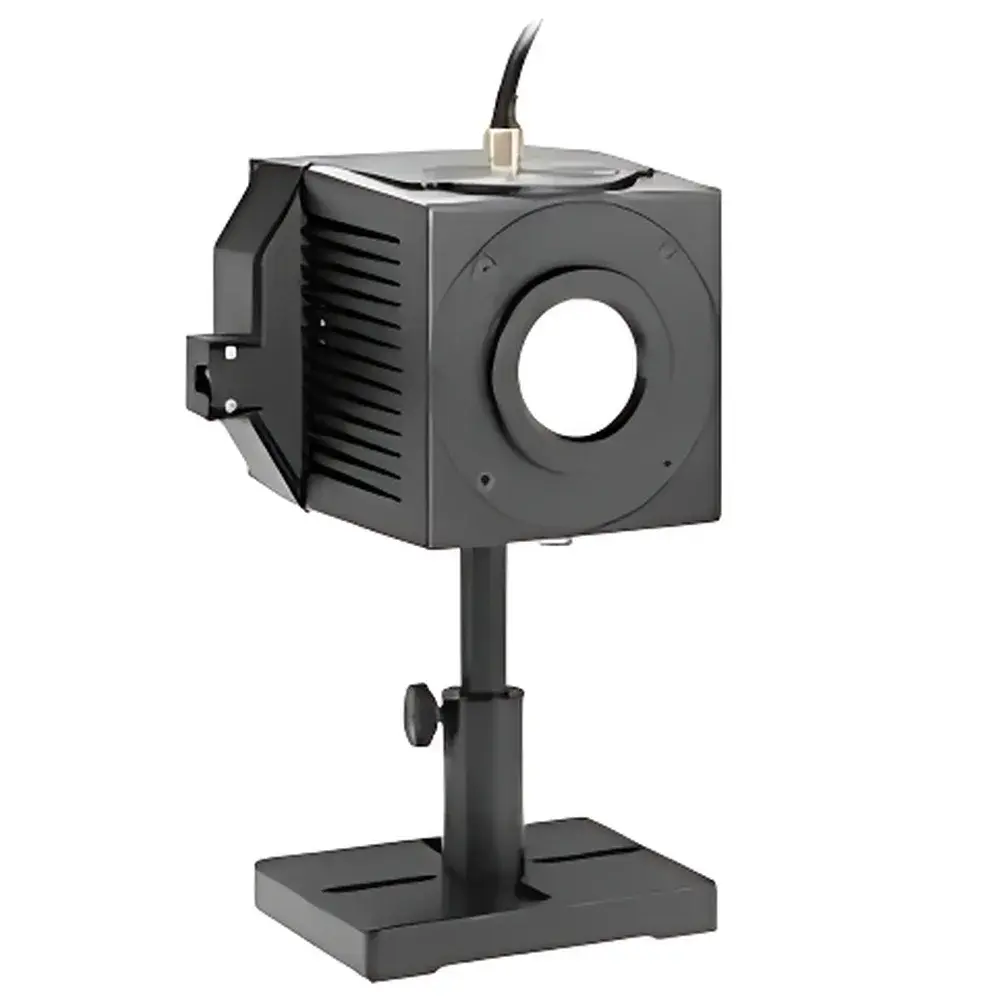
Ophir BeamTrack 3A-QUAD Position-Sensing Thermopile Sensor
| Brand | Ophir |
|---|---|
| Origin | Israel |
| Model | 3A-QUAD |
| Type | Position-Sensing Thermopile Detector for Laser Beam Characterization |
| Power Range | Up to 3 W (CW), 3 J (Pulsed) |
| Position Accuracy | ±0.1 mm |
| Beam Size Accuracy | ±5% |
| Spectral Range | 0.19–20 µm |
| Active Area | Ø9.5 mm |
| Interface | Compatible with Ophir Vega, Nova II, StarLite Meters and Juno USB Interface |
Overview
The Ophir BeamTrack 3A-QUAD is a high-stability, thermopile-based beam profiling sensor engineered for simultaneous real-time measurement of laser power (or single-shot pulse energy), beam centroid position (X/Y), and beam diameter (D4σ or knife-edge equivalent). Unlike CCD- or CMOS-based cameras, the 3A-QUAD employs a quadrant thermopile architecture—four electrically isolated, identically sized thermal sensing elements arranged radially around a central axis. This design enables direct analog output of position and size without reliance on pixel interpolation or frame-rate-limited imaging, making it inherently suitable for high-repetition-rate pulsed lasers, continuous-wave (CW) sources, and environments where optical scattering or ambient light would compromise camera-based systems. The sensor operates across an exceptionally broad spectral range—from deep ultraviolet (190 nm) through visible and near-infrared to far-infrared (20 µm)—ensuring compatibility with excimer, diode-pumped solid-state (DPSS), CO₂, and quantum cascade lasers. Its Ø9.5 mm active aperture supports collimated and moderately divergent beams while maintaining sub-millimeter positional fidelity critical for alignment-critical applications such as cavity optimization, fiber coupling, and multi-axis scanning system calibration.
Key Features
- Quadrant thermopile detector architecture enabling concurrent measurement of power/energy, X/Y centroid displacement, and beam width (D4σ)
- Position resolution of ±0.1 mm over full active area—traceable to NIST-calibrated reference standards
- Beam size accuracy of ±5% (relative to ISO 11146-compliant D4σ definition), validated using calibrated Gaussian and top-hat beam profiles
- Thermal compensation circuitry minimizes drift under varying ambient conditions; typical long-term stability <±0.5% over 8 hours at constant temperature
- No moving parts or optical coatings—robust against misalignment, contamination, and high peak-power density exposure (up to 10 kW/cm² for nanosecond pulses)
- Direct analog outputs (0–5 V) for X, Y, and power channels, plus digital USB or RS-232 interface via Ophir Juno or StarLite controllers
Sample Compatibility & Compliance
The 3A-QUAD is compatible with free-space laser beams up to 3 W average power (CW) or 3 J per pulse (with repetition rates ≤10 Hz). It accommodates wavelengths from 190 nm to 20 µm without filter changes—eliminating spectral calibration dependencies common in photodiode-based trackers. The sensor meets mechanical and electrical safety requirements per IEC 61010-1:2010 and is CE-marked. Measurement traceability follows ISO/IEC 17025 principles through Ophir’s accredited calibration laboratory (ISO/IEC 17025:2017 certified), with optional factory calibration certificates including uncertainty budgets per ISO/IEC Guide 98-3. For regulated environments—including medical laser device manufacturing and aerospace photonics QA—the sensor supports audit-ready data logging when used with Ophir StarLite or Vega meters configured for FDA 21 CFR Part 11 compliance (electronic signatures, audit trails, user access control).
Software & Data Management
Ophir’s proprietary StarLab v3.30 software provides real-time visualization of beam position trajectories, dynamic size histograms, and time-synchronized power/position/time stamps. Data export formats include CSV, MATLAB (.mat), and HDF5 for integration into LabVIEW, Python (via PyOphir SDK), or custom QC dashboards. The software implements ISO 11146-compliant beam width algorithms (second-moment D4σ, knife-edge, and 1/e²), with configurable averaging windows (1–1000 samples) to suppress noise in low-SNR conditions. All measurement sessions are timestamped and logged with metadata (sensor ID, firmware version, calibration date, operator ID), satisfying GLP/GMP documentation requirements for process validation and equipment qualification (IQ/OQ/PQ).
Applications
- Laser system alignment and active feedback control in industrial cutting/welding platforms
- Real-time monitoring of beam pointing stability during ultrafast amplifier pump diagnostics
- Verification of spatial mode quality in single-mode fiber launch setups
- Positional drift analysis of diode laser arrays under thermal load cycling
- Beam parameter product (BPP) estimation in conjunction with M² measurement systems
- Qualification of laser safety interlocks requiring position-triggered shutdown protocols
FAQ
Does the 3A-QUAD require periodic recalibration?
Yes. Ophir recommends annual recalibration for metrological continuity; intervals may be extended to 24 months under controlled lab conditions with documented in-house verification using reference sources.
Can the 3A-QUAD measure elliptical or astigmatic beams accurately?
It reports D4σ diameters independently along X and Y axes, enabling ellipticity ratio calculation—but does not resolve higher-order moments (e.g., skewness, kurtosis) or reconstruct full intensity distributions.
Is vacuum-compatible operation supported?
The standard 3A-QUAD is rated for ambient pressure only; a vacuum-compatible variant (3A-QUAD-V) with modified housing and feedthroughs is available upon request.
How does the sensor handle partially clipped beams?
Clipping degrades size accuracy beyond ±5%; position measurement remains valid if ≥70% of beam power falls within the active area, per ISO 11146 Annex B guidelines.
Which Ophir meters support full BeamTrack functionality (power + position + size)?
Vega, Nova II, StarLite, and Juno interfaces all provide native support—no firmware upgrade required beyond v4.20 or later.




