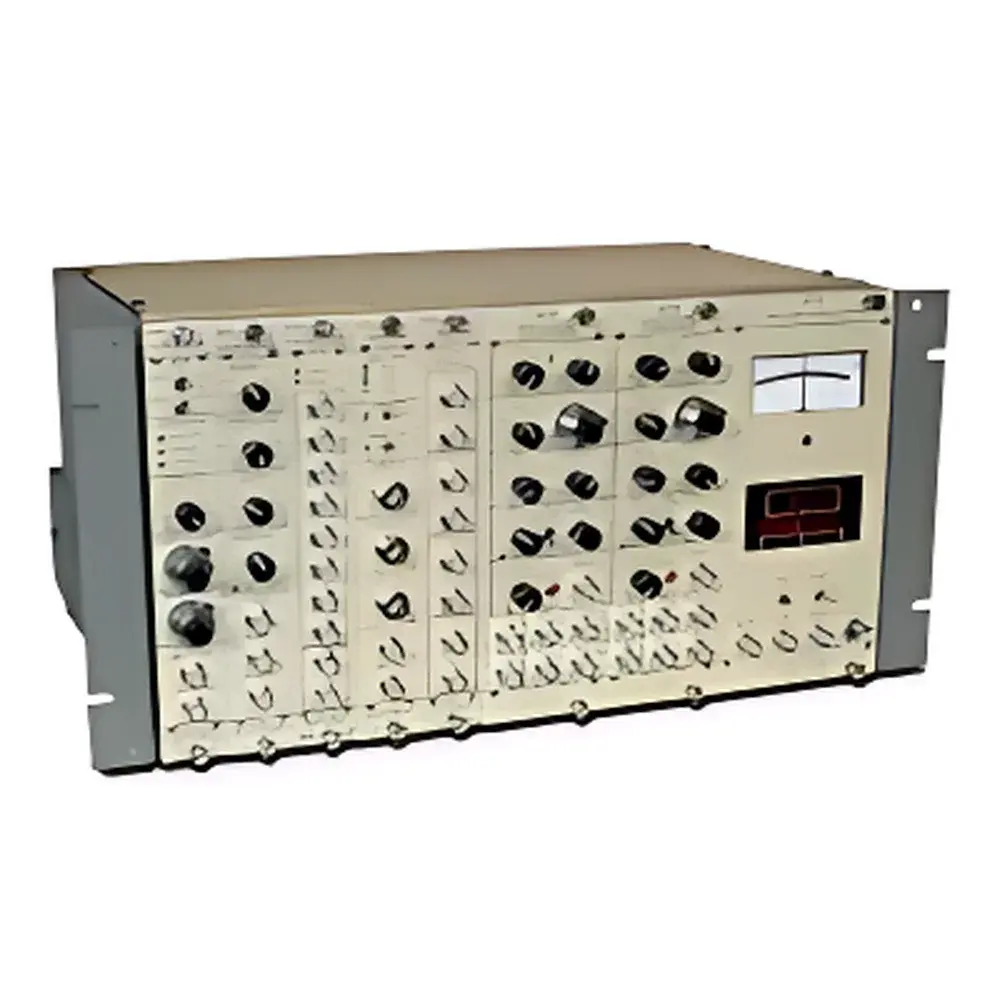
SRS SR280 Boxcar Averager System
| Brand | SRS (Stanford Research Systems) |
|---|---|
| Origin | USA |
| Model(s) | SR280, SR250, SR255, SR240A, SR245, SR270, SR200, SR235 |
| Key Specifications | Gate Width Range: 2 ns – 150 µs (SR250), down to 100 ps (SR255) |
| Sampling Averages | 1–10,000 cycles |
| RMS Jitter | <2 ps (SR255) |
| Bandwidth | 350 MHz (SR240A) |
| Rise/Fall Time | 1.2 ns (SR240A) |
| Interface | GPIB, RS-232, TTL I/O, 8-bit DIO, 8-channel analog I/O |
Overview
The SRS SR280 Boxcar Averager System is a precision time-domain signal recovery instrument engineered for the detection and quantitative analysis of weak, repetitive analog pulses buried in high-noise environments. Based on the principle of gated integration—where a precisely timed integration window (or “gate”) is synchronized to the expected arrival of a pulse—the system accumulates charge over repeated acquisitions and computes a statistically robust average. This technique leverages the deterministic timing of periodic or triggered events (e.g., laser pulses, LED decay transients, phosphorescence decay) while rejecting uncorrelated broadband noise, achieving effective signal-to-noise ratio (SNR) improvements proportional to the square root of the number of averages. Unlike digitizers with fixed sampling rates, the boxcar method offers superior dynamic range and temporal resolution for low-duty-cycle signals, especially where pulse widths fall below 10 ns and repetition rates reach up to 50 kHz. The modular architecture centers on the SR280 NIM-standard mainframe, which supplies regulated ±24 V and ±12 V power, supports daisy-chained module synchronization, and maintains mechanical and electrical compatibility with legacy nuclear instrumentation modules.
Key Features
- Modular NIM-based design enables flexible configuration: users select only the required functional blocks—gate integrators, fast amplifiers, computer interfaces, and signal processors—to match experimental constraints.
- SR250 Gated Integrator provides gate widths adjustable from 2 ns to 15 µs, with low-drift DC-coupled integration and linear response across its full dynamic range; supports up to 10,000 sample averages per measurement point.
- SR255 Ultra-Fast Sampling Module extends temporal resolution with programmable gate widths of 100 ps, 200 ps, 500 ps, or 1 ns, and sub-2 ps RMS jitter—critical for resolving ultrafast photoluminescence decay components or picosecond-scale transient responses.
- SR240A High-Speed Preamplifier delivers 350 MHz bandwidth, 1.2 ns rise/fall time, and selectable voltage gains (×5, ×25, ×125) across four independent channels—optimized for low-noise amplification of PMT or APD output signals prior to gating.
- SR245 Computer Interface Module provides bidirectional control and data transfer via GPIB and RS-232, eight analog I/O channels (±10 V, 12-bit), eight digital I/O lines, and two TTL-compatible trigger ports—enabling full remote automation and integration into LabVIEW or Python-based test sequences.
- SR270 Data Acquisition & Analysis Software offers real-time waveform display, multi-curve overlay, exponential decay fitting (single/multi-exponential), baseline correction, and export to CSV or MATLAB-compatible formats—designed for reproducible, audit-ready data handling.
Sample Compatibility & Compliance
The SR280 system is routinely deployed in photophysics laboratories for time-resolved measurements of luminescent materials, including organic LEDs, quantum dots, scintillators, and rare-earth-doped phosphors. It interfaces directly with photomultiplier tubes (PMTs), silicon photomultipliers (SiPMs), and fast avalanche photodiodes (APDs), accepting TTL or NIM-level triggers synchronized to pulsed lasers (e.g., Q-switched Nd:YAG, Ti:sapphire oscillators). All modules comply with NIM standard mechanical and electrical specifications (IEEE 315-1975), ensuring interoperability with third-party timing discriminators, delay generators, and pulse height analyzers. While not certified for clinical or industrial process control use, the system supports GLP-aligned workflows through SR270’s timestamped acquisition logs, parameter traceability, and software-configurable pass/fail thresholds—facilitating documentation for internal quality reviews or academic peer replication.
Software & Data Management
SR270 software operates under Windows 10/11 and communicates exclusively via GPIB or RS-232 using SCPI-compliant command sets. Each acquired trace includes embedded metadata: gate position, width, number of averages, amplifier gain, trigger delay, and system calibration coefficients. Raw data are stored in binary format with lossless 16-bit resolution per point; processed results—including fitted lifetimes, amplitude ratios, and residual plots—are saved as structured ASCII files. The software supports batch processing of multi-parameter sweeps (e.g., gate delay vs. intensity), automatic generation of Arrhenius or Stern–Volmer plots, and direct export to Origin, Igor Pro, or Python (via NumPy loadtxt). Audit trails record all user-initiated changes to acquisition parameters, satisfying basic requirements for traceable scientific recordkeeping per ISO/IEC 17025 Clause 7.5.
Applications
- Time-resolved fluorescence and phosphorescence lifetime spectroscopy (TRPL/TRLFS), particularly for materials exhibiting microsecond-to-millisecond afterglow.
- Characterization of LED turn-off dynamics and afterpulse behavior in solid-state lighting R&D.
- Decay kinetics analysis of radioluminescent and scintillation materials under pulsed X-ray or electron excitation.
- Lock-in-like signal recovery in pump-probe configurations where reference timing is derived from laser sync outputs.
- Calibration of ultrafast photodetectors and transient absorption setups requiring sub-nanosecond temporal fidelity.
- Low-light single-photon counting validation via analog integration mode—complementing TCSPC systems in high-flux regimes.
FAQ
What is the minimum measurable pulse width with the SR255 module?
The SR255 supports gate widths as narrow as 100 ps, with RMS timing jitter <2 ps—enabling resolution of features separated by ≈300 ps in practice.
Can the SR280 system operate without a computer?
Yes. Front-panel controls on the SR200 Gate Controller allow manual adjustment of gate delay, width, and sweep parameters; standalone operation is fully supported for rapid prototyping or teaching labs.
Is the SR270 software compatible with modern 64-bit Windows versions?
Yes—SR270 v3.5+ is validated on Windows 10 and 11 (64-bit); driver installation requires administrator privileges and signed INF files compliant with Microsoft WHQL guidelines.
How is timing synchronization achieved between the laser trigger and the gate?
Via NIM or TTL input to the SR200 or SR250; internal delay generators provide fine-adjustable offset (10 ps resolution) and coarse delay (up to 10 s), with jitter contribution dominated by the external trigger source.
Does the system support differential input or true RMS conversion?
No—inputs are single-ended, DC-coupled, and optimized for pulse-height measurement; true RMS computation is performed offline in SR270 using numerical integration of digitized traces.