
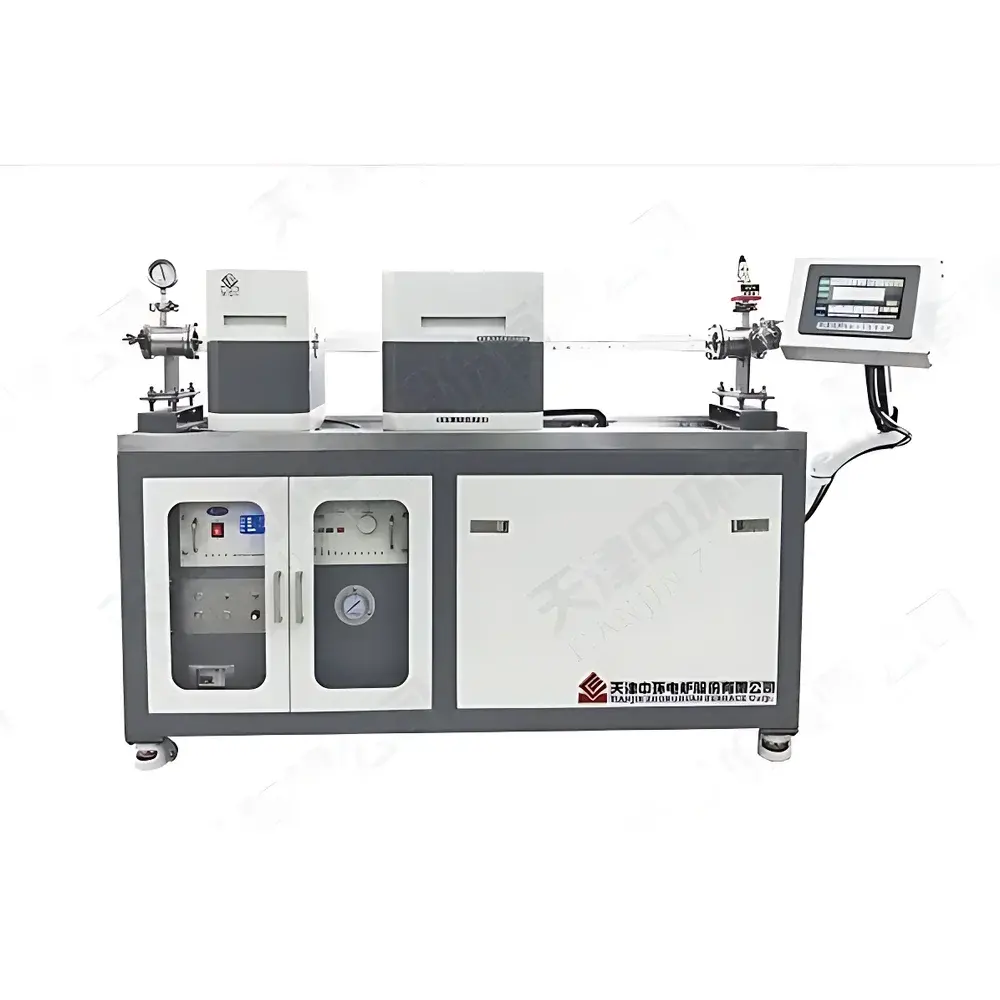
Zhonghuan Furnace PECVD-12IH-500A Integrated Automated Small-Scale Plasma-Enhanced Chemical Vapor Deposition System
| Brand | Zhonghuan Furnace |
|---|---|
| Origin | Tianjin, China |
| Model | PECVD-12IH-500A |
| Instrument Type | Horizontal Tube Furnace with Integrated RF Plasma Module |
| Max Operating Temperature | 1200 °C |
| Temperature Control Accuracy | ±1 °C |
| Heating Zone Length | 200 mm |
| Uniform Temperature Zone Length | 100 mm |
| Internal Chamber Dimensions | 290 × 350 × 340 mm |
| Quartz Tube ID | Φ60 mm |
| Rated Power | 1.2 kW |
| Programmable Ramp/Soak | 30-Stage PID Control |
| RF Frequency | 13.56 MHz ± 0.005% |
| RF Output Power Range | 0–500 W |
| RF Matching Stability | ±0.1% |
| Gas Channels | 2–4 (standard: 2) |
| Mass Flow Range | 0–500 sccm per channel |
| MFC Accuracy | ±1% F.S. |
| System Vacuum Range (with optional pump) | 10–100 Pa |
| Ultimate Vacuum (with 4 L/s dual-stage pump) | 3 × 10⁻¹ Pa |
| Cooling | Auto-activated forced-air exhaust at surface temperature ≥50 °C |
| Control Interface | LCD touchscreen + micro-PLC |
Overview
The Zhonghuan Furnace PECVD-12IH-500A is an integrated, benchtop-scale plasma-enhanced chemical vapor deposition system engineered for reproducible thin-film synthesis under controlled thermal and plasma conditions. It combines a precision horizontal tube furnace—capable of stable operation up to 1200 °C—with a synchronized 13.56 MHz radiofrequency (RF) plasma source, enabling low-temperature activation of precursor gases via electron-impact dissociation. Unlike conventional thermal CVD, PECVD lowers the required substrate temperature by leveraging highly reactive ionic and radical species generated in the glow discharge region, making it suitable for temperature-sensitive substrates such as flexible polymers, pre-patterned wafers, or multilayer heterostructures. The system’s compact footprint (420 × 1440 × 1100 mm), modular gas delivery architecture, and programmable 30-stage thermal profile support rapid process development in academic labs and R&D pilot lines.
Key Features
- Integrated design with co-aligned RF plasma zone and high-precision tube furnace—no external alignment or coupling losses.
- Automated sliding quartz tube mechanism (200 mm travel) for precise sample positioning relative to both thermal and plasma zones.
- 30-segment programmable PID temperature controller with ±1 °C stability across the 100 mm uniformity zone (measured at 1200 °C).
- Dual-channel mass flow control (expandable to 4 channels) with ±1% full-scale accuracy and <1 s response time; calibrated for N₂, Ar, NH₃, SiH₄, CH₄, and other common precursors.
- RF power supply delivering 0–500 W output with real-time forward/reflected power monitoring, automatic impedance matching, and harmonic suppression (<−50 dBc).
- Thermal management system featuring intelligent air-cooling: exhaust fans activate automatically when external casing temperature exceeds 50 °C, ensuring operator safety and long-term component reliability.
- Multi-ring vacuum flange sealing and quick-clamp gas fittings minimize leak paths and simplify maintenance—compatible with ISO-KF25 and CF35 standards.
Sample Compatibility & Compliance
The PECVD-12IH-500A accommodates substrates up to 50 mm in diameter (e.g., Si/SiO₂ wafers, glass slides, stainless steel foils, or ceramic tiles) placed inside a Φ60 mm fused quartz tube. Its operating temperature range (room temperature to 1200 °C), combined with tunable plasma density (via RF power and pressure control), supports deposition of silicon nitride (SiNₓ), silicon dioxide (SiO₂), amorphous hydrogenated silicon (a-Si:H), graphene-like carbon films, metal oxides (e.g., TiO₂, ZnO), and nanocomposite layers. The system meets baseline mechanical and electrical safety requirements per IEC 61010-1 and GB/T 14048.1. Vacuum integrity is validated per ISO 2859-1 sampling plans; optional vacuum pump configurations comply with ISO 21360-1 for rotary vane pumps. While not pre-certified for GMP environments, its data logging capability (see Software section) supports GLP-compliant documentation workflows.
Software & Data Management
The embedded micro-PLC controller records timestamped thermal profiles, RF power metrics (forward/reflected), MFC setpoints and readings, and chamber pressure (when vacuum gauge is installed). All operational parameters are stored locally on non-volatile memory with >10,000-cycle retention. Export is supported via USB 2.0 to CSV format for traceability and post-processing in MATLAB, Python, or Excel. Optional RS485/Modbus RTU interface enables integration into centralized lab automation systems. Audit trails—including user login events, parameter modifications, and emergency stop triggers—are retained for ≥90 days, satisfying basic FDA 21 CFR Part 11 readiness requirements when paired with institutional electronic signature protocols.
Applications
- Growth of passivation layers (e.g., SiNₓ) for photovoltaic cells and MEMS devices.
- Low-temperature synthesis of graphene and transition metal dichalcogenide (TMD) precursors on catalytic Cu/Ni foils.
- Deposition of biocompatible coatings (e.g., diamond-like carbon or hydroxyapatite analogs) on orthopedic implant substrates.
- In-situ plasma pretreatment and post-deposition etching using the same RF module—enabling sequential cleaning, deposition, and ashing without breaking vacuum.
- Process optimization studies requiring systematic variation of Tsub, pgas, RF power, and residence time—facilitated by repeatable ramp/soak programming and gas blending repeatability.
FAQ
What vacuum level is required for stable plasma ignition?
Stable capacitive-coupled plasma ignition typically occurs between 10–100 Pa. A dual-stage mechanical pump (4 L/s) achieves this range within ≤8 minutes from atmosphere; optional turbomolecular pumping extends capability to high-vacuum PECVD regimes.
Can the system operate without continuous gas flow?
No. Sustained plasma requires dynamic gas replenishment to maintain ionization balance. Static gas conditions lead to rapid plasma extinction and potential arcing.
Is quartz tube replacement included in routine maintenance?
Quartz tubes are consumables subject to thermal stress and plasma erosion. Users should inspect for clouding, devitrification, or microcracks after every 50–100 cycles above 900 °C and replace proactively.
Does the RF generator support pulsed mode operation?
The standard 13.56 MHz supply operates in continuous wave (CW) mode only. Pulsed RF (e.g., 1–10 kHz duty cycling) requires optional firmware upgrade and external TTL triggering input.
What certifications apply to the electrical enclosure?
The furnace chassis carries CE marking per EMC Directive 2014/30/EU and Low Voltage Directive 2014/35/EU. Full conformity documentation is available upon request for institutional procurement review.



