
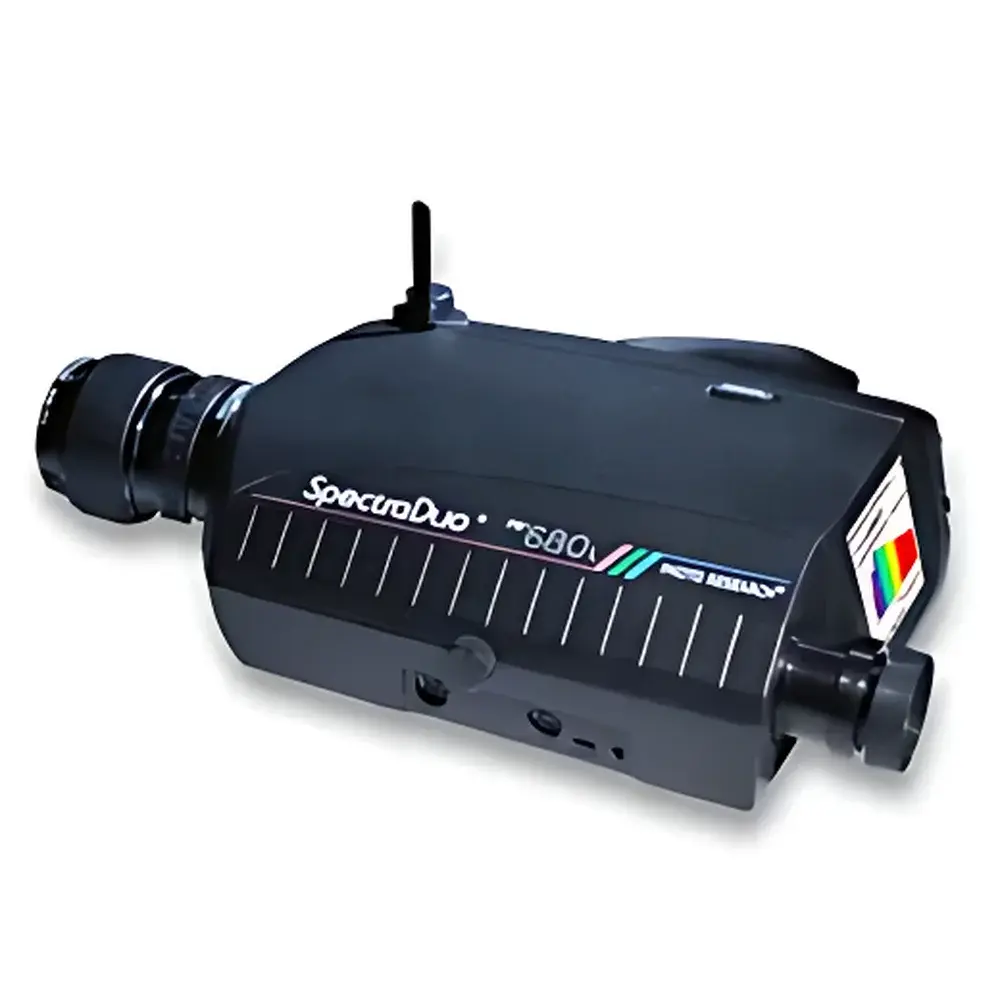
Photo Research PR-680L SpectraDuo High-Sensitivity Dual-Channel Photometer / Colorimeter / Radiometer
| Brand | Photo Research |
|---|---|
| Origin | USA |
| Model | PR-680L |
| Power Supply | Rechargeable Li-ion Battery |
| Display | 2.25" × 3" Full-Color Touchscreen |
| Detectors | 256-element CCD spectroradiometer + PMT photometer |
| Apertures | 1°, 0.5°, 0.25°, 0.125° (motorized) |
| Shutter | Motorized auto-shutter |
| Sync | AutoSync for flicker-free measurement |
| Interfaces | USB 2.0, Bluetooth (optional), RS-232 (via driver), Analog Output (optional) |
| Storage | SD card (up to 32 GB) |
| Operating Modes | Spectral Radiometry, PMT Photometry, Auto-Select Mode |
| Compliance | CIE 1931, CIE 1964, ISO/CIE 11664, ANSI C78.377, IEC 62368-1, FDA 21 CFR Part 11 (via SpectraWin software audit trail) |
Overview
The Photo Research PR-680L SpectraDuo is a field-deployable, dual-detector optical measurement instrument engineered for high-fidelity photometric, colorimetric, and radiometric characterization of light-emitting and light-reflecting surfaces. Unlike conventional single-sensor instruments, the PR-680L integrates two physically distinct detection systems—namely, a 256-channel CCD-based spectroradiometer and a high-gain photomultiplier tube (PMT) photometer—within a single, co-aligned optical path based on the Pritchard viewing geometry. This architecture eliminates mechanical realignment between spectral and photometric measurements and ensures traceable, cross-calibrated results across luminance, chromaticity, dominant wavelength, CCT, and spectral power distribution (SPD). The instrument operates without external neutral density filters, achieving an industry-leading dynamic range from 0.0002 cd/m² (PMT mode, 1° aperture) to 17.13 × 10⁶ cd/m² (spectral mode, 0.125° aperture), making it uniquely suited for display metrology, LED validation, and low-light human factors studies where both speed and sensitivity are critical.
Key Features
- Dual-sensor architecture: Simultaneous spectral radiometry (256-channel CCD) and high-speed photometry (PMT) within a shared Pritchard optical train
- Motorized aperture selection: Four calibrated field-of-view options (1°, 0.5°, 0.25°, 0.125°) with automatic mechanical actuation
- AutoSync technology: Real-time synchronization with AC-powered or PWM-driven light sources to suppress aliasing and ensure flicker-immune measurements
- Integrated rechargeable lithium-ion battery: Supports >8 hours of continuous operation in field or production environments
- Onboard data processing: Full-color touchscreen interface with embedded CIE chromaticity diagram, spectral plot rendering, and numeric output—no PC required
- Remote control capability: USB 2.0, optional Bluetooth 4.2, RS-232 emulation driver, and ASCII command protocol for ATE integration
- Expandable probe architecture: Supports up to 15 remote filter-wheel-equipped photometric probes for spatial uniformity mapping (e.g., projector screen evaluation)
Sample Compatibility & Compliance
The PR-680L is compatible with a broad spectrum of optical targets—including OLED and microLED displays, automotive lighting modules, medical illumination devices, printed substrates (paper, textiles, packaging), dental composites, and reflective signage. Its optical design conforms to CIE 1931 2° and CIE 1964 10° standard observer functions, and its spectral calibration is traceable to NIST standards. When used with optional accessories—such as the LR-127 LED measurement adapter (compliant with CIE 127:2007), cosine-corrected irradiance heads (per ISO/CIE 11664), or fiber-optic extensions—the system satisfies requirements for IEC 62368-1, ENERGY STAR® V8.0, VESA DisplayHDR™, and FDA-regulated color matching in dental and dermatological applications. SpectraWin software provides full 21 CFR Part 11 compliance through electronic signatures, audit trails, and role-based access control for GLP/GMP environments.
Software & Data Management
The PR-680L operates autonomously via its embedded firmware but also interfaces seamlessly with SpectraWin v6.x—the industry-standard application suite for Photo Research instrumentation. SpectraWin enables advanced analysis including spectral comparison, delta-E calculations (CIEDE2000), gamut volume mapping, temporal flicker metrics (IEEE 1789), and automated report generation in PDF or CSV format. All measurements are timestamped and stored either onboard (SD card, ≥3,000 records) or streamed directly to host systems. Remote operation supports ASCII command syntax over USB/Bluetooth, allowing integration into custom test sequences, CI/CD pipelines, or automated manufacturing test stations. Optional analog output (0–5 V or ±5 V) permits real-time waveform capture of fast transient events—e.g., LED turn-on/off response (<3 µs rise time) or pulse-width-modulated backlight behavior.
Applications
- Display metrology: Luminance uniformity, contrast ratio, grayscale tracking, and HDR tone-mapping verification per SMPTE ST 2084
- LED and SSL product development: Spatial color consistency, binning validation, and thermal drift monitoring under pulsed drive conditions
- Human-centric lighting research: Circadian stimulus (CS), melanopic lux, and scotopic/photopic ratio quantification
- Quality assurance in printing and coating: Spectral reflectance, metamerism index, and whiteness/yellowness evaluation per ISO 2470 and ASTM E308
- Clinical colorimetry: Dental shade matching, skin lesion chromatic assessment, and ophthalmic device calibration
- Automotive HUD and instrument cluster testing: Low-luminance readability under ambient glare conditions
FAQ
Does the PR-680L require external calibration or user recalibration?
No. Each unit ships with factory-applied NIST-traceable calibration certificates for all apertures and detector modes. Field verification is supported via optional calibration sources (e.g., PR-2100 reference lamp), but routine recalibration is not necessary under normal operating conditions.
Can the PR-680L measure pulsed or modulated light sources?
Yes. AutoSync automatically detects and locks to source refresh rates from 24 Hz to 20 kHz. In combination with the PMT’s sub-microsecond response, the instrument captures true peak, RMS, and integrated values for PWM, strobed, or flashing emissions.
Is spectral data export compatible with third-party analysis tools?
Yes. Raw spectral data (380–780 nm, 1 nm resolution) is exportable in ASCII (.txt) or XML format, supporting import into MATLAB, Python (NumPy/Pandas), JMP, or Excel for custom modeling and statistical process control.
What is the measurement uncertainty for luminance at 0.001 cd/m²?
At this level, using the 1° aperture and PMT mode, expanded uncertainty (k=2) is ±3.5% (relative) per CIE TN 006:2021 guidelines, assuming stable thermal environment and proper dark-current compensation.
How does the PR-680L handle stray light in high-dynamic-range scenarios?
The instrument employs dual-stage spectral filtering (holographic grating + order-sorting filters) and PMT gating logic to suppress second-order diffraction and out-of-band signal contamination—critical for accurate low-brightness measurement adjacent to saturated regions.




