
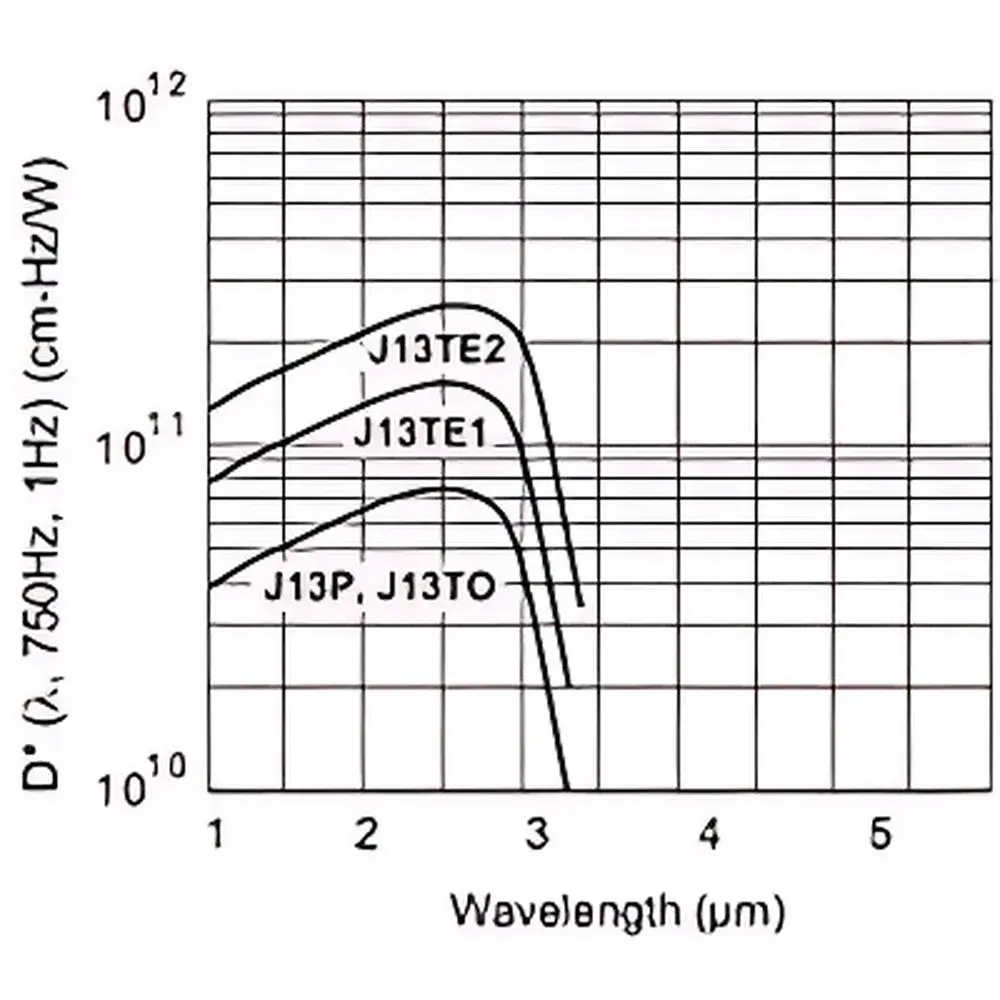
Teledyne Judson PbS Photoconductive Detector
| Brand | Teledyne Judson |
|---|---|
| Model | PbS |
| Spectral Range | 1.0–3.5 µm |
| Detector Type | Photoconductive |
| Cooling Options | Thermoelectric (TEC) Stages Available (Standard, Enhanced Stability, Low-Noise Configurations) |
| Origin | Beijing, China |
| Distribution Channel | Authorized Distributor |
| Compliance | RoHS Compliant, CE Marked for Instrument Integration |
Overview
The Teledyne Judson PbS Photoconductive Detector is a high-sensitivity, broadband infrared photodetector engineered for precise radiometric and spectroscopic measurements in the near-infrared (NIR) to short-wave infrared (SWIR) spectral region. Operating on the principle of photoconductivity—where incident photons generate electron-hole pairs in the polycrystalline lead sulfide (PbS) thin-film active layer—the detector delivers stable responsivity across a continuous spectral band from 1.0 µm to 3.5 µm. Unlike photovoltaic detectors, photoconductive PbS devices exhibit intrinsic gain, enabling superior signal-to-noise performance at moderate bias voltages without external amplification. This makes the PbS detector particularly well-suited for low-light, continuous-wave (CW) applications where spectral selectivity, thermal stability, and long-term repeatability are critical—such as in extractive gas cells, non-contact thermometry, and flame emission monitoring systems.
Key Features
- Wide spectral response: Uniform responsivity from 1.0 µm to 3.5 µm, optimized for molecular absorption bands of CO, CO₂, CH₄, H₂O vapor, NO, and hydrocarbons
- Thermoelectrically cooled variants available: Standard TEC stage (ΔT ≈ 40 °C below ambient), enhanced-stability configuration (±0.1 °C setpoint control), and ultra-low-noise variant with dual-stage cooling and shielded housing
- Low dark current design: Achieves typical dark resistance > 100 kΩ at 25 °C (uncooled); < 5 kΩ at –20 °C (TEC-cooled), enabling improved dynamic range in DC-coupled readout circuits
- Hermetically sealed TO-8 metal package with AR-coated BaF₂ or CaF₂ window (optional), ensuring long-term reliability in industrial environments
- Compatible with standard 5 V DC bias and transimpedance amplifier interfaces; output impedance matched for 50 Ω systems
- Factory-calibrated spectral responsivity curves traceable to NIST-traceable reference detectors
Sample Compatibility & Compliance
The PbS detector is designed for integration into optical bench setups, gas analyzers, and OEM spectrometer modules where sample interaction occurs via transmitted, reflected, or emitted IR radiation. It supports both flow-through gas cells (e.g., 10 cm pathlength multi-pass cells) and blackbody-radiation-based temperature measurement configurations. The device complies with IEC 61000-6-3 (EMC emission standards) and IEC 61000-6-2 (immunity requirements) for laboratory and light-industrial use. All units undergo 100% burn-in testing and thermal cycling validation per MIL-STD-883H Method 1010.8. Documentation includes full RoHS Declaration of Conformity and CE DoC for instrumentation subsystems. While not certified as a standalone medical device, it meets essential safety and electromagnetic compatibility criteria required for integration into Class IIa medical gas analyzers under ISO 13485–aligned manufacturing protocols.
Software & Data Management
As a passive analog sensor, the PbS detector does not include embedded firmware or digital interfaces. However, it is fully compatible with industry-standard data acquisition platforms—including National Instruments DAQmx, Keysight U1242B, and Thorlabs K-Cube drivers—when paired with appropriate transimpedance amplifiers and lock-in amplifiers. Teledyne Judson provides downloadable calibration certificates (CSV and PDF formats) containing wavelength-dependent responsivity (A/W), NEP (W/√Hz), and D* (cm·√Hz/W) values referenced to 295 K blackbody source conditions. For GLP/GMP environments, users may implement audit-trail-capable software (e.g., LabVIEW with 21 CFR Part 11 add-ons or MATLAB Production Server) to log detector ID, calibration date, operating temperature, and raw voltage outputs—ensuring traceability during method validation and instrument qualification (IQ/OQ/PQ).
Applications
- Extractive and in-situ gas analysis: Quantification of combustion byproducts (CO, NOₓ), greenhouse gases (CH₄, N₂O), and anesthetic agents (sevoflurane, isoflurane) using non-dispersive infrared (NDIR) or Fourier-transform infrared (FTIR) architectures
- Non-contact optical pyrometry: Calibration-grade temperature measurement of furnace linings, semiconductor wafers, and molten metals between 300 °C and 1200 °C via Planck’s law fitting
- Flame photometric detection: Real-time monitoring of potassium and sodium emissions in industrial burners and incinerators
- Humidity sensing: Differential absorption measurements at 1.37 µm and 1.88 µm water vapor bands in HVAC and cleanroom environmental monitoring systems
- Medical breath analysis: Detection of acetone (1.37 µm), ethanol (3.37 µm—via harmonic generation), and ammonia (1.53 µm) in exhaled breath condensate studies
FAQ
What is the typical response time of the PbS detector?
The 10–90% rise time ranges from 100 µs to 500 µs depending on bias voltage, load resistance, and thermal stabilization state. For AC-coupled lock-in detection, bandwidth extends to ~2 kHz under optimal cooling.
Can this detector be used in vacuum environments?
Yes—the TO-8 hermetic package is rated for operation at pressures down to 1 × 10⁻⁴ Torr; however, outgassing characterization data is available upon request for ultra-high-vacuum integration.
Is spectral calibration provided with each unit?
Yes—each detector ships with a unique NIST-traceable spectral responsivity curve measured at 25 °C and –20 °C, covering 1.0–3.5 µm at 10 nm resolution.
How does temperature drift affect measurement accuracy?
Peak responsivity shifts ~0.015 nm/°C toward longer wavelengths; dark resistance changes ~3.5% per °C. Active TEC stabilization reduces this drift to < ±0.002 nm/°C and < ±0.1% Rdark/°C.
Are custom window materials available?
Yes—standard BaF₂ (1.0–8.0 µm), CaF₂ (0.15–9.0 µm), or ZnSe (0.6–16 µm) windows can be specified; AR coatings optimized for 1.5–3.0 µm are standard.





