
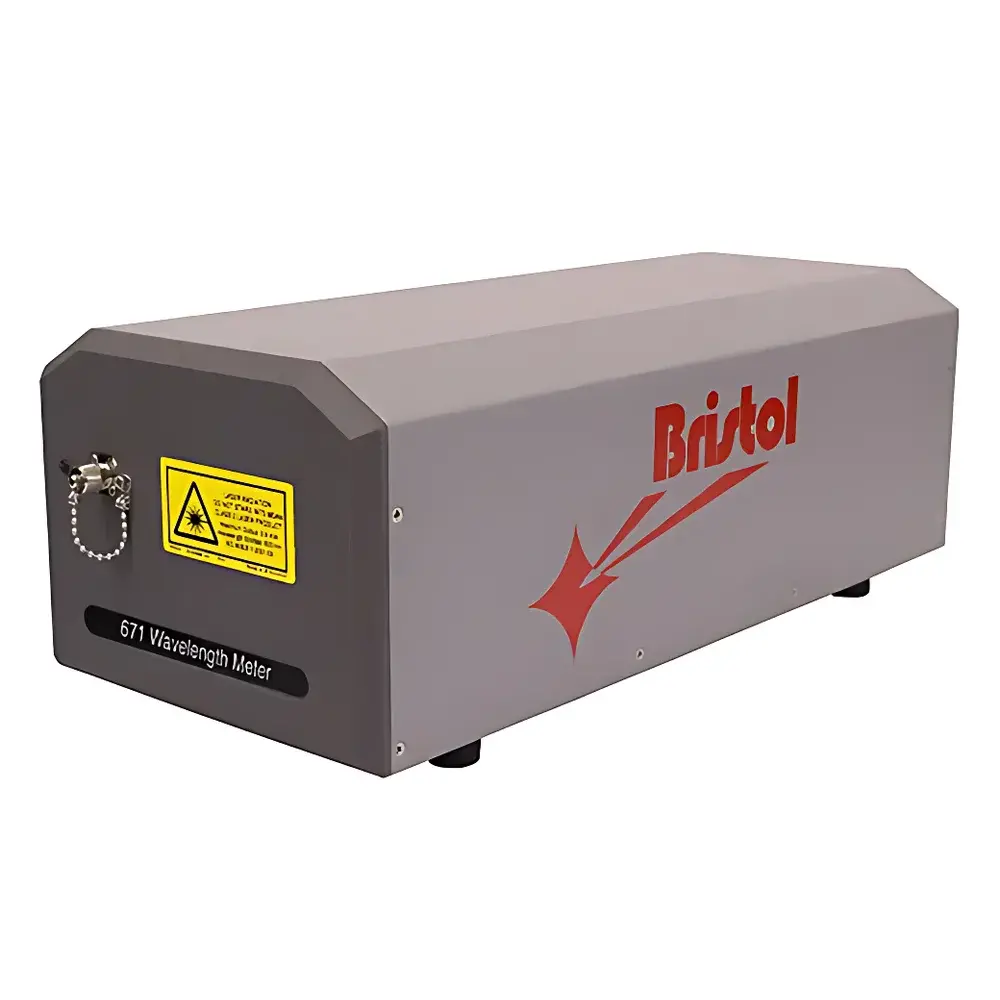
Bristol 671 Series Continuous and Quasi-Continuous Laser Wavelength Meter
| Brand | Bristol |
|---|---|
| Origin | USA |
| Model | 671 Series |
| Wavelength Range | 375 nm – 5 µm (671A), 375 nm – 12 µm (671B) |
| Absolute Accuracy | ±0.2 ppm (VIS/NIR), ±0.75 ppm (IR), ±1 ppm (MIR) |
| Repeatability | ±0.03 ppm (VIS/NIR), ±0.06 ppm (IR), ±0.1 ppm (MIR) |
| Calibration Source | Stabilized He-Ne Laser |
| Input Options | Fiber-coupled (VIS/NIR), Collimated Beam with Alignment Pilot (IR/MIR) |
| Minimum Input Power | 10–250 µW (VIS/NIR), 65–925 µW (IR/MIR) |
| Display Resolution | 9 digits (671A), 8 digits (671B) |
| Units | nm, µm, cm⁻¹, GHz, THz |
| Warm-up Time | <15 min (671A), None required (671B) |
| Dimensions (H×W×L) | 142×165×381 mm (VIS/NIR), 191×165×381 mm (IR/MIR) |
| Interface | USB 2.0 with SCPI-compatible command set for OEM integration |
Overview
The Bristol 671 Series Laser Wavelength Meter is a high-precision interferometric instrument engineered for absolute wavelength measurement of continuous-wave (CW) and quasi-continuous (QCW) lasers operating across the ultraviolet-visible-near-infrared (UV-VIS-NIR) to mid-infrared (MIR) spectral regions. Utilizing a thermally stabilized, high-finesse Fabry–Pérot interferometer combined with real-time referencing against an internal, frequency-stabilized He-Ne laser, the 671 Series achieves metrological-grade traceability without external calibration or manual intervention. Unlike scanning monochromators or grating-based spectrometers, this instrument delivers direct, non-scanning absolute wavelength determination based on optical path difference measurements—ensuring sub-picometer resolution and long-term stability under laboratory or industrial environmental fluctuations. Designed for integration into laser development labs, quantum optics facilities, and metrology centers, the 671 Series complies with fundamental requirements for ISO/IEC 17025-accredited calibration workflows and supports traceable validation per NIST-traceable standards.
Key Features
- Two model variants: 671A (375 nm – 5 µm, 9-digit display) and 671B (375 nm – 12 µm, 8-digit display), optimized for distinct infrared transmission windows and detector technologies
- Real-time internal calibration via a temperature- and vibration-compensated, Zeeman-stabilized He-Ne reference laser—eliminating drift from thermal expansion or mechanical perturbation
- Dual-input architecture: SMA-905 fiber port for VIS/NIR sources (375–1700 nm); motorized collimated-beam input with integrated alignment pilot laser for IR/MIR wavelengths (1–12 µm)
- Dynamic power monitoring circuitry provides simultaneous readout of incident optical power (±5% accuracy), enabling correlation between wavelength shift and power-induced thermal lensing in diode-pumped systems
- USB 2.0 interface compliant with SCPI (Standard Commands for Programmable Instruments); full command set provided for LabVIEW, Python, MATLAB, and C++ integration—supporting automated test sequences in production QC environments
- No warm-up requirement for 671B; 671A achieves operational stability within 15 minutes—critical for time-sensitive metrology tasks and multi-laser characterization campaigns
Sample Compatibility & Compliance
The 671 Series accommodates CW and QCW lasers with repetition rates exceeding 10 MHz, including single-frequency diode lasers, Ti:sapphire oscillators, fiber lasers, and solid-state Nd:YAG or Er:YAG systems. It is incompatible with low-repetition-rate pulsed lasers (<10 MHz), ultrafast femtosecond sources (requiring spectral interferometry or autocorrelation), or broadband ASE sources. The instrument conforms to electromagnetic compatibility (EMC) Directive 2014/30/EU and Low Voltage Directive 2014/35/EU. Its firmware architecture supports audit-trail logging and user-access controls aligned with FDA 21 CFR Part 11 principles for regulated environments. While not certified as GMP-compliant hardware, it is routinely deployed in GLP-compliant laser qualification protocols for photonics manufacturing and aerospace-grade laser source verification.
Software & Data Management
Bristol’s proprietary Wavemeter Control Software (v5.x) provides real-time spectrum visualization, statistical trending (mean, std dev, min/max over user-defined intervals), and CSV/TXT export with timestamped metadata. Raw data files include instrument serial number, calibration epoch, ambient temperature/humidity logs (via optional sensor module), and input power history. For enterprise integration, the SDK enables direct embedding into custom LIMS or MES platforms. All measurement records retain full traceability to the internal He-Ne reference, satisfying ISO 10110-17 and ASTM E2750 requirements for optical metrology documentation. Firmware updates are delivered via signed binary packages with SHA-256 hash verification.
Applications
- Verification of wavelength stability in external cavity diode lasers (ECDLs) used in atomic physics (e.g., Rb/D2-line locking at 780.24 nm)
- Characterization of tunable OPOs and QCLs in spectroscopic gas sensing applications (e.g., CO₂ detection at 4.26 µm)
- Calibration transfer between primary wavelength standards and secondary field instruments in national metrology institutes
- In-process monitoring of DFB and DBR laser wafers during photonic IC fabrication
- Validation of frequency combs in optical clock architectures where offset-free absolute frequency measurement is required
FAQ
Can the 671 Series measure pulsed lasers?
No—it is designed exclusively for CW and quasi-CW lasers with repetition rates >10 MHz. For true pulsed lasers (ns–ps pulse widths, kHz–MHz rep rates), consider the Bristol 871 Series.
What is the minimum measurable power for a 1064 nm laser?
For the 671A in NIR configuration: 10 µW typical; for the 671B in IR mode: 65 µW minimum—dependent on beam quality and coupling efficiency.
Is NIST traceability provided with the instrument?
Yes—each unit ships with a certificate of calibration traceable to NIST Standard Reference Material (SRM) 2034, valid for 12 months from date of shipment.
Does the device support remote triggering or synchronization with external equipment?
The 671 Series does not feature TTL trigger inputs; however, measurement initiation and data acquisition can be fully scripted via USB-SCPI commands synchronized to external clocks using host-side timing control.
How often must the internal He-Ne laser be serviced or replaced?
The stabilized He-Ne reference has a rated lifetime of ≥20,000 hours; no scheduled replacement is required within normal laboratory service intervals (typically 5–7 years).




