
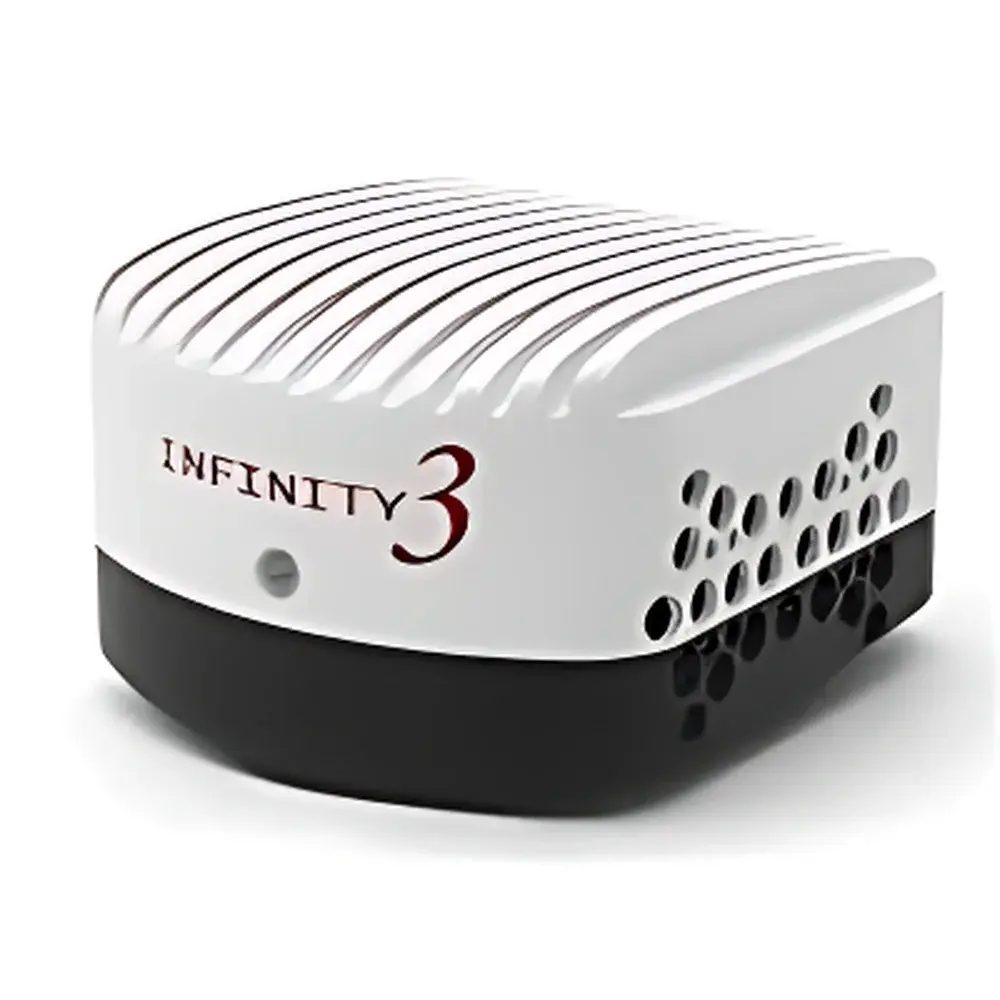
Lumenera INFINITY3-1U Cold CCD Camera for Low-Light Imaging
| Brand | Lumenera |
|---|---|
| Origin | Canada |
| Model | INFINITY3-1U |
| Sensor | Sony ICX285 Interline CCD |
| Resolution | 1392 × 1040 (1.4 MP) |
| Pixel Size | 6.45 µm |
| Full-Frame Readout Speed | 15 fps |
| ROI & Binning Support | Yes |
| Dynamic Range | >66 dB |
| Bit Depth | 8/12-bit |
| Interface | USB 2.0 |
| Cooling | Thermoelectric (Peltier) |
| Sensor Format | 2/3″ |
Overview
The Lumenera INFINITY3-1U is a thermoelectrically cooled, high-sensitivity interline transfer CCD camera engineered for quantitative low-light imaging applications—particularly in fluorescence microscopy, live-cell imaging, chemiluminescence detection, and bioluminescence assays. Based on the Sony ICX285 progressive-scan interline CCD sensor, the camera delivers exceptional quantum efficiency (>60% peak QE), low read noise (<10 e⁻ RMS typical), and high full-well capacity (~17,000 e⁻), enabling reliable photon-limited signal capture without compromising spatial fidelity. Its integrated Peltier cooling system stabilizes the sensor at up to 25°C below ambient temperature, significantly suppressing dark current—critical for long-exposure acquisitions where thermal noise would otherwise dominate the signal. Designed for seamless integration into automated microscopy platforms and OEM instrumentation, the INFINITY3-1U operates via a robust USB 2.0 interface with driver support for Windows, Linux, and macOS, complying with USB Video Class (UVC) standards for plug-and-play compatibility.
Key Features
- Thermoelectric (Peltier) cooling system reduces sensor temperature up to 25°C below ambient, lowering dark current by >90% compared to uncooled operation
- Sony ICX285 interline CCD sensor with 1392 × 1040 active pixels, 6.45 µm pixel pitch, and 2/3″ optical format for optimal light collection and field-of-view balance
- 15 frames per second full-frame readout at 12-bit depth; accelerated acquisition via region-of-interest (ROI) selection and hardware binning (2×2, 4×4)
- Dynamic range exceeding 66 dB—achieved through dual-gain architecture and correlated double sampling (CDS)—ensuring simultaneous visibility of weak and bright signal regions
- Flexible bit-depth output: selectable 8-bit (for speed-critical applications) or 12-bit (for quantitative intensity linearity and dynamic range preservation)
- USB 2.0 interface with zero-latency streaming, memory-mapped I/O, and hardware-triggered exposure synchronization (TTL input/output)
- Firmware-upgradable architecture supporting future feature enhancements and protocol optimizations
Sample Compatibility & Compliance
The INFINITY3-1U is compatible with standard C-mount and CS-mount optical interfaces, enabling direct coupling to inverted and upright microscopes, spectrographs, and macro imaging systems. Its interline architecture provides inherent anti-blooming capability and global electronic shutter functionality—eliminating motion artifacts during rapid acquisition or stage scanning. The camera complies with CE, FCC, and RoHS directives. For regulated environments—including clinical research labs and GLP-compliant facilities—the device supports audit-ready metadata logging (exposure time, gain, temperature, timestamp) and integrates with third-party software platforms validated under FDA 21 CFR Part 11 requirements when used with appropriate electronic signature and audit trail modules.
Software & Data Management
Lumenera provides the fully featured INFINITY ANALYZE software suite (Windows/macOS/Linux), offering real-time image optimization, multi-channel overlay, measurement tools (intensity profiling, particle counting, area quantification), and batch export in TIFF, FITS, and AVI formats. SDKs (C/C++, .NET, Python) enable custom integration with MATLAB, LabVIEW, Micro-Manager, and OpenCV-based pipelines. All acquired images embed EXIF-compatible metadata—including sensor temperature, exposure parameters, and calibration flags—facilitating traceable data provenance. Raw 12-bit data is preserved end-to-end without lossy compression, ensuring suitability for publication-grade quantitative analysis.
Applications
- Widefield fluorescence microscopy: DAPI, FITC, TRITC, and Cy5 channel acquisition with minimal photobleaching
- Chemiluminescent Western blot imaging—detecting low-abundance protein bands without film development
- Time-lapse live-cell imaging requiring stable baseline performance over hours-long acquisitions
- Single-molecule localization microscopy (SMLM) pre-screening and alignment verification
- Low-light industrial inspection: semiconductor defect mapping, thin-film interference analysis, and phosphor decay characterization
- Teaching laboratories requiring rugged, driver-stable imaging hardware with reproducible calibration
FAQ
Does the INFINITY3-1U support hardware triggering for synchronized multi-camera or multi-modal acquisition?
Yes—dedicated TTL-compatible trigger input and output ports enable precise external synchronization with lasers, shutters, or other cameras.
What is the maximum recommended exposure duration for optimal dark current suppression?
At 20°C ambient and -5°C sensor setpoint, exposures up to 60 seconds maintain <1% dark signal contribution in 12-bit mode; longer durations require frame averaging or dark-frame subtraction.
Is the camera compatible with Linux-based acquisition servers used in synchrotron or observatory control systems?
Yes—the open-source liblumenera SDK and V4L2-compliant drivers provide deterministic timing and memory-mapped buffer access for real-time embedded applications.
Can I perform flat-field correction using built-in features?
INFINITY ANALYZE includes automated flat-field and dark-frame calibration workflows; raw image streams also expose uncorrected pixel data for custom pipeline integration.
Does the USB 2.0 interface limit sustained data throughput during continuous acquisition?
At full resolution and 12-bit depth, sustained throughput is ~22 MB/s—within USB 2.0’s theoretical 480 Mbps (60 MB/s) envelope; no frame drops occur under nominal host controller load with DMA-enabled drivers.




