
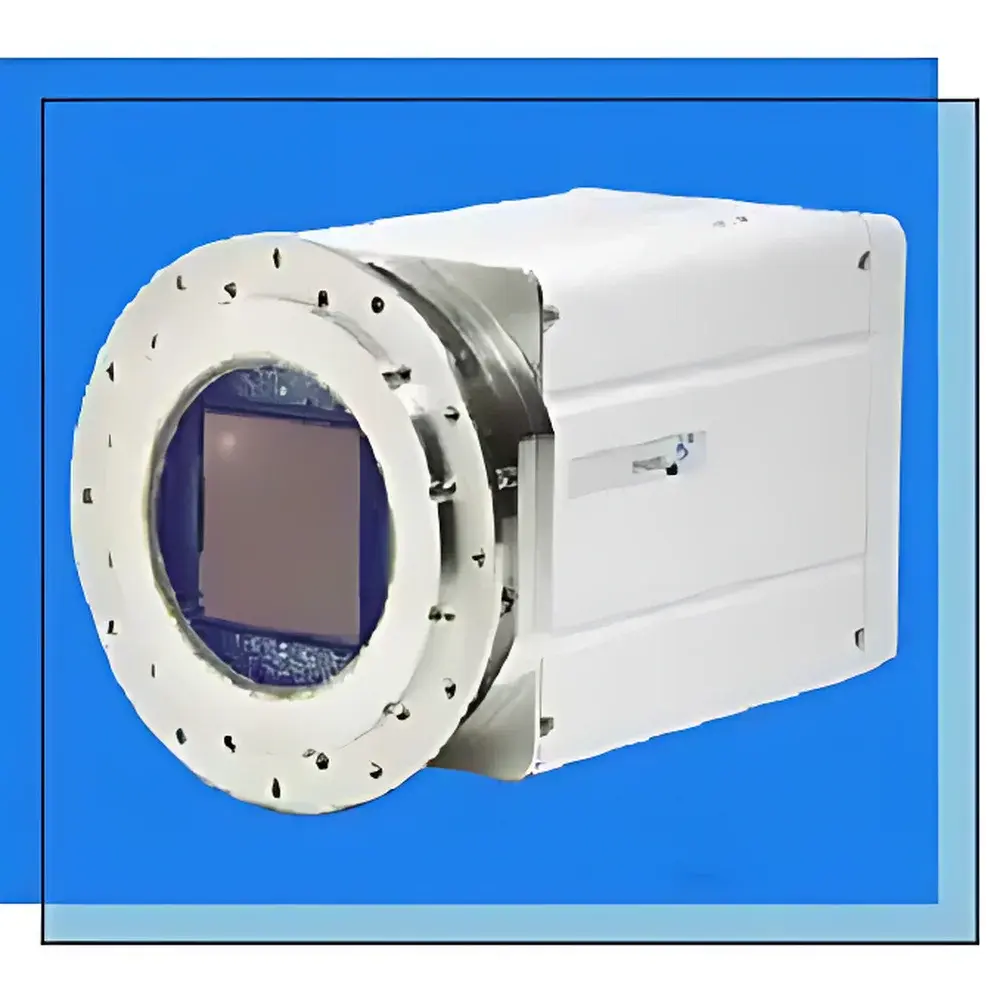
Peregrine 486 4K×4K Large-Format Scientific CCD Camera
| Origin | USA |
|---|---|
| Manufacturer Type | Authorized Distributor |
| Origin Category | Imported |
| Model | Peregrine 486 |
| Pricing | Available Upon Request |
| CCD Format | 4096 × 4096 pixels |
| Pixel Size | 15 µm × 15 µm |
| Illumination Type | Front- or Back-Illuminated |
| Readout Ports | 4 |
| Readout Speeds | 250 kHz and 1 MHz per port |
| Readout Noise | <7 e⁻ at 1 MHz |
Overview
The Peregrine 486 is a high-performance, large-format scientific CCD camera engineered for demanding low-light, high-resolution imaging applications in research-grade optical systems. Built around a monolithic 4096 × 4096 pixel front- or back-illuminated sensor, it delivers exceptional quantum efficiency—particularly in the visible to near-ultraviolet (NUV) spectral range—when configured with back-illuminated architecture. Its operation is grounded in charge-coupled device physics: photogenerated electrons are accumulated in potential wells during exposure, then serially transferred and converted to voltage via correlated double sampling (CDS) at the output amplifier. The quad-port readout architecture enables parallel charge transfer, significantly reducing total frame readout time while maintaining low noise integrity—making it suitable for time-resolved experiments where both spatial fidelity and temporal resolution are critical.
Key Features
- Monolithic 4K × 4K (16.8 MP) CCD sensor with 15 µm × 15 µm square pixels, ensuring high spatial sampling without interpolation artifacts.
- Configurable illumination architecture: front-illuminated for cost-sensitive UV-VIS applications; back-illuminated for maximum QE (>90% peak) in spectroscopic and faint-object imaging.
- Four independent output ports, each supporting dual-speed readout modes (250 kHz and 1 MHz), enabling flexible trade-offs between frame rate and read noise.
- Ultra-low read noise performance: <7 e⁻ RMS at 1 MHz/port (CDS-enabled), validated under laboratory-controlled bias and temperature conditions.
- Thermoelectrically cooled sensor stage (typically −30 °C to −60 °C, depending on configuration), minimizing dark current to <0.001 e⁻/pix/sec at −60 °C.
- Full-well capacity exceeding 100,000 e⁻ per pixel, supporting high-dynamic-range acquisition without saturation in mixed-intensity scenes.
Sample Compatibility & Compliance
The Peregrine 486 integrates seamlessly with standard C-mount and F-mount optical interfaces, and is compatible with vacuum-compatible cryostats, vacuum chambers, and beamline end stations. It supports synchronization via TTL-triggered exposure control, programmable exposure timing (1 ms to 1 hour), and hardware-level shutter coordination. From a regulatory standpoint, the system complies with CE electromagnetic compatibility (EMC) directives and RoHS material restrictions. While not FDA-cleared (as it is a non-diagnostic research instrument), its data integrity features—including deterministic frame timestamps, non-volatile configuration storage, and hardware-based gain/offset calibration—support adherence to GLP and ISO/IEC 17025 documentation requirements for metrology traceability.
Software & Data Management
The camera operates via a vendor-provided SDK (C/C++, Python bindings) and third-party compatibility with common scientific platforms including LabVIEW, MATLAB Image Acquisition Toolbox, and EPICS IOC drivers. All image data is output in lossless 16-bit TIFF or FITS format, preserving full dynamic range and metadata (exposure time, temperature, gain, binning mode). Onboard FPGA logic ensures real-time pixel correction (dark frame subtraction, flat-field normalization, and bad-pixel masking) can be applied pre-transfer—reducing host CPU load and enabling high-throughput streaming. Audit trails for acquisition parameters are logged automatically, satisfying basic 21 CFR Part 11 readiness when deployed in regulated environments with supplementary procedural controls.
Applications
- Astronomical imaging: Wide-field sky surveys, adaptive optics wavefront sensing, and speckle interferometry requiring sub-pixel centroiding stability.
- Condensed matter physics: Time-resolved diffraction pattern capture, pump-probe microscopy, and synchrotron beamline diagnostics.
- Materials science: In-situ TEM/STEM detector coupling, cathodoluminescence mapping, and laser-induced damage threshold characterization.
- Quantum optics: Single-photon counting arrays (via photon-counting mode firmware), entanglement verification setups, and spatial mode analysis of structured light fields.
- Biophysics: High-magnification fluorescence lifetime imaging (FLIM) with gated intensifiers, and super-resolution localization microscopy (e.g., PALM/STORM) requiring precise photon statistics.
FAQ
What cooling options are available for the Peregrine 486 sensor?
The camera employs a two-stage thermoelectric cooler (TEC) capable of stabilizing the CCD die at temperatures between −30 °C and −60 °C, depending on ambient conditions and optional forced-air or water-cooling accessories.
Is binning supported, and how does it affect noise and resolution?
Yes—hardware binning (2×2, 4×4) is implemented at the readout register level, improving SNR by √N while proportionally reducing spatial resolution and readout time.
Can the four ports be operated independently for multi-region-of-interest (ROI) acquisition?
No—the four ports operate in parallel across the full frame; however, user-defined ROI windows can be extracted post-readout using the SDK’s region-of-interest API without transferring unused pixels.
Does the camera support external triggering with sub-millisecond jitter?
Yes—TTL-compatible trigger input accepts rising-edge signals with ≤100 ns timing jitter relative to exposure start, verified under synchronized oscilloscope measurement.
What is the typical full-well linearity deviation across the dynamic range?
Linearity error remains within ±0.5% over 99% of full-well capacity, as certified in factory calibration reports traceable to NIST standards.






