
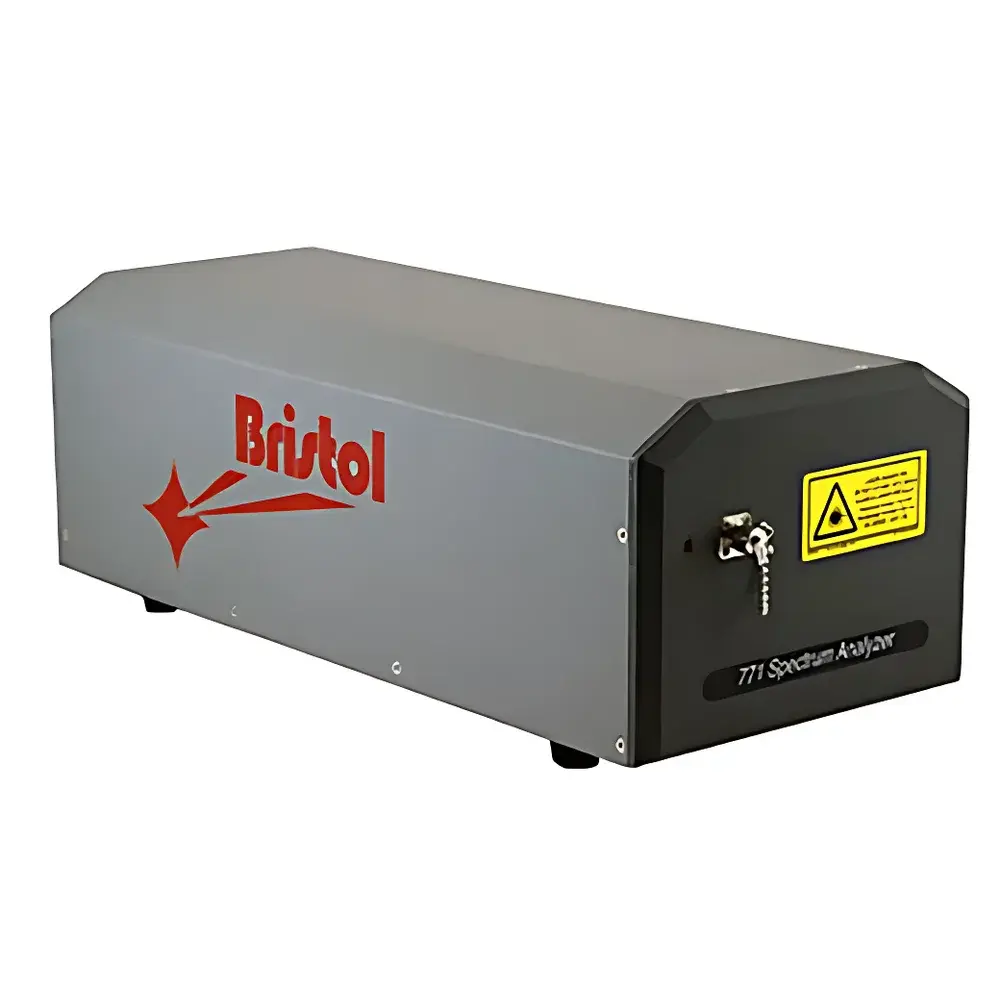
Bristol 771 Series High-Precision Laser Spectrum Analyzer
| Brand | Bristol |
|---|---|
| Origin | USA |
| Model | 771 Series |
| Wavelength Range | VIS (375–1100 nm), NIR (520–1700 nm), IR (1–5 µm), MIR (1–12 µm) |
| Absolute Wavelength Accuracy | ±0.2 ppm (VIS/NIR), ±0.75 ppm (IR/MIR) |
| Spectral Resolution | 4 GHz standard / 2 GHz high-res (VIS/NIR) |
| Calibration Source | Internal stabilized He-Ne laser |
| Input | Fiber-coupled (VIS/NIR), collimated beam with alignment guide (IR/MIR) |
| Warm-up Time | <15 min (VIS/NIR), no warm-up required (IR/MIR) |
| Dimensions (H×W×L) | 142×165×381 mm (VIS/NIR), 191×165×381 mm (IR/MIR) |
| Interface | USB 2.0 with SCPI command set for OEM integration |
Overview
The Bristol 771 Series High-Precision Laser Spectrum Analyzer is an interferometric wavelength and spectral characterization instrument engineered for metrology-grade analysis of continuous-wave (CW), quasi-CW (repetition rate >10 MHz), and pulsed lasers (repetition rate >50 kHz, pulse width >50 ns). Based on a scanning Michelson interferometer architecture with active path-length stabilization, the system delivers simultaneous high-accuracy wavelength measurement and fine-resolution spectral decomposition—enabling precise quantification of longitudinal mode structure, mode spacing (FSR), mode stability over time, and intrinsic laser linewidth. Unlike conventional wavemeters or optical spectrum analyzers, the 771 Series employs a dual-function design: it operates as both a primary wavelength reference and a high-fidelity spectral analyzer within a single compact benchtop platform. Its measurement traceability is anchored to an internal, temperature-stabilized He-Ne laser, providing real-time calibration against the 632.991 nm iodine-stabilized line per ISO/IEC 17025-compliant procedures.
Key Features
- Simultaneous wavelength determination and spectral analysis in a single acquisition cycle
- Absolute wavelength accuracy of ±0.2 ppm (VIS/NIR) and ±0.75 ppm (IR/MIR), traceable to NIST-referenced He-Ne standards
- Two operational resolution modes: standard (4 GHz / 8 GHz) and high-resolution (2 GHz / 4 GHz), selectable via software without hardware modification
- Fiber-coupled input for visible and near-infrared models (375–1700 nm); collimated free-space input with integrated alignment pilot beam for mid- and far-infrared configurations (1–12 µm)
- Real-time thermal and mechanical drift compensation enabled by active interferometer arm stabilization
- USB 2.0 interface with full SCPI command set, supporting automated test sequences, LabVIEW™ integration, and custom application development
- Nine-digit wavelength display (VIS/NIR) with unit flexibility: nm, µm, cm⁻¹, GHz, or THz
Sample Compatibility & Compliance
The 771 Series accommodates a broad class of laser sources used in quantum optics, spectroscopy, semiconductor inspection, and defense-related directed-energy applications. It supports CW diode, solid-state, fiber, and gas lasers; gain-switched and mode-locked oscillators; and high-repetition-rate pulsed systems meeting minimum temporal criteria (≥50 ns pulse width, ≥50 kHz repetition rate). All variants comply with IEC 61000-6-3 (EMC emission) and IEC 61010-1 (safety for laboratory equipment). The VIS/NIR models meet RoHS 2015/863/EU requirements. Data integrity protocols align with GLP/GMP documentation needs: timestamped measurements include instrument ID, calibration epoch, ambient sensor readings (temperature, humidity), and interferogram metadata. While not FDA 21 CFR Part 11 certified out-of-the-box, audit-trail logging and user-access controls can be implemented via host-side software per customer validation requirements.
Software & Data Management
Bristol’s proprietary SpectrumAnalyzer™ software (v5.2+) provides real-time spectral visualization, peak tracking, FSR calculation, and dynamic linewidth estimation using Gaussian/Lorentzian fitting algorithms. Raw interferograms are stored in HDF5 format with embedded metadata compliant with the NeXus standard. Export options include CSV (tabular spectral data), PNG/SVG (publication-ready plots), and MATLAB® .mat files. The SDK includes C/C++, Python, and .NET bindings, enabling integration into automated manufacturing test stands or university-based ultrafast laser labs. Remote operation is supported via TCP/IP wrapper around the native USB-SCPI layer, facilitating centralized fleet monitoring across multi-instrument environments.
Applications
- Verification of distributed feedback (DFB) and external cavity diode laser (ECDL) wavelength stability under thermal modulation
- Characterization of frequency combs and optical parametric oscillators (OPOs) in metrology laboratories
- Validation of narrow-linewidth fiber amplifiers for coherent LIDAR and gravitational wave detection interferometers
- Qualification of quantum cascade lasers (QCLs) and interband cascade lasers (ICLs) in the mid-IR for trace-gas sensing platforms
- Long-term drift analysis of He-Ne and iodine-stabilized lasers referenced to primary standards
- Teaching advanced photonics concepts—including coherence length derivation, Fourier-transform spectroscopy principles, and mode competition dynamics—in graduate-level optics courses
FAQ
Does the 771 Series require external calibration?
No. Each unit contains a built-in, thermally stabilized He-Ne laser serving as an absolute wavelength reference. Internal calibration is performed automatically at power-on and optionally triggered during operation.
Can the instrument measure femtosecond pulses?
Yes—provided the repetition rate exceeds 50 kHz and individual pulses are longer than 50 ns in duration. For sub-nanosecond pulses, spectral reconstruction relies on ensemble averaging across multiple shots.
Is vacuum operation supported for IR/MIR models?
The IR and MIR variants are designed for ambient-air use with purge-compatible optical paths. Optional dry-air or nitrogen purge fittings are available to minimize H₂O/CO₂ absorption features in the 2.7 µm and 4.3 µm bands.
What is the minimum measurable power level?
VIS/NIR models require ≥10 µW; IR/MIR models require ≥50 µW for reliable signal-to-noise ratio (>25 dB) in standard resolution mode.
How is spectral resolution validated?
Resolution verification follows ASTM E275-22 Annex A3 using well-characterized dual-line argon-ion laser emissions (e.g., 514.5 nm and 501.7 nm), confirming separation fidelity at the specified GHz-level resolution bandwidth.





