
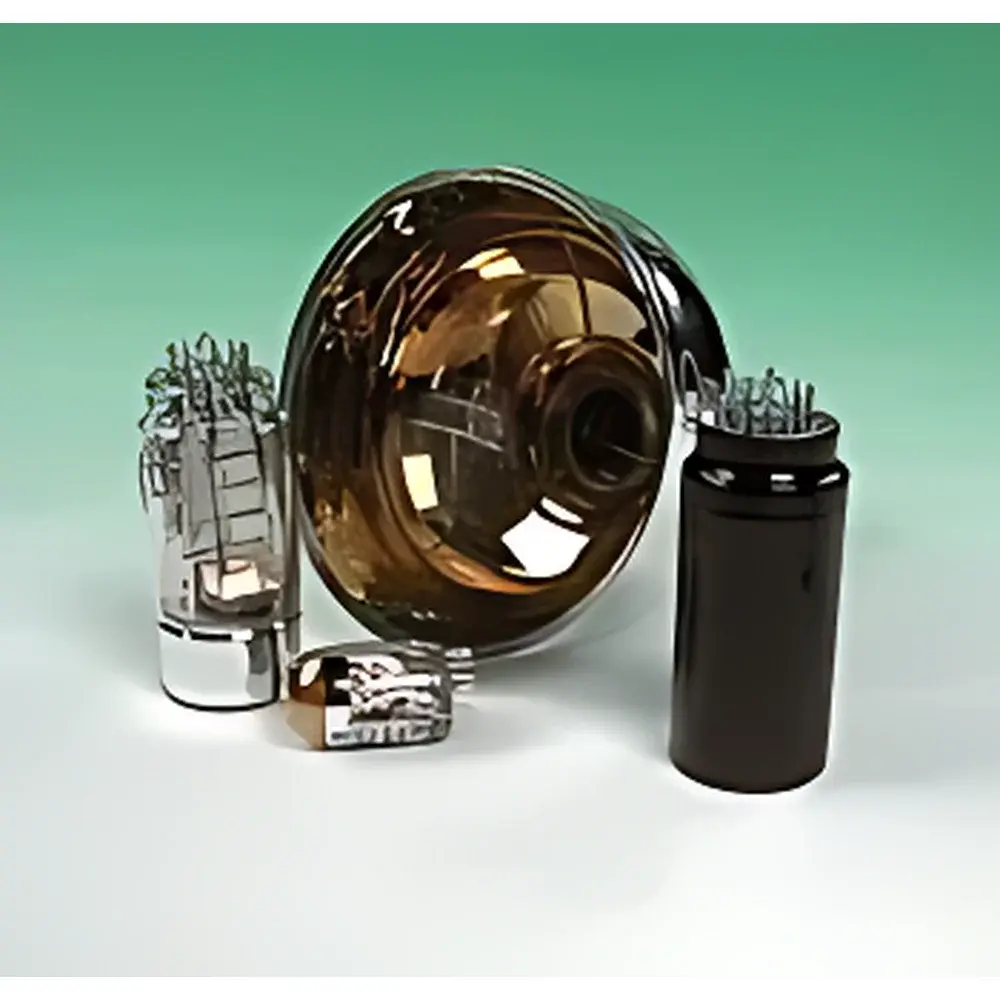
Photek PMT Series Photomultiplier Tube
| Brand | Photek |
|---|---|
| Origin | United Kingdom |
| Model | PMT Series |
| Wavelength Range | 115–850 nm (dependent on photocathode and window material) |
| Photocathode Types | Bialkali, Rb-Bialkali, Multialkali S20, High-Temperature Bialkali, Solar-Blind Cs-Te |
| Window Materials | UV-grade fused silica, borosilicate glass, MgF₂ |
| Typical Active Diameter | 19–280 mm |
| Operating Temperature Range | −30 °C to +200 °C (model-dependent) |
| Housing Options | Side-on & Head-on configurations |
| Compatible Accessories | HV power supplies, voltage dividers, magnetic shields, cryogenic housings, thermoelectric coolers |
Overview
The Photek PMT Series Photomultiplier Tube is a high-gain, low-noise vacuum electron multiplier engineered for single-photon detection across ultraviolet (UV), visible (VIS), and near-infrared (NIR) spectral regions. Based on the principle of secondary electron emission within a multi-stage dynode chain, these tubes deliver exceptional quantum efficiency, fast temporal response (sub-nanosecond rise time), and high signal-to-noise ratio—critical for applications requiring ultra-low-light quantification. Designed and manufactured in the United Kingdom, each Photek PMT undergoes rigorous calibration and aging protocols to ensure long-term gain stability and inter-unit reproducibility. The device operates under high vacuum (typically <10⁻⁶ Pa) and relies on precise photocathode-to-dynode geometry to maintain linearity over six to eight decades of incident photon flux.
Key Features
- Multiple photocathode formulations optimized for distinct spectral bands: bialkali (160–630 nm), Rb-bialkali (160–680 nm), multialkali S20 (300–850 nm), high-temperature bialkali (160–630 nm, rated to +200 °C), and solar-blind Cs-Te (115–360 nm)
- UV-transmitting window options including MgF₂ (for VUV down to 115 nm), synthetic fused silica (160–2000 nm), and borosilicate glass (280–700 nm)
- Standardized mechanical configurations: side-on (for compact optical path integration) and head-on (for large-area uniform illumination)
- Active diameters spanning 19 mm (3/4″) to 280 mm (11″), supporting both benchtop spectrometers and large-aperture astrophotonic systems
- Integrated or modular magnetic shielding (μ-metal) to suppress external field-induced gain drift, essential for high-precision photon counting in unshielded environments
- Compatibility with active cooling solutions—including Peltier-based cryostats and liquid nitrogen dewars—to reduce dark current by up to three orders of magnitude in NIR-sensitive S20 variants
Sample Compatibility & Compliance
Photek PMTs are designed for integration into OEM analytical platforms and research-grade instrumentation where regulatory traceability and environmental robustness are mandatory. All units comply with IEC 60529 (IP54-rated housings for industrial enclosures), RoHS 2011/65/EU, and REACH SVHC screening standards. For pharmaceutical and clinical instrument manufacturers, Photek PMTs support full audit trails when paired with FDA 21 CFR Part 11–compliant HV controllers and data acquisition firmware. Units designated for aerospace or downhole oilfield use meet MIL-STD-810G shock/vibration specifications and operate reliably under thermal cycling from −40 °C to +200 °C. Calibration certificates (NIST-traceable) are available upon request for GLP/GMP-aligned validation protocols.
Software & Data Management
While Photek PMTs are analog signal transducers, their performance is fully leveraged through third-party and OEM-compatible digital signal processing ecosystems. Standard TTL/HTL-compatible anode outputs interface seamlessly with commercial photon-counting modules (e.g., Becker & Hickl SPC-150, PicoQuant HydraHarp 400) supporting time-correlated single-photon counting (TCSPC), fluorescence lifetime imaging (FLIM), and time-of-flight (ToF) analysis. Photek provides detailed pinout schematics, voltage divider design guidelines, and noise floor characterization reports—enabling deterministic system-level noise budgeting. Firmware-upgradable HV power supplies (e.g., CAEN DT5530 series) offer programmable ramp rates, overvoltage protection, and real-time gain monitoring—critical for automated QC workflows in regulated labs.
Applications
- Spectroscopic detection in UV-Vis-NIR spectrophotometers, fluorometers, and monochromator-based systems
- Time-resolved luminescence analysis for materials science and phosphor development
- Cherenkov radiation detection in nuclear physics and particle accelerator experiments
- LIDAR receivers for atmospheric profiling, wind sensing, and topographic mapping
- Medical imaging subsystems including gamma cameras, PET detectors, and flow cytometers
- Oil & gas well logging tools operating under high-temperature, high-pressure (HTHP) borehole conditions
- Astronomical photometry and adaptive optics wavefront sensors in ground-based observatories
FAQ
What determines the spectral response range of a Photek PMT?
The effective wavelength coverage is governed jointly by the transmission spectrum of the entrance window material and the quantum efficiency curve of the selected photocathode. For example, MgF₂ windows enable VUV sensitivity down to 115 nm, while Cs-Te photocathodes provide solar-blind operation up to 360 nm.
Can Photek PMTs be used in photon-counting mode without additional hardware?
Yes—when operated below ~10⁶ cps incident photon rate and coupled to a low-noise preamplifier and discriminator, Photek PMTs deliver intrinsic single-photon resolution. However, optimal timing jitter and dead-time correction require dedicated TCSPC electronics.
Are custom voltage divider networks available for specific gain linearity requirements?
Photek offers application-specific divider designs—including tapered, active, and gated configurations—for pulse linearity optimization, dynamic range extension, and fast-gated detection (down to 2 ns gate width).
How does cooling affect dark current in NIR-sensitive S20 PMTs?
Operating at −20 °C reduces thermionic emission by ~90% compared to room temperature; further cooling to −40 °C yields sub-10 Hz dark count rates over 25 mm active areas—enabling high-fidelity NIR photon counting in spectroscopy and lidar.
Do Photek PMTs support GLP-compliant calibration documentation?
Yes—certificates of conformance, spectral responsivity curves (±2% uncertainty), and gain-vs-voltage characterization reports are provided per unit or batch, aligned with ISO/IEC 17025 laboratory accreditation requirements.



