
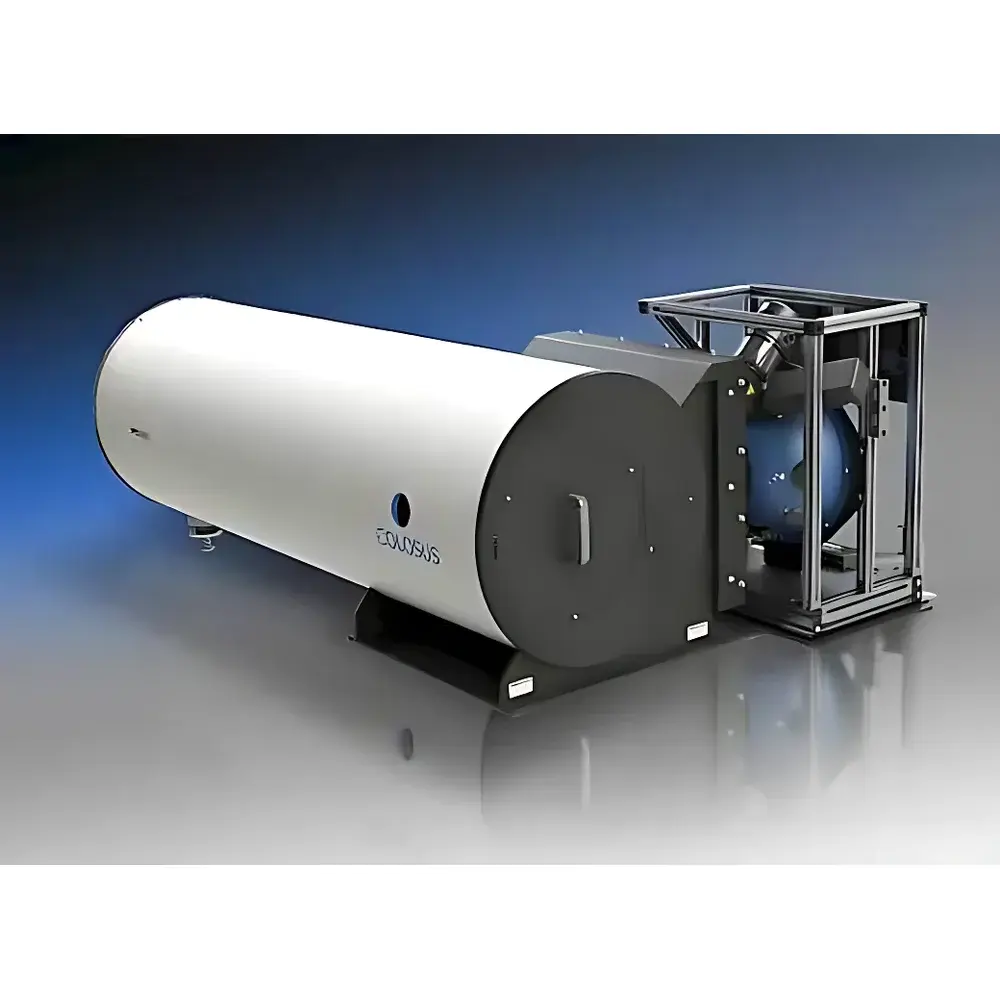
COLOSUS Camera Calibration and Testing System
| Origin | USA |
|---|---|
| Manufacturer Type | Authorized Distributor |
| Origin Category | Imported |
| Model | COLOSUS |
| Price Range | USD 7,000 – 14,000 |
Overview
The COLOSUS Camera Calibration and Testing System is a fully integrated, metrology-grade optical test platform engineered for radiometric, photometric, and spectral characterization of imaging sensors across an unprecedented 0.3–14 µm wavelength range—from deep ultraviolet (UV) through visible (VIS), near-infrared (NIR), short-wave infrared (SWIR), mid-wave infrared (MWIR), to long-wave infrared (LWIR). Built upon a modular architecture co-developed by two industry-leading optical metrology firms, COLOSUS implements traceable, NIST-aligned calibration methodologies rooted in absolute radiance and irradiance measurement principles. Its core measurement paradigm combines collimated target projection, spatial uniformity validation, and dynamic spectral irradiance control—enabling quantitative assessment of MTF, SNR, dynamic range, non-uniformity, photoresponse nonuniformity (PRNU), and spectral responsivity under controlled, repeatable illumination conditions. Designed for compliance-critical environments—including defense R&D labs, aerospace sensor qualification facilities, and ISO/IEC 17025-accredited calibration laboratories—the system supports full audit trails, version-controlled test procedures, and instrument-level uncertainty budgets per ISO/IEC 17025:2017 Annex A.2.
Key Features
- Full-spectrum coverage from 0.3 µm (UV) to 14 µm (LWIR) via interchangeable source modules: plasma arc, xenon, tunable LED arrays, and high-stability blackbodies
- Traceable radiance calibration with uncertainty < ±1.5% (k=2) across VIS–LWIR, certified against NIST-traceable standards
- Dynamic range exceeding 1×10¹⁰: enables seamless transition from starlight-level irradiance (10⁻⁷ W/m²/sr) to solar-equivalent brightness (1.36 kW/m²)
- Modular HELIOS® integrating sphere system with selectable CCT (1200–6500 K), programmable spectral output, and real-time spectral monitoring
- High-emissivity (>99.8%) blackbody sources with thermal stability ≤ ±5 mK over 8-hour operation and spatial uniformity >98%
- Motorized precision target wheel (6/12/16 positions) with laser-cut, NIST-traceable reflective and transmissive targets (e.g., slanted-edge, Siemens star, grayscale wedges)
- Off-axis Newtonian collimator options (6″, 8″, 12″ apertures) optimized for wavefront fidelity and minimal stray light across UV–LWIR
Sample Compatibility & Compliance
COLOSUS accommodates focal plane arrays (FPAs) up to 40 mm diagonal, including cooled/uncooled microbolometers, InGaAs, HgCdTe, Si-based CMOS/CCD, and quantum dot-enhanced sensors. It supports testing of lens-integrated cameras, gimbal-mounted EO/IR systems, and multi-spectral payloads. The system conforms to ASTM E1548-22 (Standard Guide for Characterizing Spectral Responsivity of Imaging Detectors), ISO 15739:2013 (Photography — Electronic still picture imaging — Noise measurements), and MIL-STD-810H environmental test interface protocols. All radiometric calibrations are documented with full uncertainty budgets compliant with ISO/IEC Guide 98-3 (GUM) and support GLP/GMP audit requirements. Data acquisition and reporting meet FDA 21 CFR Part 11 electronic record and signature criteria when deployed with IRWindows™4’s role-based access control and electronic audit trail.
Software & Data Management
IRWindows™4 is the native application suite—deployed on Windows 10/11 x64 platforms with deterministic real-time I/O drivers. It provides three operational modes: Operator (guided workflow), Developer (scripted test sequence authoring), and Software Engineer (API-level integration via C/C++, Python, or MATLAB). The software controls all hardware subsystems—including motorized stages, spectral engines, blackbody controllers, and image acquisition cards—via IEEE 1394, GigE Vision, Camera Link, CoaXPress, USB3 Vision, and SMPTE 292M/274M interfaces. Test data is stored in a relational SQL Server database with timestamped metadata, raw frame buffers (16-bit TIFF/RAW), calibrated radiance maps, and full spectral irradiance logs. Export formats include HDF5, CSV, and XML for traceability and third-party analysis (e.g., MATLAB, ENVI, Python SciPy). Version-controlled test templates ensure procedural consistency across shifts and sites.
Applications
- Radiometric validation of satellite Earth observation sensors (e.g., VIIRS, OLI, TIRS heritage testing)
- EO/IR countermeasure system qualification per STANAG 4347 and NATO AEP-97
- Automotive ADAS camera calibration for ISO 26262 functional safety workflows
- Medical endoscope and ophthalmic imager spectral responsivity mapping
- Quantitative evaluation of quantum efficiency degradation in UV-sensitive scientific cameras
- Multi-spectral fusion algorithm development using synchronized VIS–SWIR–LWIR stimulus generation
- Low-light performance benchmarking using night-sky spectrum emulation (Bortle Class 1–2 models)
FAQ
Is COLOSUS compatible with custom camera interfaces not listed in the standard specifications?
Yes—IRWindows™4 SDK provides low-level register access and vendor-neutral abstraction layers for integrating proprietary frame grabbers, FPGAs, or embedded vision processors.
Can calibration certificates be issued with ISO/IEC 17025 accreditation?
Accredited calibration services are available through authorized partner laboratories; COLOSUS hardware includes all necessary reference artifacts and uncertainty documentation to support in-house accreditation efforts.
Does the system support automated pass/fail decision logic based on user-defined thresholds?
Yes—test sequences can embed conditional branching, statistical process control (SPC) limits, and automatic report generation with PDF/HTML export and email notification triggers.
What level of spectral resolution is achievable with the tunable LED and filter modules?
LED-based spectral tuning achieves ≤5 nm FWHM resolution in VIS–NIR; monochromator-coupled configurations reach <0.5 nm resolution in UV and SWIR bands.
How is thermal drift compensated during extended LWIR calibration runs?
Blackbody temperature is actively stabilized using dual-sensor PID feedback with sub-mK resolution; collimator and target wheel thermal expansion is modeled and corrected in real time via embedded thermal mapping algorithms.




