
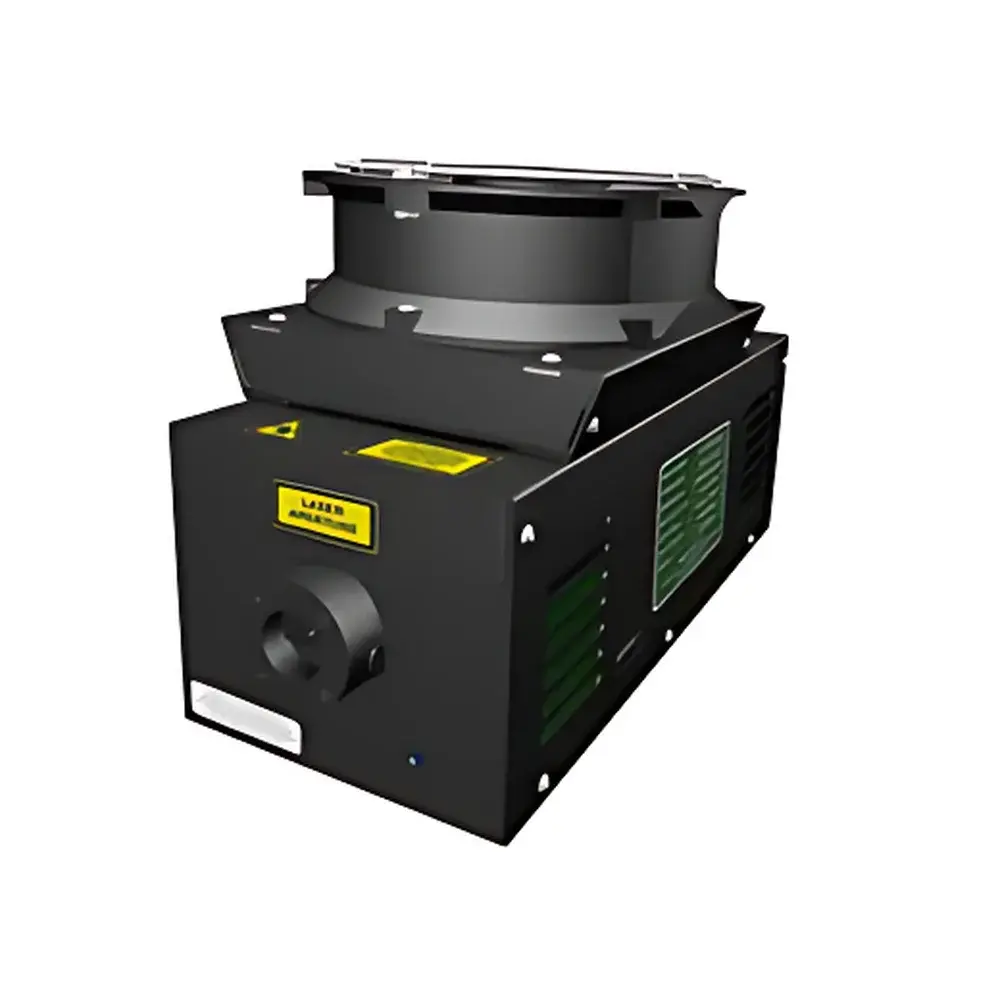
Aries Series Argon Ion Laser System
| Origin | USA |
|---|---|
| Manufacturer Type | Authorized Distributor |
| Origin Category | Imported |
| Model | Aries Series |
| Core Component | Sealed Tube Argon Ion Laser System |
| Wavelength (Single-Line) | 514.5 nm |
| Output Power (Max) | 25 mW |
| Beam Mode | TEM₀₀ |
| Beam Diameter (@ 1/e²) | 0.70 mm |
| Beam Divergence | 0.90 mrad |
| Beam Pointing Stability | < 30 µrad |
| Power Drift (After Warm-up) | < ±1% |
| Intensity Noise | < 1% RMS |
| Polarization Ratio | > 250:1 |
| Warm-up Time | 5 min |
| Input Voltage/Frequency | 105–120 VAC, 50–60 Hz |
| Power Consumption | < 1200 W |
| Weight | 4.1 kg |
Overview
The Aries Series Argon Ion Laser System is a high-stability, air-cooled continuous-wave (CW) ion laser engineered for precision optical measurement, spectroscopy, and alignment applications in research laboratories and industrial metrology environments. Based on sealed-tube argon ion plasma discharge technology, the system operates at the fundamental 514.5 nm green emission line with single-longitudinal-mode TEM₀₀ spatial profile—ensuring diffraction-limited beam quality essential for interferometry, confocal microscopy, and holographic calibration. Unlike open-tube or water-cooled variants, the Aries design integrates a rigid mechanical baseplate and optimized thermal architecture to minimize mechanical drift and acoustic coupling. Its axial high-flow fan assembly delivers quiet, uniform cooling across the plasma bore while maintaining long-term wavelength stability and mode purity. The system is fully compatible with standard optical tables and vibration-isolated platforms, and supports optional remote chiller integration for extended duty-cycle operation in temperature-sensitive facilities.
Key Features
- Rigid monolithic baseplate construction with precision-machined mounting interfaces for sub-microradian alignment repeatability
- Optimized axial airflow path with low-noise DC brushless fan delivering >120 CFM at <45 dBA—enabling silent operation in shared lab spaces
- LPS-1300 intelligent power supply with active current regulation, soft-start sequencing, and real-time arc voltage monitoring
- High-flexure umbilical cable (rated for >100,000 bend cycles) ensuring reliable electrical and signal integrity between laser head and PSU
- Integrated beam diagnostics port with calibrated photodiode output for external power stabilization feedback loops
- Comprehensive safety interlock architecture compliant with IEC 60825-1:2014 Class 3B laser requirements, including key-switch enable, door interlock, and emergency stop interface
Sample Compatibility & Compliance
The Aries Series is designed for use with standard optical components—including dichroic mirrors, acousto-optic modulators (AOMs), and fiber-coupling optics rated for 514 nm CW irradiance up to 10 kW/cm². It meets international regulatory standards for laboratory laser systems: certified to IEC 60825-1:2014 (Edition 3) and FDA 21 CFR Part 1040.10/1040.11. All firmware and control logic adhere to ISO/IEC 17025 traceability requirements for measurement equipment used in accredited testing laboratories. While not classified as a medical device, its beam parameters align with ANSI Z136.1-2022 guidelines for non-beam hazards (e.g., ozone generation < 0.05 ppm during continuous operation).
Software & Data Management
The LPS-1300 power supply includes an RS-232 serial interface (with optional USB-to-serial adapter) supporting ASCII command protocol for integration into LabVIEW™, Python (pySerial), or MATLAB® automation frameworks. Real-time telemetry—including tube current, cathode voltage, output power estimate, and internal temperature—is logged at 10 Hz resolution. Firmware supports configurable warm-up hold states, scheduled shutdown sequences, and event-triggered data capture. Audit trails for all parameter changes are retained in non-volatile memory for GLP/GMP-aligned validation protocols. No proprietary software installation is required; configuration is performed via terminal emulator or custom SCPI-compatible scripts.
Applications
- Calibration of CCD/CMOS-based optical encoders and position-sensitive detectors (PSDs)
- Excitation source for Raman spectroscopy systems requiring narrow-linewidth visible excitation
- Reference beam in heterodyne interferometers for nanometer-level displacement metrology
- Alignment fiducial in semiconductor lithography tool qualification and wafer stepper calibration
- Stimulated emission depletion (STED) microscopy prealignment and beam profiling
- Education and training platforms for laser physics labs emphasizing plasma kinetics and cavity mode analysis
FAQ
Is the Aries Series compatible with existing JDSU TM2211 optical mounts and beam paths?
Yes—the mechanical footprint, kinematic mount interface, and beam height (120 mm above baseplate) match the legacy TM2211 series. Optical axis alignment tolerances are maintained within ±5 µm lateral and ±10 µrad angular deviation.
What is the expected lifetime of the sealed argon ion tube under nominal operating conditions?
Rated mean time to failure (MTTF) is 10,000 hours at 25 mW output, assuming ambient temperature ≤25°C and uninterrupted power conditioning per manufacturer specifications.
Can the system operate continuously for 24/7 production environments?
Yes—when paired with the optional remote liquid chiller (model RC-200), thermal load management extends duty cycle to indefinite operation without performance degradation.
Does the LPS-1300 support analog modulation input for intensity control?
Yes—a 0–5 VDC analog input is provided for external TTL-compatible modulation up to 10 kHz bandwidth, with <1% linearity error across full dynamic range.
Are calibration certificates and NIST-traceable power meter reports included with shipment?
Each unit ships with a factory calibration report (including power, pointing stability, and polarization ratio measurements) traceable to NIST SRM 2211, valid for 12 months from date of manufacture.



