
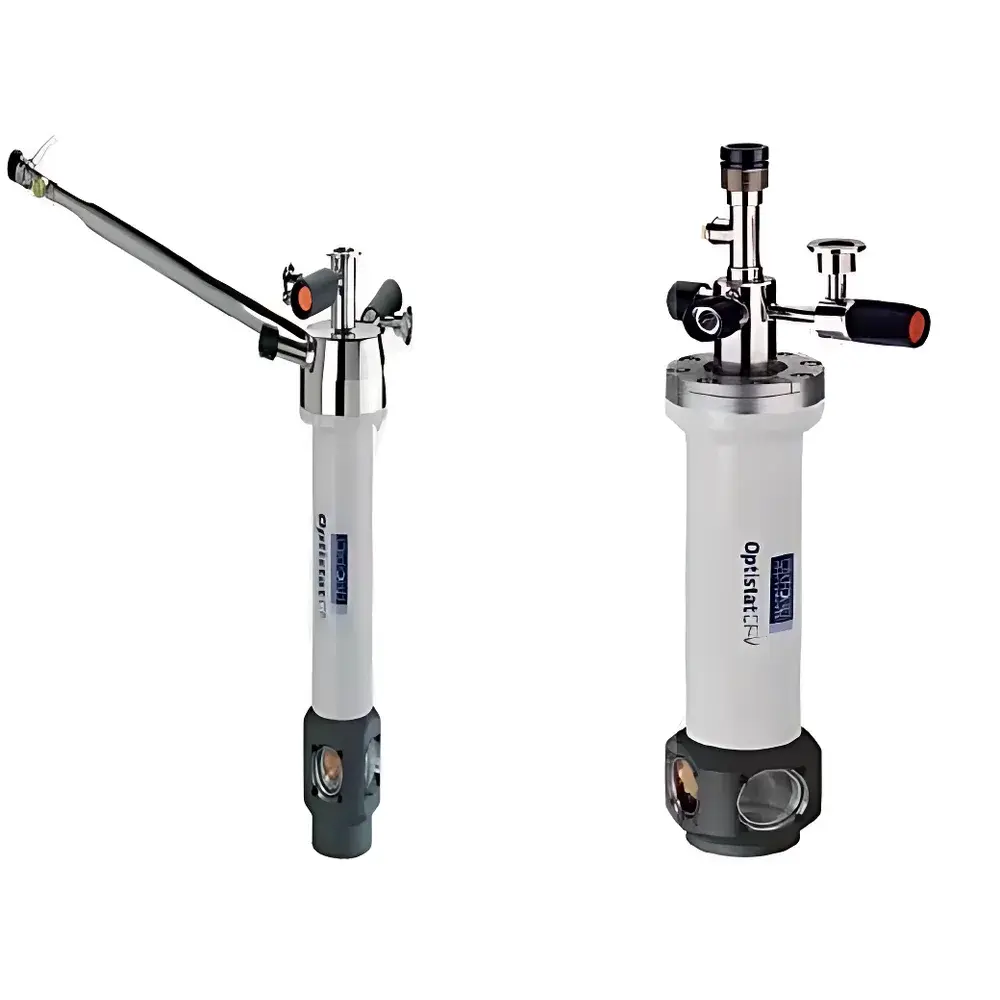
Oxford Instruments Optistat CF Continuous-Flow Cryostat
| Origin | UK |
|---|---|
| Manufacturer Type | Authorized Distributor |
| Origin Category | Imported |
| Model | Optistat CF (Gas Exchange) / Optistat CF-V (Vacuum) |
| Operating Modes | Pull Mode / Push Mode |
| Sample Temperature Range | 2.3–500 K (CF) / 4.2–500 K (CF-V) |
| Temperature Stability | ±0.1 K |
| Max Sample Chamber Dimensions | 30 mm (W) × 58 mm (L) |
| Sample Holder Dimensions | 20 mm (W) × 50 mm (L) |
| Sample Environment | Vacuum or Controlled Exchange Gas (e.g., He, N₂) |
| Sample Exchange Time | ~60 min |
| Cool-down to 4.2 K | ≤10 min |
| Liquid Helium Consumption at 4.2 K | <0.45 L/h (f/0.9 optical access) |
| Mass | 2 kg |
| Optional Upgrades | 500 K High-Temperature Stage |
| Optical Window Materials | Fused Silica, IR-Grade Quartz, Sapphire, CaF₂, Polyethylene |
Overview
The Oxford Instruments Optistat CF is a compact, high-performance continuous-flow cryostat engineered for precision low-temperature spectroscopy and optical characterization in research laboratories. Based on the principle of direct liquid helium (LHe) flow through an exchange gas channel or vacuum-jacketed cold finger, the Optistat CF achieves rapid thermal equilibration and exceptional temperature stability across a broad operational range—from 2.3 K (in gas-exchange configuration) or 4.2 K (in vacuum configuration) up to 500 K with optional heating. Its core architecture integrates a lightweight (<2 kg), modular stainless-steel body with optimized thermal shielding and f/0.9 optical access—enabling high-throughput light collection for demanding photonic experiments. Unlike bath-type cryostats, the continuous-flow design eliminates thermal hysteresis and enables repeatable, stepwise temperature ramping under active feedback control, making it particularly suitable for quantitative temperature-dependent measurements requiring high reproducibility.
Key Features
- Two operational configurations: Optistat CF (gas-exchange mode, 2.3–500 K) and Optistat CF-V (high-vacuum mode, 4.2–500 K), selectable based on experimental requirements for background suppression or gas-phase sample interaction
- Sub-0.1 K temperature stability maintained via integrated Pt-100 sensor and proportional–integral–derivative (PID) feedback loop, compliant with ISO/IEC 17025 traceability protocols for metrological integrity
- Modular sample stage with interchangeable mounts—including transmission, reflection, and cuvette-compatible holders—designed for seamless integration into commercial spectrometers (e.g., Horiba, Bruker, Thermo Fisher)
- Rapid cooldown capability: reaches 4.2 K in ≤10 minutes from ambient, minimizing experiment downtime and supporting high-throughput screening workflows
- Low LHe consumption (<0.45 L/h at 4.2 K) achieved through optimized heat exchanger geometry and multi-layer insulation (MLI), reducing operational cost and environmental footprint
- Compact footprint and lightweight construction (2 kg) facilitate mounting on optical tables, goniometers, or confocal microscope stages without structural reinforcement
Sample Compatibility & Compliance
The Optistat CF accommodates diverse sample geometries within its 30 mm × 58 mm internal chamber, with standard sample holders sized at 20 mm × 50 mm. Samples may be mounted in vacuum (CF-V) or in controlled exchange gas environments (e.g., purified He or N₂), enabling studies of gas-phase reactions, pressure-dependent phenomena, or surface adsorption kinetics. All optical windows—including fused silica (UV–VIS), IR-grade quartz (NIR), sapphire (broadband VIS–MIR), CaF₂ (deep UV), and polyethylene (far-IR)—are certified to ASTM E1335 and ISO 10110 standards for wavefront distortion and transmission uniformity. The system supports GLP/GMP-aligned operation when paired with validated temperature logging software and meets mechanical safety requirements per IEC 61010-1 for laboratory electrical equipment.
Software & Data Management
Oxford Instruments’ Intelligent CryoControl software provides real-time monitoring and closed-loop temperature regulation via USB or Ethernet interface. The platform logs timestamped temperature, pressure, flow rate, and heater power data with ≥1 Hz sampling resolution, generating CSV-compatible output for post-processing in MATLAB, Python (NumPy/Pandas), or OriginLab. Audit trails comply with FDA 21 CFR Part 11 requirements when configured with user authentication, electronic signatures, and immutable data archiving—essential for regulated QC/QA labs performing ASTM E1423 (thermal analysis of polymers) or USP (aseptic processing validation). Remote scripting (via LabVIEW or Python API) enables synchronization with spectrometer acquisition triggers and automated multi-point spectral mapping.
Applications
- Temperature-dependent UV-Vis-NIR absorption and reflectance spectroscopy for semiconductor bandgap analysis and exciton dynamics
- FTIR and Raman spectroscopy of molecular vibrations under cryogenic conditions, including phonon-mode identification in 2D materials
- Photoluminescence (PL) and electroluminescence (EL) quantum yield measurements across wide thermal ranges (e.g., perovskite LED stability assessment)
- Fluorescence lifetime imaging (FLIM) and time-resolved emission spectroscopy (TRES) requiring sub-K stability for lifetime deconvolution
- Ellipsometry and magneto-optic Kerr effect (MOKE) studies where thermal drift must be suppressed below 10 pm/°C
- In-situ catalytic reaction monitoring using operando DRIFTS (Diffuse Reflectance Infrared Fourier Transform Spectroscopy)
FAQ
What is the difference between Optistat CF and Optistat CF-V?
The Optistat CF operates with exchange gas (e.g., He) surrounding the sample, enabling thermalization in reactive or pressure-controlled atmospheres; the CF-V variant maintains high vacuum (<10⁻⁵ mbar) inside the sample space, eliminating gas-phase interference for ultra-high-resolution optical measurements.
Can the system be upgraded to 500 K operation after purchase?
Yes—the 500 K high-temperature option is field-installable and includes a calibrated resistive heater, additional thermal shielding, and extended PID tuning parameters validated per ASTM E220.
Is the liquid helium consumption rate affected by optical window material choice?
No—helium consumption is governed primarily by cold-head thermal load and insulation efficiency; however, window material selection impacts spectral throughput and must be matched to the wavelength range of interest.
How is sample alignment performed during installation?
The optional precision-adjustable sample rod allows ±5 mm vertical translation and ±10° rotational tilt, referenced to laser alignment ports integrated into the cryostat flange, ensuring repeatable positioning across experiments.
Does Oxford provide calibration certificates traceable to NIST standards?
Yes—each unit ships with a factory calibration certificate for the Pt-100 sensor, traceable to NPL (UK) standards, and optional on-site recalibration services are available under ISO/IEC 17025 accreditation.
Related Products



