
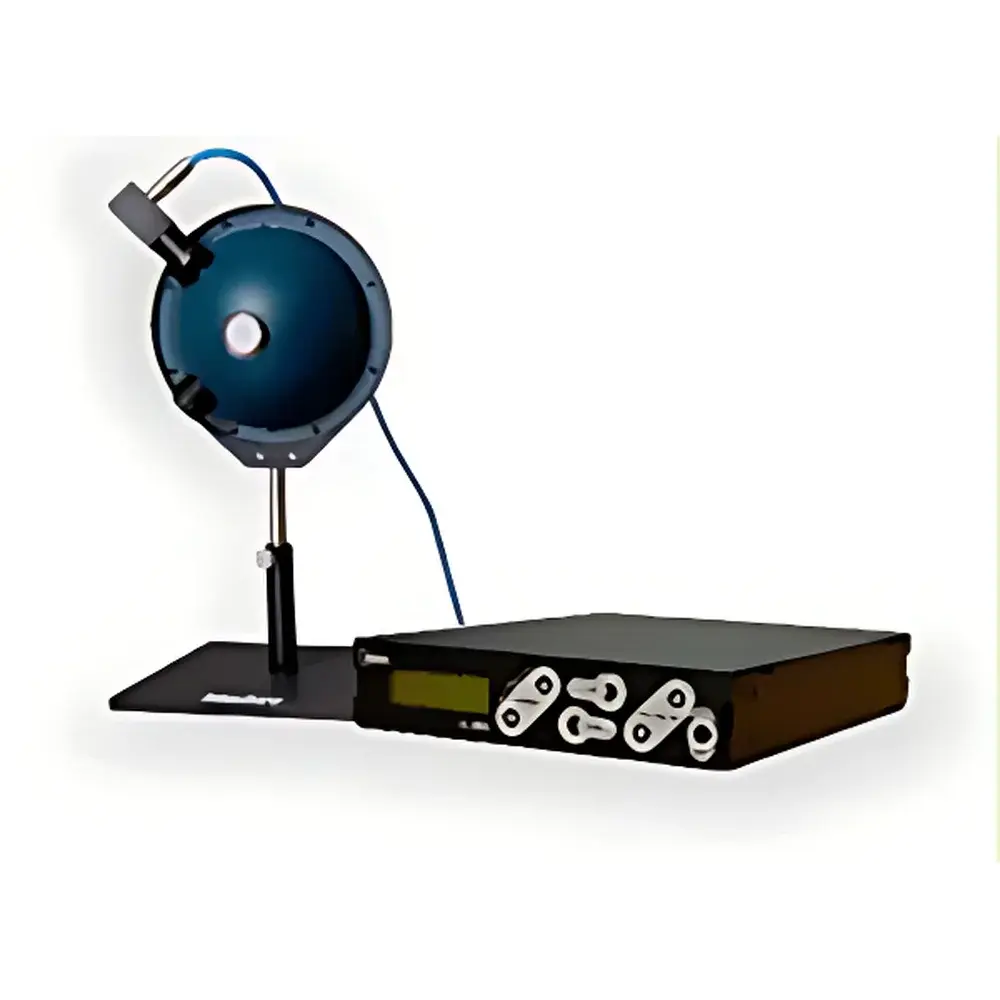
Labsphere LPS Laser Power Measurement Integrating Sphere System
| Brand | Labsphere |
|---|---|
| Origin | USA |
| Model | LPS |
| Coating Options | Spectraflect®, Infragold®, Spectralon® |
| Wavelength Range | UV–Vis–NIR–MIR (200 nm – 12 µm) |
| Beam Acceptance Angle | Up to ±40° half-angle |
| Detector Compatibility | Dual-detector or spectrometer integration supported |
| Cooling Options | Air-cooled and water-cooled configurations available |
| Target Plate | Integrated laser beam diffuser plate |
| Thermal Management | Optimized heat dissipation architecture for high-power operation |
| Compliance | Designed for ASTM E275, ISO/IEC 17025-aligned calibration workflows |
Overview
The Labsphere LPS Laser Power Measurement Integrating Sphere System is an engineered optical metrology platform designed for traceable, geometry-independent quantification of total radiant power from highly divergent or collimated laser sources. Operating on the principle of diffuse multiple-scattering within a precisely characterized spherical cavity, the LPS system converts spatially non-uniform irradiance distributions into uniform radiance at the sphere wall—enabling detector-agnostic power measurement without sensitivity to beam profile, divergence, pointing stability, or polarization state. This physical principle ensures high reproducibility (<±0.5% RSD over repeated measurements under controlled thermal conditions) and eliminates alignment-dependent errors common in direct-coupled thermopile or photodiode-based systems. The LPS supports continuous-wave (CW) and pulsed laser sources across an extended spectral range—from deep ultraviolet (200 nm) through visible and near-infrared (NIR) to mid-infrared (12 µm)—making it suitable for characterization of diode lasers, fiber lasers, CO₂ lasers, Nd:YAG systems, and free-electron laser (FEL) outputs.
Key Features
- Geometry-invariant measurement capability: Validated acceptance angle up to ±40° half-angle, enabling accurate capture of highly divergent beams from laser diodes and VCSEL arrays without realignment.
- Modular coating architecture: Interchangeable internal coatings—including Spectraflect® (broadband UV–Vis–NIR), Infragold® (optimized for 1–12 µm MIR performance), and Spectralon® (highest Lambertian reflectance >99% in UV–Vis–NIR)—allow wavelength-specific optimization and NIST-traceable calibration transfer.
- Dual-port detector configuration: Two independent detector ports support simultaneous broadband power measurement and spectral analysis via integrated spectrometer coupling—facilitating real-time power-spectrum correlation studies.
- High-power thermal management: Water-cooled variants incorporate stainless-steel sphere bodies with integrated coolant channels and calibrated thermal shunts; air-cooled versions utilize finned aluminum housings with forced-air convection paths engineered for stable operation at up to 500 W CW input (dependent on coating and port configuration).
- Beam conditioning interface: Integrated laser target plate disperses incident energy across the sphere interior, mitigating localized heating and coating degradation—critical for FEL and high-peak-power pulsed laser applications.
- Calibration-ready design: All spheres are supplied with NIST-traceable spectral responsivity data and optional factory calibration certificates compliant with ISO/IEC 17025 requirements.
Sample Compatibility & Compliance
The LPS system accommodates free-space laser beams with diameters ranging from 1 mm to 80 mm (dependent on sphere size selection: 50 mm, 100 mm, 150 mm, or 300 mm internal diameter). It is compatible with both single-mode and multimode sources, including quantum cascade lasers (QCLs), interband cascade lasers (ICLs), and tunable OPO systems. The system meets foundational requirements for optical safety (ANSI Z136.1 Class 3B/4 enclosure compatibility) and supports integration into GLP/GMP environments through optional audit-trail-enabled software modules. While not inherently FDA 21 CFR Part 11 compliant, its data acquisition architecture is designed for third-party validation to support regulated QC workflows in medical laser device manufacturing and aerospace photonics testing.
Software & Data Management
The LPS integrates with Labsphere’s TruPower™ Software Suite (v5.2+), a Windows-based application supporting real-time power monitoring, drift compensation algorithms, spectral responsivity correction, and automated calibration coefficient application. Raw detector signals (thermopile voltage or photodiode current) are digitized via 24-bit ADC hardware with programmable gain and filtering. Data export formats include CSV, HDF5, and XML—structured to align with laboratory information management systems (LIMS). Optional API access enables Python- and LabVIEW-driven automation for high-throughput production line testing. All measurement sessions log timestamp, ambient temperature, cooling status, and user-defined metadata to support ISO/IEC 17025 documentation requirements.
Applications
- Characterization of semiconductor laser diodes and VCSEL arrays in R&D and wafer-level test environments.
- Output power validation of industrial CO₂ and Nd:YAG lasers used in material processing, welding, and ablation.
- Mid-infrared laser source evaluation for gas sensing and spectroscopic applications.
- Free-electron laser (FEL) beamline diagnostics in synchrotron and accelerator facilities.
- Calibration transfer between primary standards (e.g., cryogenic radiometers) and secondary power meters in national metrology institutes.
- Thermal load profiling and long-term stability assessment of high-repetition-rate ultrafast laser systems.
FAQ
What spectral ranges does the LPS support with each coating option?
Spectraflect® covers 200 nm–2.5 µm; Infragold® extends to 12 µm with peak reflectance >95% from 1–10 µm; Spectralon® provides >99% reflectance from 250 nm–2.5 µm.
Can the LPS be used for pulsed laser measurements?
Yes—when paired with fast-response thermopiles or photodiodes and appropriate signal conditioning, it supports pulse energies down to 10 µJ and repetition rates up to 10 kHz.
Is NIST-traceable calibration included standard?
A baseline spectral responsivity certificate is provided; full NIST-traceable calibration with uncertainty budget is available as an optional service.
How is detector saturation prevented during high-power measurement?
Neutral density filters, attenuating apertures, and dual-detector ratioing modes are implemented in firmware to maintain linear response across six orders of magnitude.
Does the system support automated compliance reporting for ISO/IEC 17025?
TruPower™ includes configurable report templates with embedded uncertainty calculations and electronic signature fields—validated for use in accredited laboratories.



