
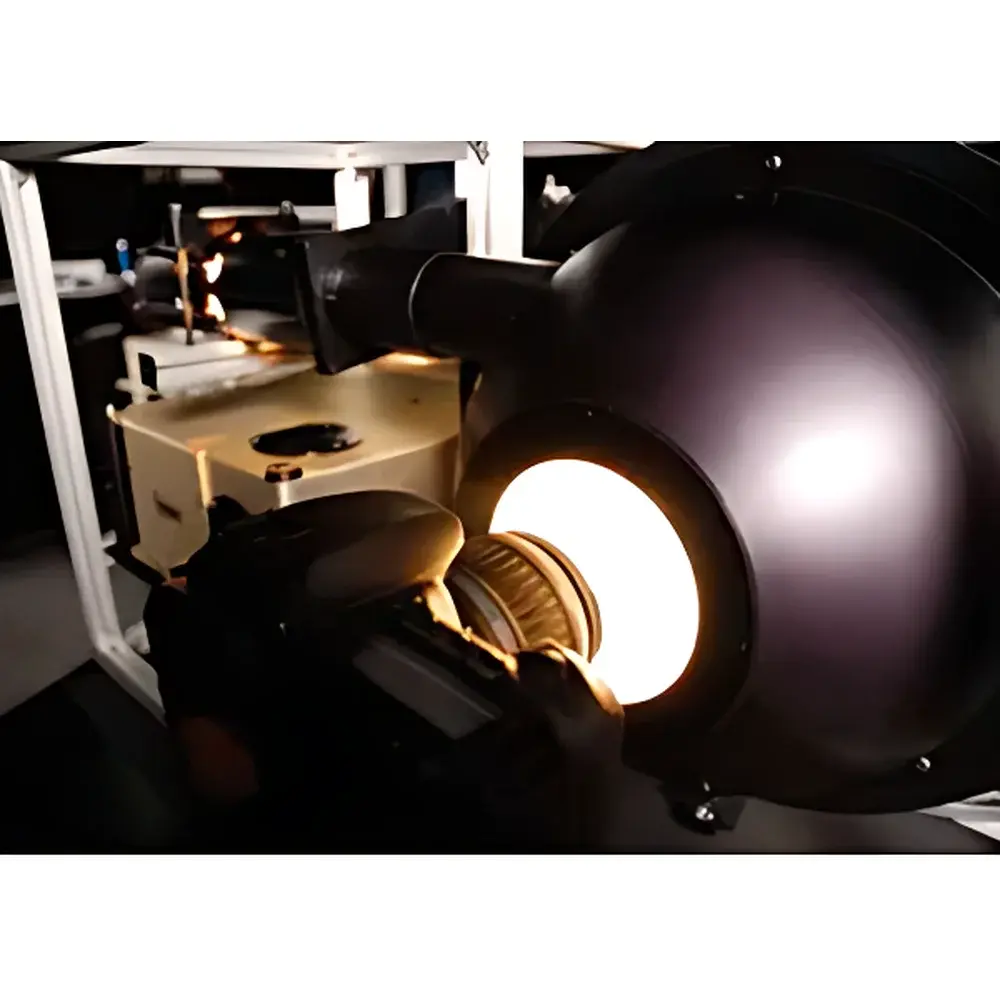
LabSphere XTH-2000C Solar Spectral Simulation System
| Brand | LabSphere |
|---|---|
| Origin | USA |
| Manufacturer Type | Authorized Distributor |
| Import Status | Imported |
| Model | XTH-2000C |
| Calibration Traceability | NIST-traceable Certificate Provided |
| Color Temperature Range | 3000 K to 6000 K |
| Spectral Range | 250 nm to 1100 nm |
| Output Monitoring | Integrated spectrometer and calibrated photodetector |
| Configurable Aperture Sizes | Standard options include 50 mm, 100 mm, and 200 mm exit ports |
| Control Interface | RS-232 / USB with LabSphere SpectraSuite-compatible software |
Overview
The LabSphere XTH-2000C Solar Spectral Simulation System is a precision-engineered optical source designed to replicate the spectral irradiance distribution of natural sunlight under controlled laboratory conditions. It operates on the principle of broadband continuum generation via stabilized xenon arc lamp technology, coupled with high-fidelity optical filtering and collimation optics to emulate the ASTM G173-03 (Global Tilted Surface) and ISO 9022-18 reference solar spectra. Unlike simple broadband lamps or LED-based simulators, the XTH-2000C delivers continuous, spectrally stable output across the ultraviolet (UV), visible (VIS), and near-infrared (NIR) regions—spanning 250 nm to 1100 nm—with minimal temporal drift (<0.5% over 4 hours) and spatial uniformity exceeding ±2.5% across the defined test plane. Its primary function is to serve as a metrologically traceable irradiance source for radiometric and spectral calibration of remote sensing instruments—including multispectral imagers, hyperspectral sensors, radiometers, and solar-blind UV detectors—prior to field deployment or satellite integration.
Key Features
- Full-spectrum solar simulation from 250 nm to 1100 nm, covering critical atmospheric transmission windows used in Earth observation and planetary science applications.
- Adjustable correlated color temperature (CCT) from 3000 K to 6000 K, enabling spectral tuning to match specific solar zenith angle conditions or target illumination environments (e.g., AM0, AM1.5G, or custom spectral profiles).
- Integrated real-time spectral monitoring using a calibrated miniature spectrometer and NIST-traceable silicon photodetector, providing closed-loop feedback for irradiance stability control.
- Modular optical design supporting multiple exit port configurations: standard apertures of 50 mm, 100 mm, and 200 mm diameter are available, each optimized for collimated or diffuse illumination geometries per application requirements.
- NIST-traceable calibration certificate included with each system, documenting spectral irradiance values at 5 nm resolution across the full operating range, with uncertainty budgets compliant with ISO/IEC 17025 guidelines.
- RS-232 and USB 2.0 interfaces enable seamless integration into automated test benches; compatible with LabSphere’s SpectraSuite software for spectral acquisition, irradiance mapping, and time-series stability analysis.
Sample Compatibility & Compliance
The XTH-2000C is engineered for compatibility with optical components and detectors requiring high-fidelity solar-spectrum excitation, including but not limited to: silicon and InGaAs photodiodes, CCD/CMOS focal plane arrays, diffraction gratings, interference filters, and integrating spheres. Its output meets the spectral fidelity criteria specified in ASTM E927-22 (Standard Specification for Solar Simulation for Photovoltaic Testing) for Class AAA spectral match (within ±12.5% deviation from AM1.5G reference in UV-VIS-NIR bands). While primarily intended for calibration laboratories and aerospace R&D facilities, the system adheres to electromagnetic compatibility (EMC) standards per FCC Part 15 Subpart B and IEC 61326-1 for laboratory equipment. All calibration data are generated under GLP-compliant procedures, with full audit trails available upon request for FDA 21 CFR Part 11–aligned environments.
Software & Data Management
SpectraSuite software provides a validated platform for spectral acquisition, irradiance normalization, and long-term stability trending. Users can define custom measurement protocols—including sequential spectral scans at varying CCT settings, timed irradiance logging, and pass/fail threshold comparisons against reference spectra. Raw spectral data are exported in CSV and HDF5 formats, ensuring interoperability with MATLAB, Python (via NumPy/Pandas), and commercial data analysis suites such as OriginPro and JMP. Audit logs record operator ID, timestamp, instrument configuration, and calibration metadata—supporting compliance with ISO 17025 Clause 7.7 (Results Reporting) and internal quality management systems requiring traceable digital records.
Applications
- Radiometric calibration of airborne and spaceborne remote sensing payloads (e.g., VIIRS, OLI, MSI).
- Validation of spectral response functions for UV-VIS-NIR spectroradiometers and field-deployable environmental monitors.
- Testing and characterization of solar cell spectral responsivity under standardized AM1.5G conditions.
- Development and verification of atmospheric correction algorithms requiring ground-truth spectral irradiance inputs.
- Intercomparison campaigns between national metrology institutes (NMIs) and third-party calibration labs.
FAQ
Is the XTH-2000C suitable for photovoltaic device testing?
Yes—it satisfies ASTM E927-22 Class AAA spectral match requirements for terrestrial PV applications when configured with appropriate filters and collimation optics.
Can the system be integrated into an automated calibration line?
Yes—its RS-232 and USB interfaces support SCPI command sets and programmable spectral ramping, enabling synchronization with motion controllers, shutter systems, and data acquisition hardware.
What is the typical recalibration interval recommended for NIST-traceable performance?
LabSphere recommends annual recalibration under ISO/IEC 17025-accredited conditions; extended intervals may be justified based on usage logs and stability verification data.
Does the system include spectral irradiance uncertainty budgets?
Yes—the delivered NIST-traceable certificate includes expanded uncertainties (k=2) for spectral irradiance at all reported wavelengths, derived from component-level uncertainty propagation per GUM (JCGM 100:2008).



