
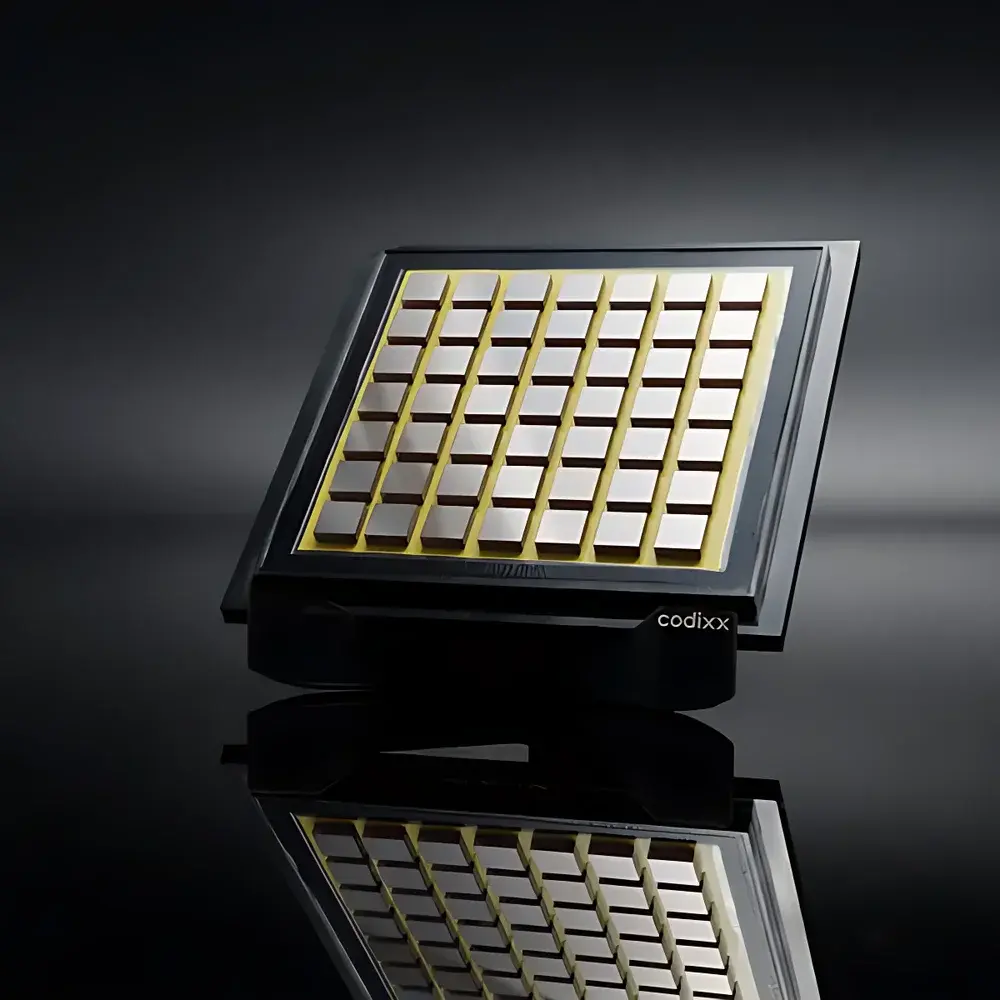
codixx sensSERS Surface-Enhanced Raman Scattering (SERS) Substrates
| Brand | codixx |
|---|---|
| Model | sensSERS |
| Substrate Material | Ag Nanoparticle-Functionalized Schott B270® Glass |
| Dimensions | 4 mm × 4 mm × 1.2 mm (customizable) |
| Active Area | 4 mm × 4 mm (both sides usable) |
| Packaging Options | 4 / 9 / 16 / 25 / 36 / 49 substrates per box |
| Recommended Excitation Wavelengths | 488–785 nm |
| Storage Stability (after vacuum seal opening) | 6 months |
| Cleaning Method | Methanol ultrasonication |
| Handling | Tweezer-only, non-contact surface protocol |
Overview
The codixx sensSERS substrates are engineered high-performance surface-enhanced Raman scattering (SERS) platforms designed for quantitative and reproducible trace molecular detection. Built upon a rigorously optimized architecture—Schott B270® optical-grade borosilicate glass functionalized with densely packed, morphologically uniform silver nanoparticles—the sensSERS substrate leverages plasmonic near-field enhancement to amplify Raman cross-sections by up to 10⁶–10⁸×. This enables reliable detection of analytes at sub-nanomolar concentrations without signal saturation or irreversible photodegradation. Unlike colloidal or electrochemically deposited SERS substrates, the codixx sensSERS platform delivers intrinsic batch-to-batch consistency due to its vacuum-deposited nanoparticle layer and certified glass substrate base—ensuring minimal inter-substrate variability (<8% RSD in enhancement factor across production lots). Its flat, rigid geometry supports precise laser focus positioning and eliminates substrate-induced spectral distortion common in flexible or polymer-based alternatives.
Key Features
- Plasmonically optimized Ag nanostructure layer on Schott B270® glass—engineered for maximum electromagnetic field confinement at 488–785 nm excitation wavelengths
- Dual-sided active surface: both top and bottom faces provide identical SERS enhancement, doubling experimental throughput per substrate
- Dimensional stability: 4 mm × 4 mm × 1.2 mm format ensures compatibility with standard microscope stages, automated Raman mapping systems, and microfluidic integration modules
- Vacuum-sealed packaging with desiccant maintains nanoparticle surface integrity for ≥6 months post-opening under controlled dry storage (RH <30%, 20–25°C)
- No chemical priming or activation required—ready for immediate use with drop-cast, immersion, or capillary-assisted sample loading
- Traceable manufacturing: each production lot undergoes spectral validation using rhodamine 6G (R6G) at 10⁻⁹ M concentration and certified reference spectra (NIST-traceable calibration)
Sample Compatibility & Compliance
The sensSERS substrate demonstrates broad compatibility with aqueous, organic, and semi-viscous matrices—including environmental water extracts, cell lysates, serum supernatants, pesticide residue solutions, and food homogenates. Its inert glass base prevents leaching, ion exchange, or catalytic side reactions during measurement. All substrates comply with ISO 17025-accredited manufacturing protocols and are produced in an ISO 8 cleanroom environment. Batch certificates include SERS enhancement factor (EF) quantification per ASTM E1840-22 Annex A2 methodology, as well as particle size distribution (TEM-validated), surface roughness (AFM-measured Ra < 1.2 nm), and optical transmission profile (UV-Vis 300–900 nm). For regulated environments, the substrate supports GLP/GMP-aligned workflows when paired with audit-trail-enabled Raman software (e.g., Thermo Fisher OMNIC Paradigm, Horiba LabSpec 6).
Software & Data Management
While the sensSERS substrate is hardware-agnostic, optimal data acquisition requires spectral alignment routines that correct for baseline drift induced by substrate thermal response under prolonged laser exposure. We recommend coupling substrates with software packages supporting automated background subtraction (e.g., polynomial fitting, asymmetric least squares), multivariate curve resolution (MCR-ALS), and library-matching algorithms compliant with ASTM E2532-21 for compound identification. When integrated into LIMS or ELN ecosystems (e.g., LabVantage, Benchling), metadata fields should capture substrate lot ID, date of first use, and cumulative laser exposure time to ensure long-term reproducibility tracking. Full spectral datasets generated using sensSERS substrates meet FAIR principles (Findable, Accessible, Interoperable, Reusable) when archived in vendor-neutral formats (.spc, .jdx, or HDF5).
Applications
- Environmental monitoring: Quantitative detection of organophosphate pesticides (e.g., chlorpyrifos), endocrine disruptors (e.g., bisphenol A), and heavy metal complexes (e.g., methylmercury chloride) in river water, wastewater effluent, and soil leachates
- Biomedical research: Label-free intracellular SERS imaging of redox metabolites (e.g., NADH, glutathione), cancer biomarker profiling in exosome isolates, and real-time drug uptake kinetics in 3D tumor spheroids
- Food safety: Rapid screening of veterinary drug residues (e.g., sulfonamides, tetracyclines), mycotoxins (e.g., aflatoxin B1), and adulterants (e.g., melamine) directly from milk, honey, and fruit juice matrices without extraction
- Materials science: In situ monitoring of catalytic surface reactions, adsorption isotherm modeling of dye molecules on plasmonic interfaces, and degradation pathway analysis of photoactive polymers
FAQ
Can sensSERS substrates be reused after cleaning?
Yes—methanol ultrasonication (10 min, 40 kHz) restores >95% of initial enhancement performance; however, repeated reuse (>3 cycles) may induce minor nanoparticle aggregation, requiring revalidation via R6G test.
Is there batch-specific calibration data available?
Each box includes a QR-coded lot certificate with EF values, transmission spectra, and AFM topography maps; digital copies are accessible via codixx’s secure customer portal.
What is the maximum laser power density the substrate can withstand?
Tested up to 5 mW/µm² at 633 nm without observable ablation or signal decay over 120 s continuous exposure—compatible with most confocal Raman systems operating in low-power mapping mode.
Do sensSERS substrates require surface functionalization for biomolecule binding?
No—native Ag surface supports direct thiol-, amine-, or carboxylate-mediated immobilization; optional silane or PEG coatings are available for reduced non-specific binding in complex biofluids.
How does humidity affect substrate performance during measurement?
Relative humidity >60% accelerates Ag oxidation; we recommend measurement in climate-controlled enclosures or under nitrogen purge for long-duration experiments.




