
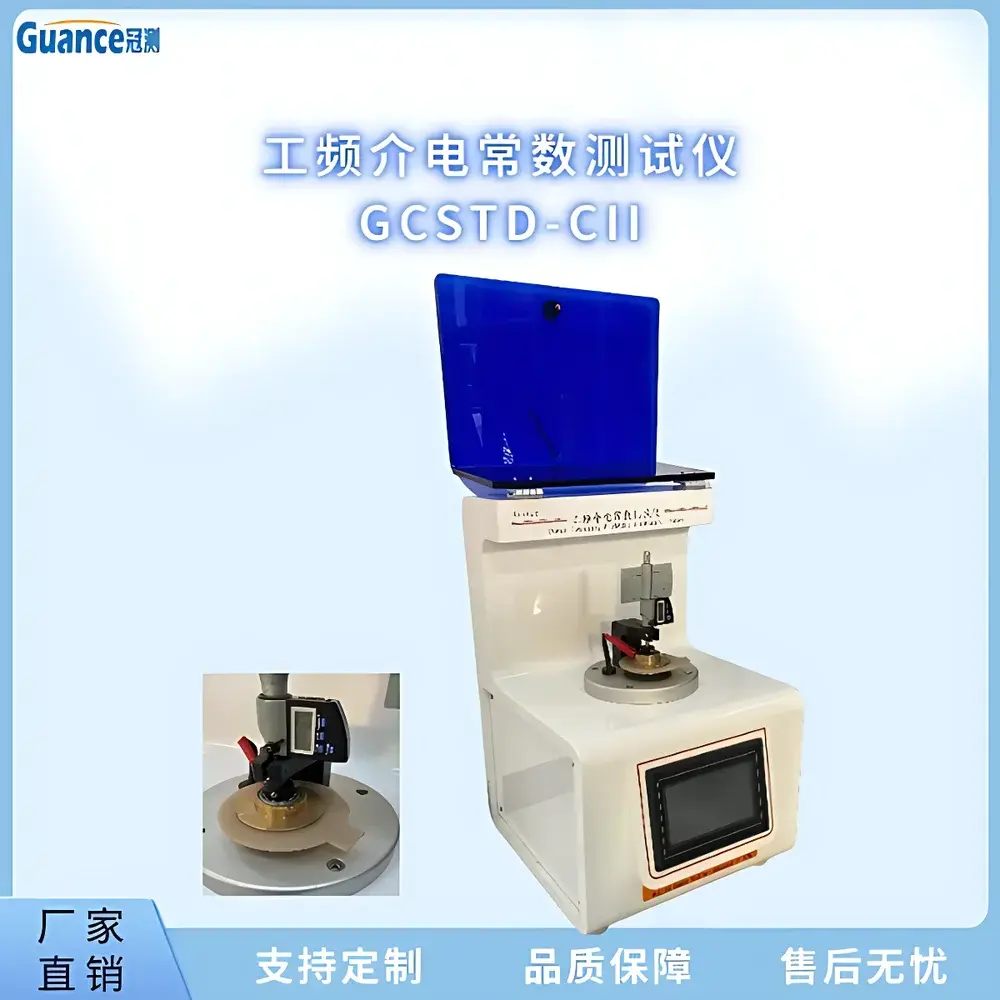
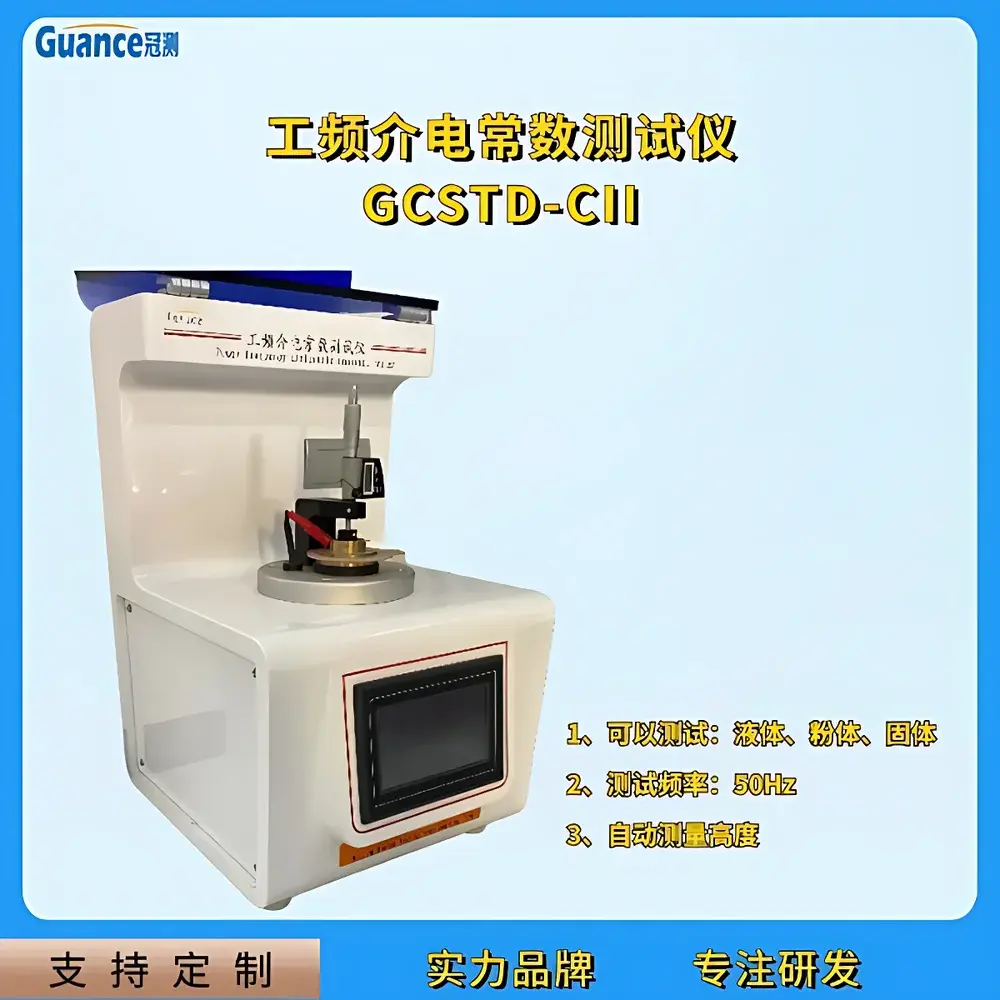
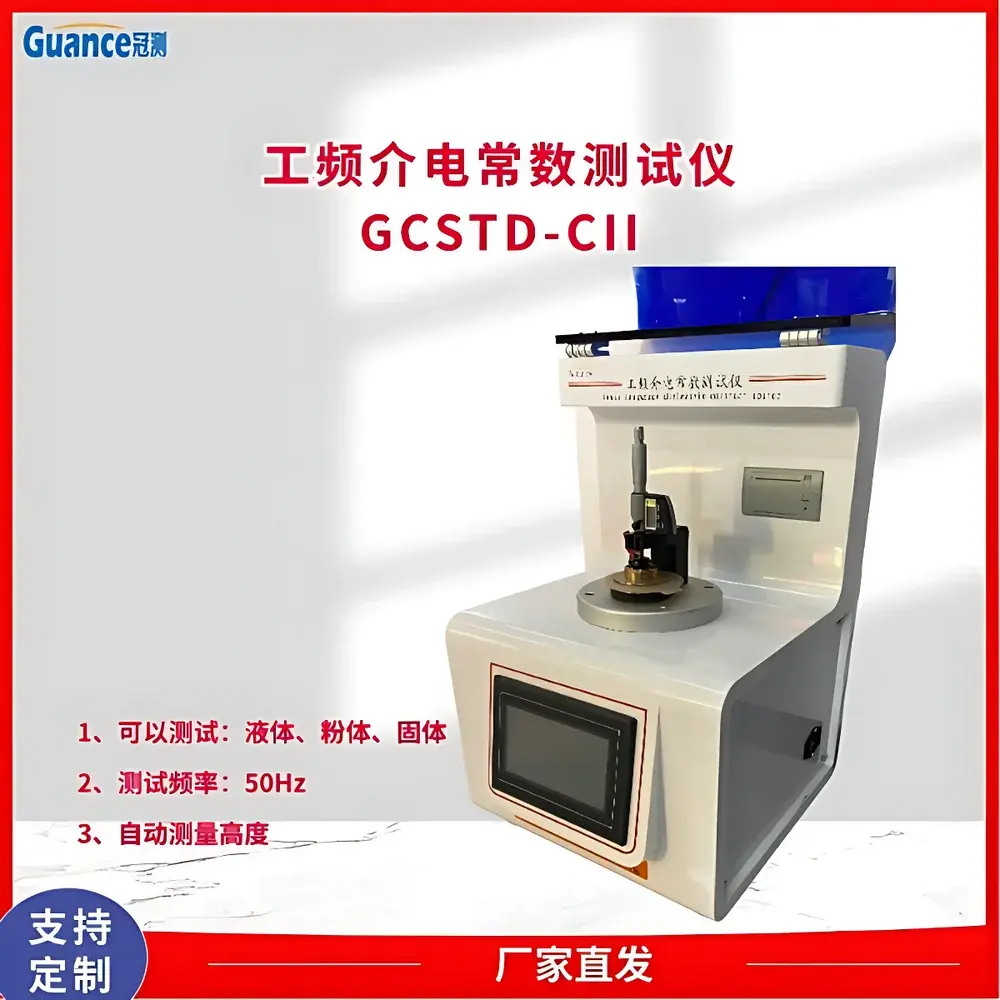
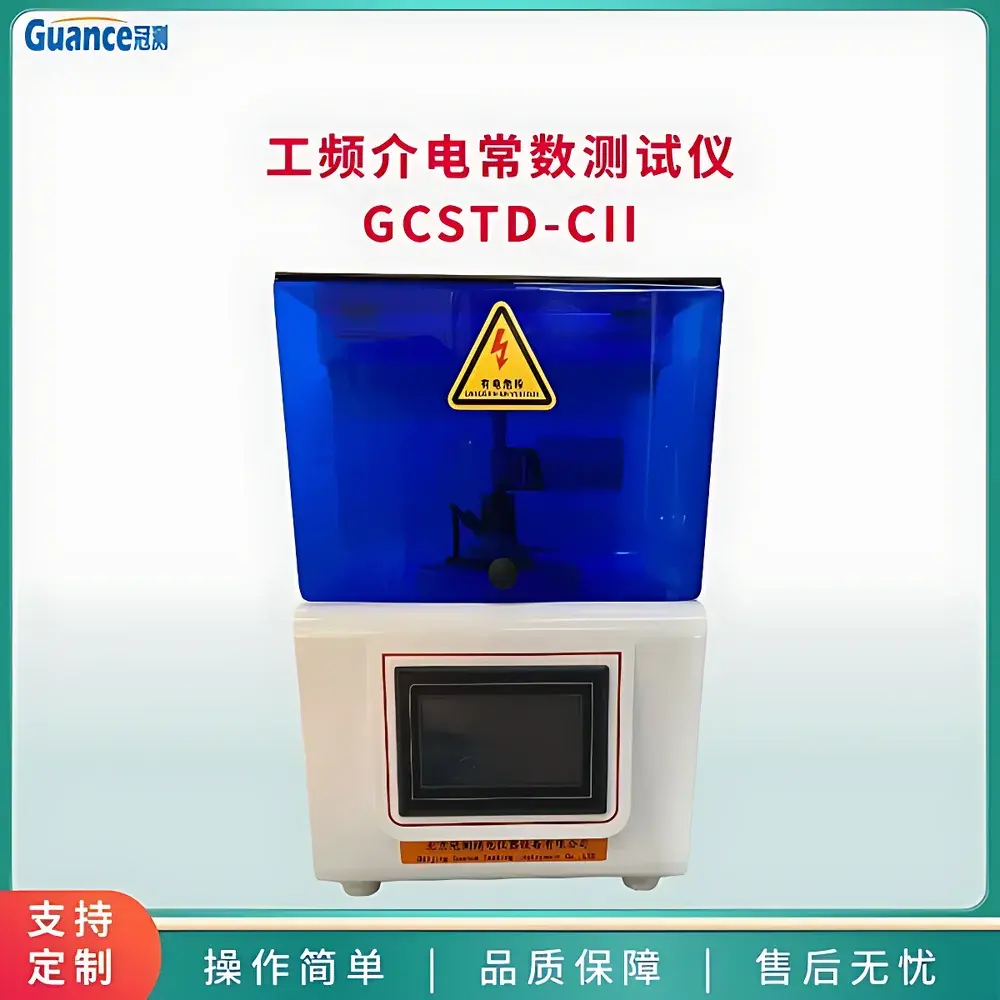
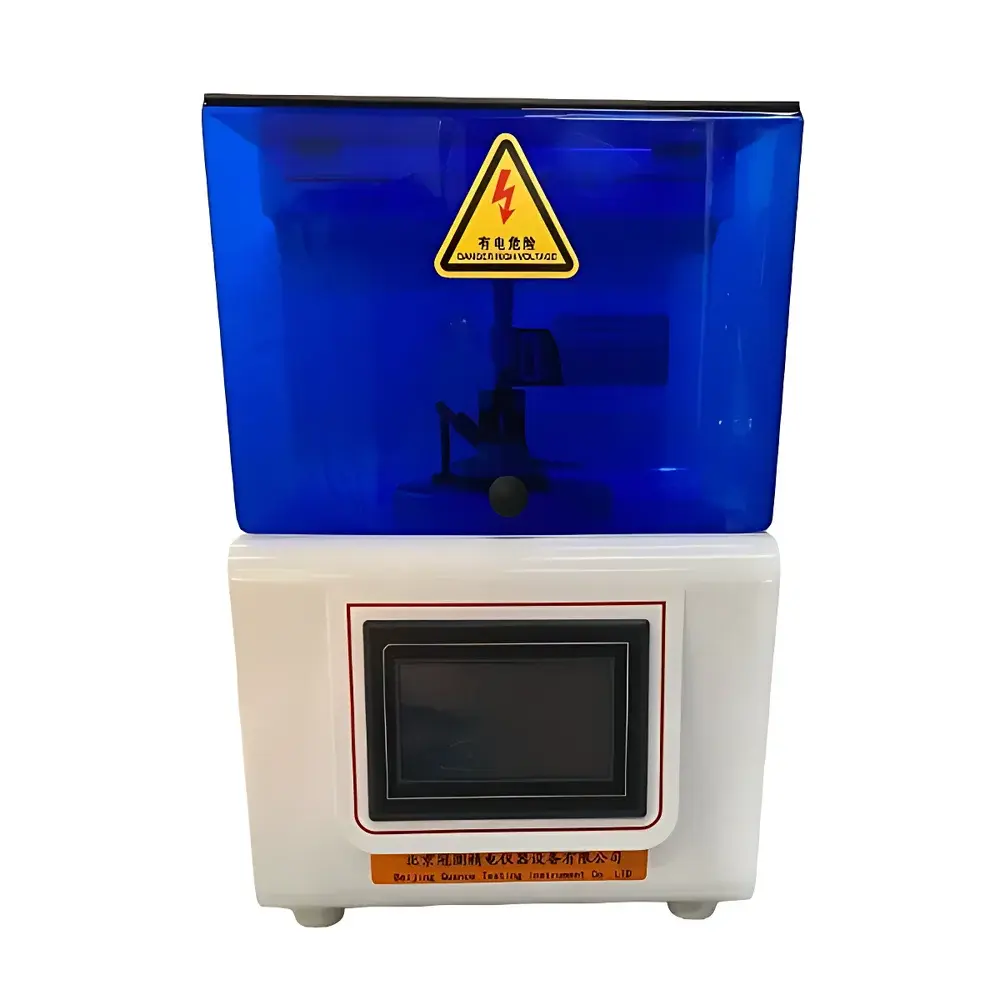
Guance GCSTD-CII6 Dielectric Constant and Dissipation Factor Analyzer for Insulating Sleeves
| Brand | Guance |
|---|---|
| Origin | Beijing, China |
| Manufacturer Type | Authorized Distributor |
| Country of Manufacture | China |
| Model | GCSTD-CII6 |
| Price | USD 1,400 (FOB Beijing) |
| Standard Compliance | GB/T 1409–2006, GB/T 5654–2007, GB/T 21216–2007, GB/T 1693–2007, GB/T 5594.4–1985 |
| Measurement Principle | Schering Bridge (Auto-balancing AC Bridge) at Power Frequency (50 Hz ± variable frequency suppression) |
| Test Voltage Range | 2.5 kV – 10 kV (5-step adjustable, integrated HV source) |
| tanδ Accuracy | ±(1% × reading + 0.09%) |
| Cx Accuracy | ±(1.5% × reading + 1 pF) |
| tanδ Resolution | 0.01% |
| Cx Resolution | 0.1 pF |
| Sample Interface | Internal HV electrode fixture for cylindrical insulating sleeves (Ø38 mm, Ø50 mm, Ø100 mm) |
| Operating Temp. | 10–30 °C |
| Relative Humidity | 20–80% RH |
| Power Supply | 220 V ±10%, 50 Hz, 1.5 kVA |
| Dimensions (L×W×H) | 470 × 320 × 360 mm |
| Weight | 16 kg |
| Display | Large-character LCD with Chinese menu navigation |
| Protection | Overcurrent trip, arc detection, short-circuit & flashover safeguard |
| Data Output | Built-in thermal printer, RS232 interface for PC logging |
Overview
The Guance GCSTD-CII6 Dielectric Constant and Dissipation Factor Analyzer is a dedicated power-frequency (50 Hz) impedance measurement system engineered for precise determination of relative permittivity (εr) and dielectric loss tangent (tan δ) in solid and liquid electrical insulation materials. It operates on the principle of an auto-balancing Schering bridge, where the unknown capacitive impedance of the test specimen—such as polymeric insulating sleeves, transformer bushings, cable terminations, or insulating oils—is compared against a high-stability internal reference capacitor under controlled sinusoidal excitation. The instrument integrates a fully regulated, five-range high-voltage AC source (2.5 kV to 10 kV), eliminating reliance on external transformers for routine field or lab-based acceptance testing. Its variable-frequency rejection architecture actively suppresses ambient 50 Hz electromagnetic interference—critical for on-site diagnostics near energized substations or switchgear—ensuring measurement integrity without shielding enclosures or remote grounding compromises.
Key Features
- Integrated high-voltage generator (2.5–10 kV, 5 discrete steps) with real-time current limiting and arc detection circuitry
- Auto-balancing Schering bridge architecture with 6-digit internal A/D resolution and digital phase-sensitive demodulation
- Triple-test-mode capability: direct internal HV connection (positive/negative guard configurations), reverse connection for grounded specimens, and external HV transformer coupling
- Onboard thermal printer for immediate hardcopy reporting of εr, tan δ, Cx, and test conditions—including date/time stamp and operator ID field
- Large-format monochrome LCD with full Chinese character interface; menu-driven workflow minimizes training overhead for QC technicians
- Comprehensive protection suite: overcurrent shutdown (<5 µs response), dielectric breakdown lockout, and open-circuit voltage monitoring
- No external calibration standards required—factory-traceable internal reference capacitor certified per ISO/IEC 17025 procedures
Sample Compatibility & Compliance
The GCSTD-CII6 is validated for standardized evaluation of cylindrical insulating components per major national and industry specifications. It accommodates standard-diameter sleeve specimens (Ø38 mm, Ø50 mm, Ø100 mm) using precision-machined brass electrodes with guard rings to minimize fringing field errors. For liquid dielectrics (e.g., mineral oil, silicone fluid), compatibility extends to ASTM D924 and IEC 60247 when paired with a calibrated ASTM D1169-type oil test cell. All measurements comply with traceability requirements outlined in GB/T 1409–2006 (equivalent to IEC 60250), GB/T 5654–2007 (IEC 60247), and GB/T 21216–2007. The instrument’s firmware embeds calculation algorithms aligned with the complex permittivity formalism ε* = ε′ − jε″, enabling direct derivation of εr = ε′/ε0 and tan δ = ε″/ε′ from raw bridge balance data—fully auditable for GLP/GMP-regulated environments.
Software & Data Management
While the GCSTD-CII6 operates autonomously via its embedded microcontroller, optional PC connectivity via RS232 enables structured data export in CSV format compatible with LIMS platforms (e.g., LabWare, Thermo Fisher SampleManager). Exported records include raw bridge phase/voltage ratios, applied test voltage, ambient temperature/humidity logs, operator-entered sample ID, and pass/fail flags against user-defined specification limits. Firmware supports audit trail functionality compliant with FDA 21 CFR Part 11 requirements when used with authenticated login protocols and electronic signature modules (sold separately). No proprietary software installation is required—data ingestion follows standard serial terminal emulation (9600 baud, N-8-1).
Applications
- Acceptance testing of epoxy-resin, silicone rubber, and porcelain insulating sleeves per IEC 60137 and GB/T 4109
- Quality control of transformer oil batches during manufacturing and maintenance intervals
- Degradation assessment of aged cable insulation systems (XLPE, EPR) via trend analysis of tan δ vs. voltage stress
- Material qualification for high-voltage DC (HVDC) converter station components where low-frequency dielectric dispersion is critical
- R&D screening of nanocomposite insulators evaluating filler dispersion effects on interfacial polarization losses
- Factory and field verification of bushing capacitance grading uniformity prior to commissioning
FAQ
Does the GCSTD-CII6 support automated multi-voltage tan δ sweeps?
No—the instrument performs single-point measurements at fixed user-selected voltages (2.5 kV, 5 kV, or 10 kV). For voltage-dependence profiling, manual stepwise retesting is required.
Can it measure samples with surface contamination or moisture films?
Surface conduction paths significantly distort tan δ readings. Per GB/T 5654–2007, specimens must be cleaned, dried, and conditioned per Clause 6.2 before testing. Optional surface guard electrode kits are available for mitigating leakage currents.
Is the internal reference capacitor user-replaceable?
No—it is hermetically sealed and factory-calibrated. Replacement requires return to Guance’s Beijing service center and full recalibration against NIM-traceable standards.
What safety certifications does the instrument carry?
It conforms to GB 4793.1–2007 (equivalent to IEC 61010-1) for electrical safety and EMC immunity per GB/T 18268.1–2010 (IEC 61326-1). CE marking is not applicable as it is designed for domestic Chinese grid compliance.
How is measurement uncertainty quantified for accreditation purposes?
A full uncertainty budget per GUM (JCGM 100:2008) is provided in the calibration certificate, covering contributions from voltage divider ratio error, phase detector nonlinearity, temperature coefficient of reference capacitor, and environmental drift—total expanded uncertainty (k=2) is ≤ ±1.8% for tan δ and ≤ ±2.2% for Cx.



