
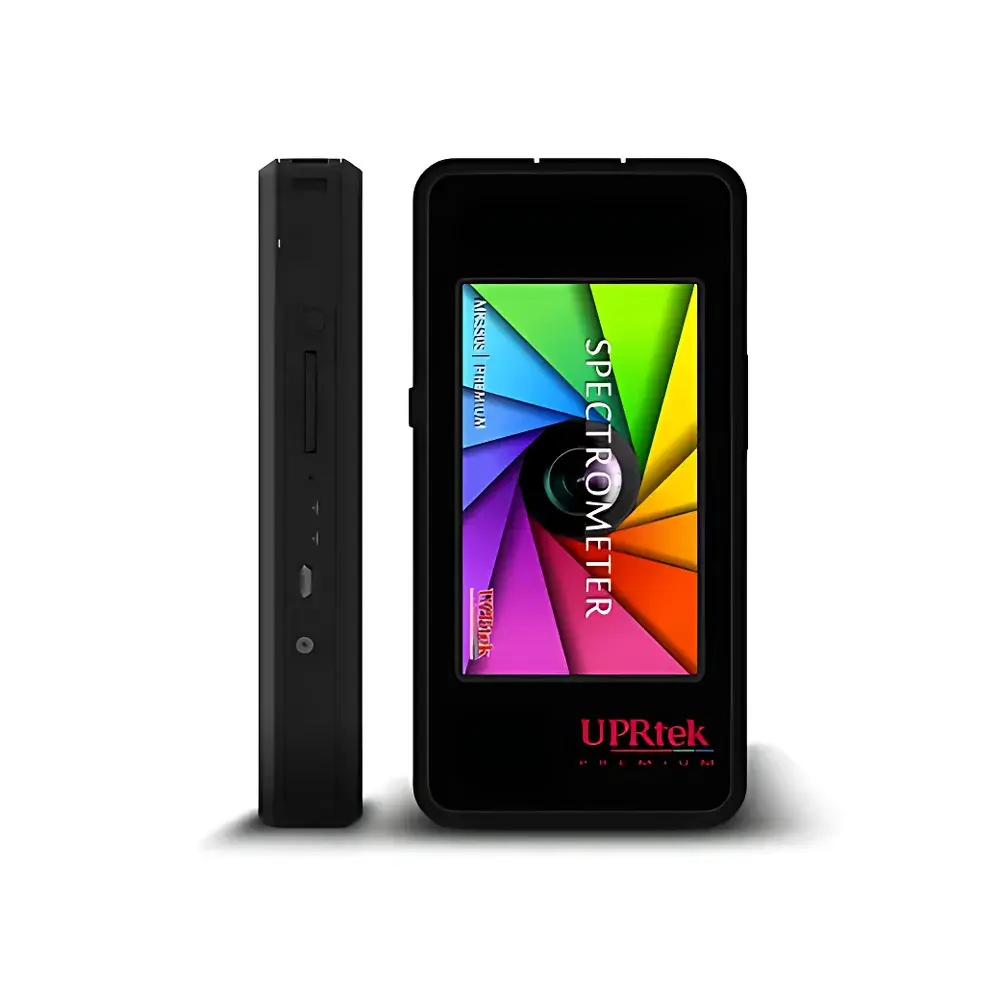
UPRtek MK350S Advanced Portable Spectrometer
| Brand | UPRtek |
|---|---|
| Origin | China (Beijing) |
| Model | MK350S |
| Spectral Range | 380–780 nm |
| Wavelength Resolution | 1 nm |
| FWHM | ~12 nm |
| Photometric Accuracy (Illuminance, Std. Illuminant A) | ±2.5% |
| Chromaticity Accuracy (x,y) | ±0.002 (100–150,000 lx) |
| CCT Accuracy | ±2% |
| CRI Accuracy | ±1.5% |
| Illuminance Range | 1–150,000 lx |
| Flicker Sampling Rate | 100 kS/s |
| Frequency Range | 5–50 kHz |
| Compliance | JIS C 1609-1:2006 AA Class, DIN 5032-7 Class B |
| Display | 4.3" resistive touchscreen |
| Internal Storage | 8 GB SD card (~21,000 measurements) |
| Battery Life | up to 4 hours |
| Dimensions (H×W×D) | 163 × 81 × 26.6 mm |
| Weight (with battery) | 260 g ±10 g |
Overview
The UPRtek MK350S Advanced Portable Spectrometer is a field-deployable, high-fidelity spectral measurement instrument engineered for precision photometric and radiometric characterization of visible-light sources. Operating on the principle of linear CMOS array-based diffraction grating spectroscopy, it captures full spectral power distributions (SPDs) across the human photopic response range (380–780 nm) with 1 nm data interval and ~12 nm optical bandwidth (FWHM). Designed for metrological rigor in real-world environments, the MK350S delivers traceable illuminance (lux), correlated color temperature (CCT), color rendering index (CRI), chromaticity coordinates (CIE 1931/1976), photosynthetic photon flux density (PPFD), scotopic-to-photopic (S/P) ratio, temporal light modulation (TLM) metrics—including IEEE 1789 and ENERGY STAR-compliant flicker risk assessment—and blue-light hazard evaluation (IEC 62471). Its architecture supports both rapid single-shot acquisition and continuous spectral logging, making it suitable for R&D validation, production line QA/QC, lighting design verification, and regulatory compliance testing under ISO/CIE-defined conditions.
Key Features
- Optical-grade linear CMOS sensor with automatic dark-current compensation—performed prior to each measurement cycle—to eliminate thermal drift and ensure long-term repeatability.
- Wide dynamic illuminance range (1–150,000 lx) with dual-range precision: ±0.2% repeatability (2σ) above 100 lx and ±0.5% below 100 lx (Std. Illuminant A).
- JIS C 1609-1:2006 AA-class and DIN 5032-7 Class B photometric certification—validating its suitability for accredited laboratory and field-based luminous flux, illuminance, and colorimetric measurements.
- Integrated IEEE 1789-compliant flicker visualization: graphical risk mapping based on frequency-modulation depth and modulation frequency, aligned with ENERGY STAR V2.1 and IEC TR 61547-1 requirements.
- Quantitative blue-light hazard index calculation per IEC 62471:2006 Ed.2, enabling objective classification of LED lighting products into Risk Groups (RG0–RG3) without external spectroradiometric calibration.
- Dual PC software suite: uSpectrum (for spectral analysis, CCT/CRI/TLA/GAI/TLCI computation, and report generation compliant with ISO 11664 and CIE S 023) and uFlicker (for time-domain waveform reconstruction, percent flicker, flicker index, SVM, and frequency spectrum analysis).
Sample Compatibility & Compliance
The MK350S is optimized for measuring steady-state and temporally modulated visible-light emitters—including white LEDs, OLEDs, fluorescent lamps, HID sources, and architectural luminaires—under ambient or controlled conditions. Its cosine-corrected input optics meet CIE Publication No. 127 and IES LM-79-19 angular response specifications. All photometric and colorimetric calibrations are traceable to NIST-traceable standards via UPRtek’s ISO/IEC 17025-accredited calibration laboratory. The device satisfies essential requirements for GLP-compliant documentation workflows, including timestamped metadata embedding (GPS optional via Bluetooth), audit-ready Excel/JPEG export, and configurable measurement protocols aligned with ASTM E308-22, CIE 15:2018, and IEC 61000-3-2 for harmonic and flicker emissions testing.
Software & Data Management
uSpectrum PC software provides full spectral data interrogation with customizable pass/fail thresholds, batch processing, comparative overlay of multiple SPDs, and automated generation of PDF reports conforming to ISO/IEC 17025 documentation structure. Raw spectral data (.CSV) retains full 1 nm resolution and includes integration time, calibration ID, and environmental metadata. uFlicker enables time-resolved analysis with selectable FFT windowing, harmonic distortion profiling, and SVM (Stroboscopic Visibility Measure) computation per IEC TR 63158. Both applications support 21 CFR Part 11-compliant user authentication, electronic signatures, and immutable audit trails when deployed in regulated GMP or pharmaceutical lighting validation environments.
Applications
- Landscape and architectural lighting design—quantifying spatial illuminance distribution, uniformity ratios, and mesopic adaptation parameters.
- LED product development and quality assurance—verifying binning consistency, aging-induced spectral shift, and driver-induced flicker artifacts.
- Healthcare and educational facility lighting audits—assessing circadian stimulus (CS), melanopic EDI, and flicker-related visual discomfort per WELL v2 and LEED v4.1 criteria.
- Photobiological safety testing—pre-screening for photoretinitis risk in consumer lighting, display backlighting, and horticultural lighting systems.
- Academic research in vision science, non-visual photoreception, and human-centric lighting—supporting publication-grade spectral datasets with documented uncertainty budgets.
FAQ
Is the MK350S calibrated to national metrology standards?
Yes—each unit ships with a factory calibration certificate traceable to NIST and accredited under ISO/IEC 17025 by Taiwan Accreditation Foundation (TAF). Optional annual recalibration services include uncertainty budget reporting.
Can the MK350S measure UV or IR radiation?
No—it is strictly limited to the photobiologically relevant visible spectrum (380–780 nm) and does not extend into ultraviolet (780 nm) regions.
Does the device support wireless data transfer?
It features Bluetooth 4.2 for remote control and real-time spectral streaming to Windows/macOS PCs; Wi-Fi and cloud synchronization are not supported in this model.
What is the recommended recalibration interval?
UPRtek recommends recalibration every 12 months under normal usage conditions, or after any mechanical shock, exposure to extreme temperatures (>50°C), or suspected optical contamination.
Can uSpectrum generate CIE 224:2017-compliant melanopic daylight efficacy ratio (MDER) values?
Yes—version 5.2+ of uSpectrum includes built-in MDER calculation using the CIE S 026:2018 melanopic action spectrum and supports custom weighting function import for research applications.





