
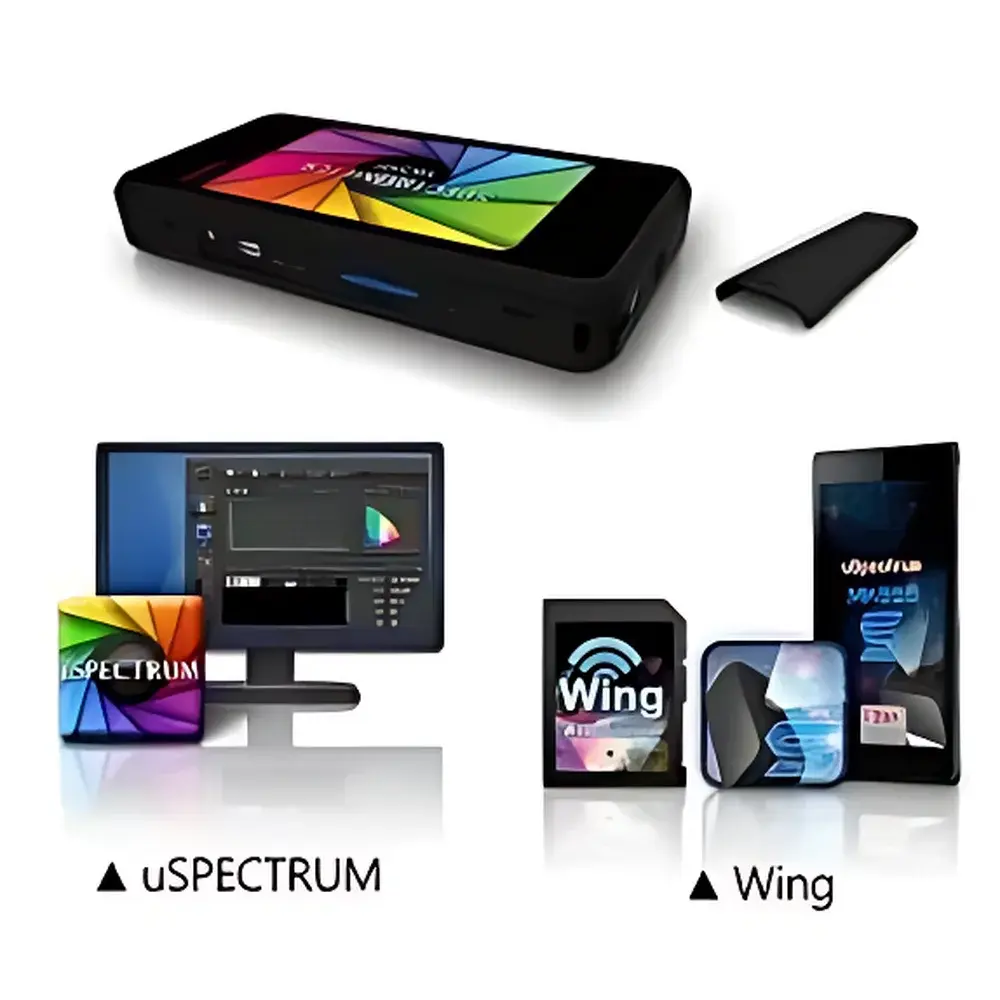
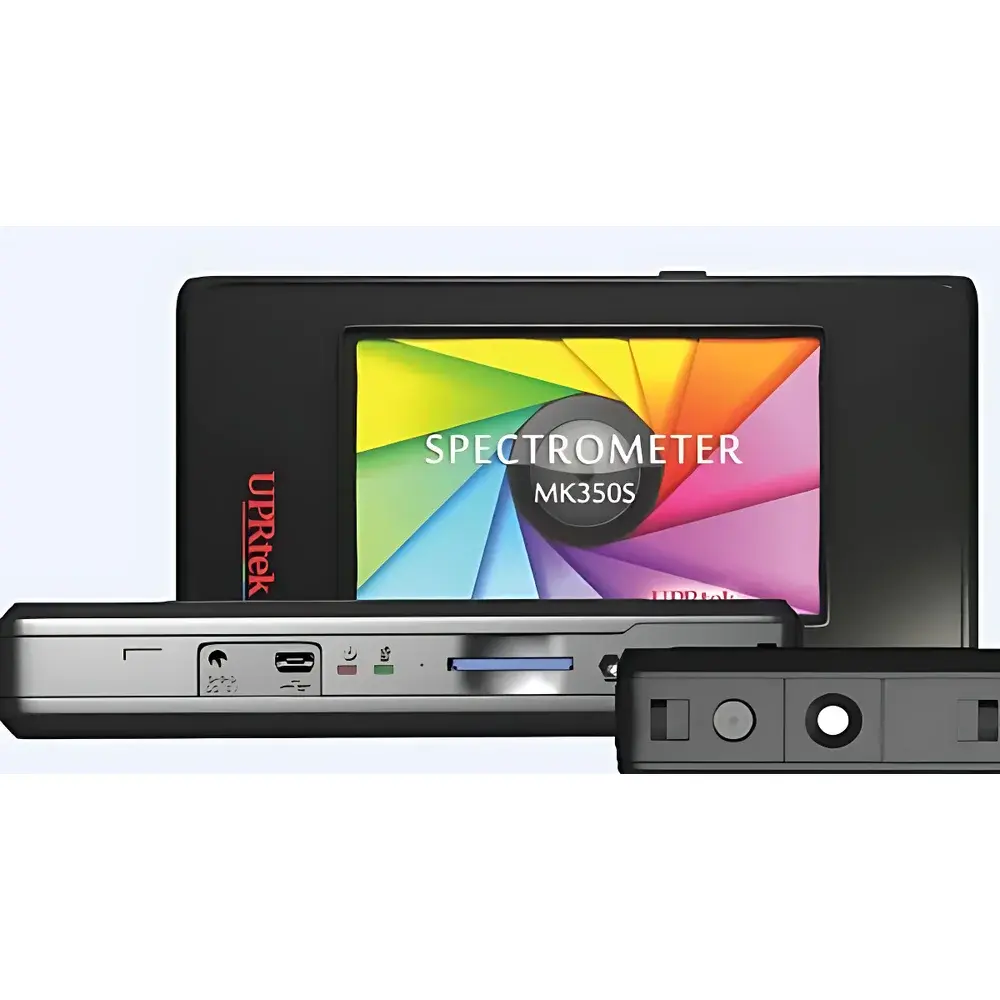
UpTek MK350S Handheld Spectroradiometer and Imaging Photometer
| Brand | UpTek |
|---|---|
| Origin | USA |
| Model | MK350S |
| Display | 3.5″ capacitive touchscreen |
| Measurement Modes | Single-shot, continuous (1 Hz update rate) |
| Spectral Range | 380–780 nm |
| Spectral Resolution | ≤ 5 nm |
| Illuminance Range | 0.01–99,999 lux |
| CCT Range | 1,000–100,000 K |
| Color Spaces | CIE 1931 xy, CIE 1976 u’v’ |
| Data Storage | microSD card (up to 32 GB) |
| Output Formats | CSV, Excel (.xlsx), BMP |
| Connectivity | Wi-Fi (iOS/Android app support), USB-C |
| Calibration Compliance | NML/CMS traceable |
| Dark Calibration | Auto-executable on startup |
| Operating Temperature | 5–35 °C |
| Battery Life | ≥ 6 hours (Li-ion rechargeable) |
Overview
The UpTek MK350S is a field-deployable handheld spectroradiometer integrating high-fidelity spectral acquisition with real-time imaging photometry. Engineered for precision in situ optical characterization, it employs a cooled linear CCD array coupled with a precision diffraction grating to deliver calibrated spectral irradiance data across the visible range (380–780 nm). Unlike conventional illuminance meters or tristimulus colorimeters, the MK350S captures full spectral power distribution (SPD) — enabling rigorous photometric, radiometric, and colorimetric analysis without reliance on PC-based software. Its dual-function architecture combines a Class A spectroradiometer per CIE S 023/E:2013 and an imaging photometer with spatial resolution sufficient to map luminance distribution across planar surfaces — making it uniquely suited for validation of lighting design intent against physical installation.
Key Features
- Integrated 3.5″ capacitive touchscreen interface with intuitive icon-driven workflow — no external computer required for operation or real-time visualization.
- Simultaneous spectral acquisition and video-based luminance mapping (Lux.G imaging photometry), enabling side-by-side comparison of simulated (e.g., DIALux) and measured light distributions.
- Full compliance with IES TM-30-15 methodology: calculates both fidelity index (Rf) and gamut index (Rg) from measured SPDs using the official 99-color evaluation set; supports comparative analysis against legacy CIE Ra.
- Comprehensive photobiological metrics: PPF (Photosynthetic Photon Flux, 400–700 nm) and PPFD (Photosynthetic Photon Flux Density) for horticultural lighting assessment.
- Transmittance measurement capability (with optional optical path adapter) for evaluating blue-light hazard mitigation in LED sources per IEC 62471.
- Wi-Fi-enabled remote control and data streaming to iOS and Android devices via dedicated UpTek FieldView™ app — supports live dashboarding, geotagged logging, and over-the-air firmware updates.
- On-device dark calibration routine aligned with NML/CMS metrological traceability requirements; recommended at power-on and after ambient temperature shifts >5°C.
Sample Compatibility & Compliance
The MK350S is validated for direct measurement of self-luminous sources including LED, OLED, and fluorescent luminaires under steady-state or pulsed operation (with selectable integration time from 10 ms to 10 s). It meets the spectral responsivity requirements of CIE Publication S 023/E:2013 for Class A spectroradiometers and adheres to photometric accuracy tolerances defined in ISO/CIE 19476:2014. For regulatory and quality assurance applications, its data export formats (CSV, Excel .xlsx) support audit-ready documentation compatible with GLP/GMP workflows. The instrument’s firmware implements secure timestamping and user-accessible metadata fields (location, operator ID, notes), satisfying foundational requirements for FDA 21 CFR Part 11–aligned electronic records where local policy permits.
Software & Data Management
All measurements are stored locally on removable microSD cards (1–32 GB) with automatic file naming, time/date stamping, and folder-based project organization. Exported datasets include raw spectral curves (nm vs. µW/cm²/nm), calculated metrics (CCT, CRI, Rf/Rg, x,y/u’,v’, peak/dominant wavelength), and BMP-formatted luminance heatmaps. The UpTek FieldView™ mobile application provides synchronized visualization, basic statistical reporting (min/max/avg/std dev across continuous sessions), and cloud upload via encrypted HTTPS. For laboratory integration, the MK350S supports USB-C mass storage mode and direct CSV ingestion into MATLAB, Python (NumPy/Pandas), or industry-standard lighting simulation platforms.
Applications
- Architectural lighting commissioning: verifying uniformity, glare control, and color consistency against design specifications on-site.
- Theatrical and entertainment lighting QA: validating gel-filter performance, LED mixing accuracy, and temporal stability during cue transitions.
- Horticultural lighting optimization: quantifying photosynthetically active radiation (PAR) distribution and spectral balance across growth zones.
- LED product development labs: rapid prototyping feedback for binning, phosphor formulation, and thermal derating studies.
- Human-centric lighting (HCL) validation: measuring circadian stimulus (CS), melanopic EDI, and spectral irradiance profiles per CIE TN 003:2015.
- Educational and research settings: hands-on instruction in photometry, color science, and spectral analysis principles.
FAQ
Does the MK350S require annual recalibration?
While not mandated annually, UpTek recommends recalibration every 12 months or after exposure to mechanical shock, extreme thermal cycling (>40°C), or significant humidity changes — especially when used in regulated environments. Certificate of Conformance with NML/CMS-traceable reference standards is provided at time of shipment.
Can the MK350S measure pulsed or modulated light sources?
Yes — adjustable integration time (10 ms to 10 s) and trigger-synchronization mode enable accurate SPD capture of PWM-driven LEDs and stroboscopic fixtures, provided modulation frequency is below Nyquist limit for selected integration window.
Is TM-30-15 analysis performed onboard or only in post-processing software?
All TM-30-15 calculations (Rf, Rg, color vector graphics, fidelity/gamut maps) are executed in real time on the device’s embedded processor and displayed immediately alongside CIE Ra and spectral plots.
What is the angular acceptance of the imaging photometer function?
The Lux.G imaging photometer features a 32° horizontal × 24° vertical field of view (FOV) with f/2.0 lens; effective spatial resolution is ~0.5° per pixel at 1 m working distance.
Does the instrument support third-party spectral database import (e.g., LUX, IESNA files)?
No — the MK350S operates as a measurement-only platform and does not import or simulate spectral data. However, exported CSV files are fully compatible with external modeling tools supporting standard spectral format conventions.





