
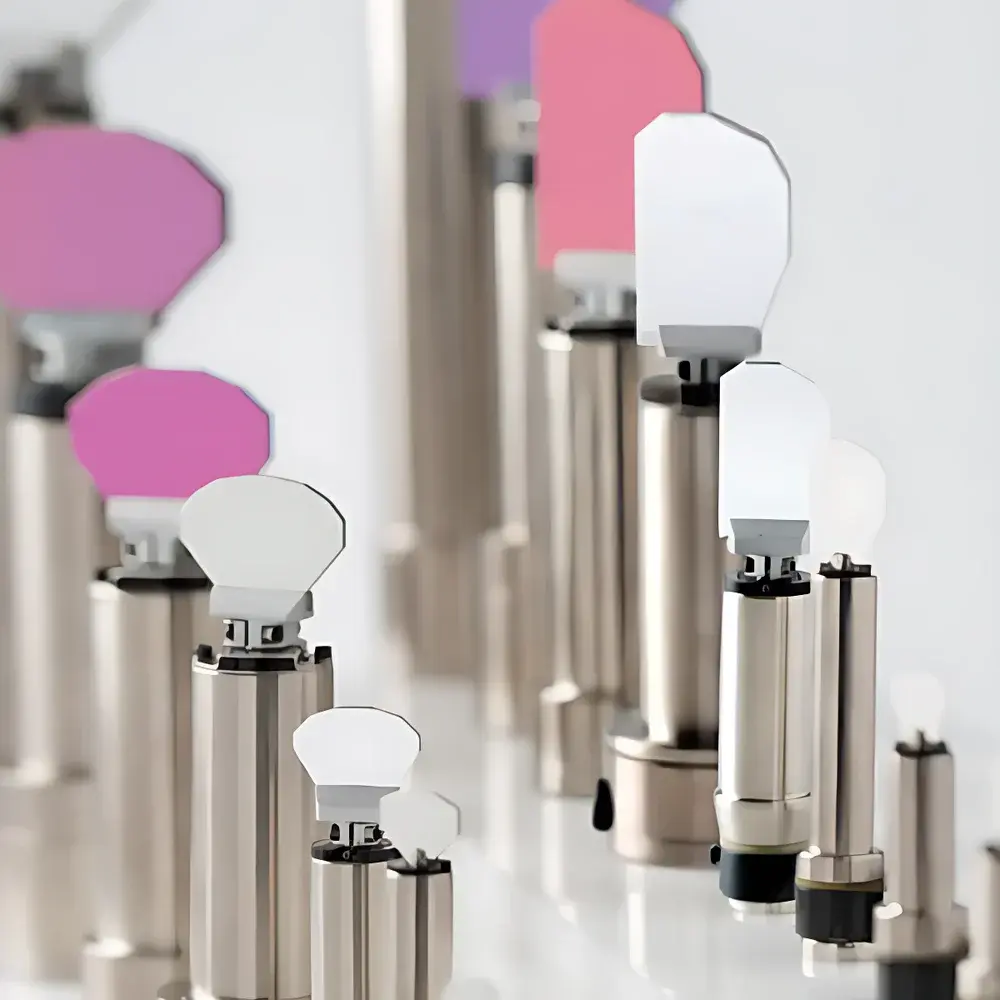
Novanta Cambridge Technology 62xx-83xx High-Speed Galvanometer Scanning Mirror Modules
| Brand | Novanta |
|---|---|
| Origin | United Kingdom |
| Manufacturer Type | Authorized Distributor |
| Origin Category | Imported |
| Model | 62xx-83xx High-Speed Galvanometer Scanning Mirror Modules |
| Pricing | Upon Request |
| Mirror Aperture Range | 3–100 mm |
| Wavelength Options | 355 nm / 532 nm / 1030–1080 nm / 9.4–10.6 µm |
| Broadband Coating Range | 350 nm – 12 µm |
| Max Scan Angle | ±20° (optical, 40° total) |
| Controller Compatibility | Analog (671/672/673), Digital (DC900, DC3000 Plus) |
| Rotor Inertia | 0.013–47.5 g·cm² (±10%) |
| Torque Constant | 1.20×10⁴–8.5×10⁵ dyne·cm/A (±10%) |
| Max Rotor Temperature | 110 °C |
| Thermal Resistance (Rotor-to-Housing) | 0.2–3.8 °C/W |
| Coil Resistance | 0.60–3.7 Ω (±10%) |
| Coil Inductance | 52–530 µH (±10%) |
| Back EMF | 20.9–1480 µV/s (±10%) |
| Max RMS Current (at 50 °C housing) | 2.3–12 A |
| Peak Current | 6–40 A |
| Mass | 13.3–1200 g |
| Position Linearity | ≥99.9% (typ. 99.5%) over ±20° scan |
| Short-Term Repeatability | 8 µrad |
| Output Signal (Standard Mode) | 155 µA (±25%) at 25 mA AGC current |
| Output Signal (Differential Mode) | 12 µA/° (±5%) referenced to 155 µA standard-mode output |
| Scale Drift (62xxK) | ≤50 ppm/°C |
| Scale Drift (83xxK) | ≤15 ppm/°C |
| Zero Drift (62xxK) | ≤15 µrad/°C |
| Zero Drift (83xxK) | ≤5 µrad/°C |
Overview
The Novanta Cambridge Technology 62xx-83xx High-Speed Galvanometer Scanning Mirror Modules represent a benchmark in precision optical beam steering for industrial and scientific laser applications. Engineered using proprietary position-sensing and closed-loop servo control architecture, these galvanometers deliver industry-leading scan speeds while maintaining exceptional thermal stability, positional fidelity, and long-term repeatability. Based on the proven moving-magnet galvanometer principle, each module integrates a high-stiffness torsion spring, low-inertia rotor assembly, and integrated photodiode-based position detection—enabling real-time feedback with sub-microradian resolution. The 62xxK series provides optimized performance for high-throughput marking, welding, and general-purpose scanning, whereas the 83xxK series incorporates enhanced thermal management and refined mechanical design to suppress scale and zero-point drift—making it suitable for demanding applications such as femtosecond laser micromachining, adaptive optics alignment, and wide-field confocal imaging where environmental sensitivity must be minimized.
Key Features
- Ultra-low thermal drift: 83xxK modules achieve ≤15 ppm/°C scale drift and ≤5 µrad/°C zero drift—critical for process consistency in temperature-variable cleanrooms or unregulated industrial environments.
- Closed-loop position sensing: Integrated PSD (Position-Sensitive Detector) or quadrant photodiode architecture ensures linearity ≥99.9% over ±20° optical scan range and ≥99.5% over full ±20° (40° total) field—validated per ISO 21088:2018 for angular measurement systems.
- Modular mirror compatibility: Supports interchangeable mirrors from 3 mm to 100 mm clear aperture, with customizable broadband dielectric coatings covering 350 nm – 12 µm—enabling seamless integration across UV, visible, NIR, and CO₂ laser platforms.
- Controller-agnostic interface: Fully compatible with analog controllers (e.g., CTI 671/672/673) and digital servo drives (DC900, DC3000 Plus), supporting both voltage-driven (±10 V) and current-driven (±25 mA) command inputs with standardized TTL synchronization I/O.
- Robust thermal architecture: Optimized heat path design achieves thermal resistance as low as 0.2 °C/W (8360K), enabling stable operation under sustained peak-current duty cycles without active cooling—validated per IEC 60068-2-14 for thermal shock resilience.
- High torque-to-inertia ratio: Rotor inertia ranges from 0.013 g·cm² (6200K) to 47.5 g·cm² (8350K), paired with torque constants up to 8.5×10⁵ dyne·cm/A—ensuring rapid settling (<100 µs typical for small-angle steps) and minimal overshoot in dynamic scanning profiles.
Sample Compatibility & Compliance
These modules are designed for integration into Class 1, 1M, 4 laser safety-compliant systems per IEC 60825-1:2014 and ANSI Z136.1-2022. Mirror substrates accommodate fused silica, silicon, and molybdenum optics with AR/HR coatings certified to MIL-C-48497A and ISO 13697:2020 specifications. All 62xx-83xx variants meet RoHS 2015/863/EU and REACH SVHC compliance requirements. Mechanical mounting follows ISO 80000-4:2019 dimensional conventions, with standardized M3 and M4 threaded holes for repeatable kinematic alignment. For regulated manufacturing environments, optional firmware logging and controller-level audit trails support FDA 21 CFR Part 11 electronic record integrity when used with validated DC3000 Plus controller configurations.
Software & Data Management
No proprietary host software is required—modules operate transparently via standard analog/digital interfaces. However, Novanta provides open SDKs (C/C++, .NET, LabVIEW) for DC-series controllers, enabling full access to real-time position feedback, thermal diagnostics, and servo gain tuning. Raw position signals (155 µA standard mode; 12 µA/° differential mode) are directly compatible with high-speed DAQ systems (e.g., National Instruments PXIe-6368) sampling at ≥1 MS/s. All controller firmware supports non-volatile parameter storage, cyclic redundancy checksum validation, and configurable watchdog timeouts—ensuring deterministic behavior during extended unattended operation in GLP/GMP-aligned production lines.
Applications
- Laser material processing: High-speed vector scanning for selective laser melting (SLM), thin-film ablation, and PCB micro-drilling with <10 µm spot placement accuracy.
- Biomedical instrumentation: Beam steering in multiphoton microscopy, OCT light delivery, and optogenetic stimulation systems requiring sub-10 µrad pointing stability over multi-hour sessions.
- Defense & aerospace: Target illumination, LIDAR beam steering, and free-space optical communication terminals operating under vibration and thermal cycling per MIL-STD-810H.
- Display & metrology: Laser projection calibration, structured light generation, and interferometric surface profiling where scan linearity directly impacts measurement traceability to NIST SRM standards.
- Quantum technologies: Cavity alignment, atomic beam deflection, and ion trap addressing—leveraging low-noise position feedback and minimal electromagnetic interference (EMI) per CISPR 32 Class B limits.
FAQ
What is the difference between 62xxK and 83xxK series modules?
The 83xxK series features improved thermal compensation design—including low-expansion materials and symmetric thermal mass distribution—reducing scale drift to ≤15 ppm/°C and zero drift to ≤5 µrad/°C versus ≤50 ppm/°C and ≤15 µrad/°C for 62xxK. This makes 83xxK preferred for applications requiring long-term absolute angle stability.
Can these galvanometers be used with ultrafast lasers?
Yes—when paired with appropriate HR-coated mirrors (e.g., 1030 nm, 1.5 kHz for 6200K; >300 Hz for 8350K) and low jitter (<2 µrad RMS) support precise pulse-on-target positioning in femtosecond machining systems.
Is active cooling required?
No—thermal resistance values down to 0.2 °C/W (8360K) and maximum rotor temperature rating of 110 °C enable passive conduction cooling in most OEM enclosures. Forced-air cooling is only recommended for continuous peak-current operation exceeding 80% duty cycle.
How is position linearity verified?
Linearity is measured using autocollimator-based angular metrology traceable to NPL (UK) primary standards, per ISO 21088 Annex D. Results are provided in individual calibration certificates, including residual error maps over full scan range.
Do you offer custom mirror mounting or coating options?
Yes—Novanta’s Cambridge Technology division offers engineering support for custom kinematic mounts, vacuum-compatible versions (UHV-rated to 10⁻⁹ mbar), and application-specific coatings—including ultra-low-absorption HR stacks for kW-class CW lasers and chirped mirrors for dispersion compensation.




