
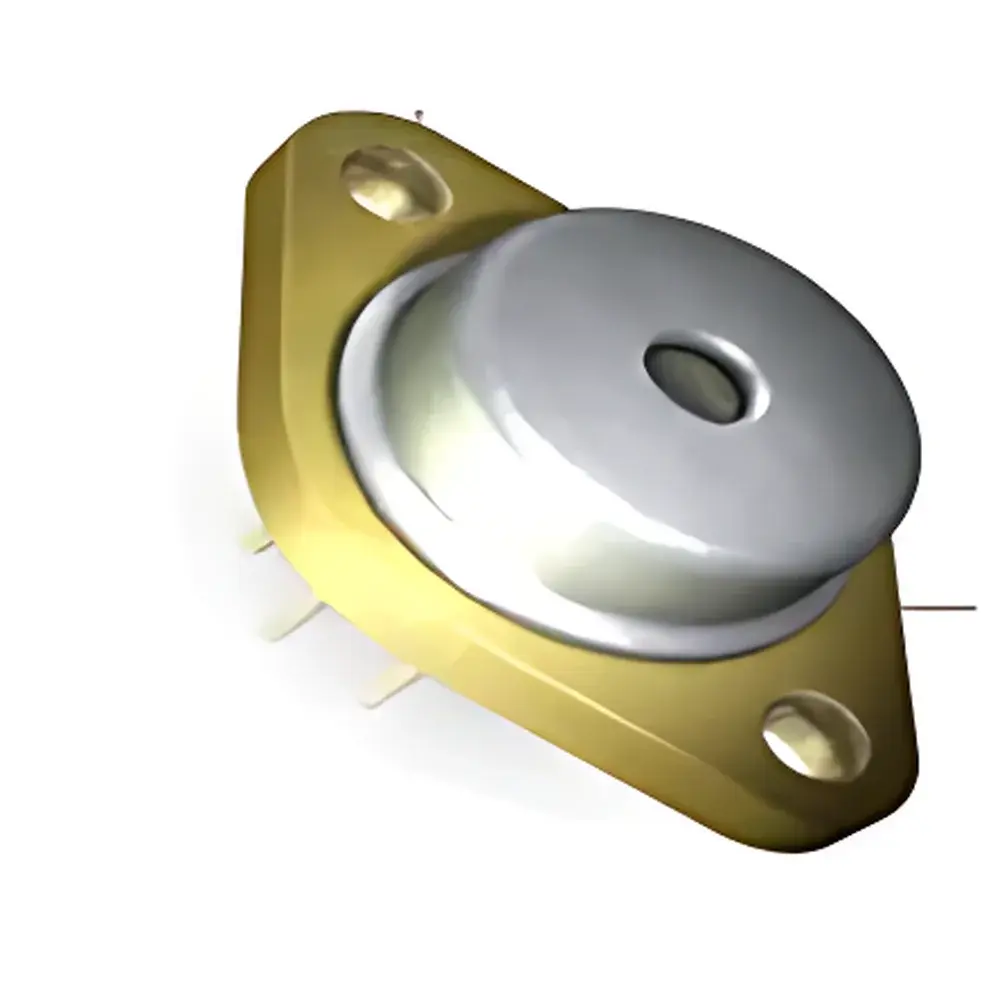
DFB and DBR Laser Diodes
| Brand | FLC |
|---|---|
| Origin | USA |
| Type | Distributed Feedback (DFB) and Distributed Bragg Reflector (DBR) Semiconductor Laser Diodes |
| Wavelength Range | 689–3400 nm |
| Output Power | 1–150 mW |
| Package Options | TO-can, Butterfly, and Fiber-Pigtailed Modules |
| Operating Temperature Range | −40 °C to +85 °C |
| Spectral Linewidth | < 3 MHz (typ.) |
| Side Mode Suppression Ratio (SMSR) | > 50 dB |
| Tuning Capability | Current- and Temperature-Tunable |
| Compliance | RoHS, CE, ISO 9001 Certified Manufacturing |
Overview
DFB (Distributed Feedback) and DBR (Distributed Bragg Reflector) laser diodes are single-frequency semiconductor lasers engineered for high spectral purity, narrow linewidth, and exceptional wavelength stability. Unlike Fabry–Pérot lasers, DFB and DBR devices integrate a built-in periodic grating structure directly into the active waveguide region (DFB) or adjacent passive section (DBR), enabling robust longitudinal mode selection without external cavity components. This monolithic design ensures intrinsic single-mode operation, making them ideal for high-resolution spectroscopic applications where precise, drift-free optical frequency control is critical—particularly in trace gas detection, fiber-optic sensing, and coherent communication testbeds.
Key Features
- Monolithic single-longitudinal-mode (SLM) emission with side-mode suppression ratio (SMSR) exceeding 50 dB, ensuring minimal mode competition and stable output under varying drive conditions.
- Wide wavelength coverage spanning 689 nm (visible red) to 3400 nm (mid-infrared), supporting applications across atomic spectroscopy (e.g., Rb, Cs, Ca lines), methane/CO2/NH3 detection, and nonlinear frequency conversion.
- Output power range of 1–150 mW, scalable via thermally optimized chip mounting and integrated TEC control—enabling direct use in absorption spectroscopy or as pump sources for difference-frequency generation (DFG) and optical parametric oscillators (OPOs).
- Low intrinsic linewidth (< 3 MHz typical) and high current/temperature tuning sensitivity (0.01 nm/mA and 0.1 nm/°C), facilitating fine spectral scanning and lock-in detection schemes.
- Multiple packaging configurations—including industry-standard 5.6 mm TO-cans, 14-pin butterfly modules with integrated thermistor and TEC, and polarization-maintaining (PM) fiber-pigtailed variants—supporting integration into OEM instrumentation and field-deployable sensor platforms.
- Manufactured under ISO 9001-certified processes; all units undergo burn-in, spectral characterization, and reliability screening per Telcordia GR-468-CORE standards.
Sample Compatibility & Compliance
These laser diodes are compatible with standard optical breadboards, fiber-coupled spectrographs (e.g., Ocean Insight, Thorlabs), and commercial wavelength meters (Bristol 621, HighFinesse WS7). They interface seamlessly with PID-controlled laser drivers (e.g., ILX Lightwave LDC-3900 series) and temperature controllers supporting analog modulation inputs. All devices comply with RoHS Directive 2011/65/EU and CE marking requirements for electromagnetic compatibility (EMC Directive 2014/30/EU) and low voltage safety (LVD Directive 2014/35/EU). For regulated environments—including environmental monitoring stations and pharmaceutical process analytical technology (PAT) deployments—the lasers support audit-ready calibration documentation and can be qualified under GLP and GMP-aligned workflows when paired with NIST-traceable wavelength references.
Software & Data Management
While the diodes themselves are hardware-only components, they are fully supported by industry-standard instrumentation control frameworks. FLC provides detailed datasheets, spectral tuning maps, and thermal derating curves in CSV and PDF formats. Integration with LabVIEW, Python (via PyVISA or instrument-specific SDKs), and MATLAB is straightforward using SCPI-compatible laser drivers. For long-term deployment, users may implement automated wavelength stabilization using feedback from external wavemeters or saturated absorption cells—enabling closed-loop operation compliant with FDA 21 CFR Part 11 requirements when paired with electronic audit trail logging software.
Applications
- Trace Gas Sensing: Tunable diode laser absorption spectroscopy (TDLAS) systems for ppm- to ppb-level detection of CH4, CO, H2O, NOx, and isotopic species (e.g., 13CH4) in industrial emissions monitoring and atmospheric research.
- Fiber Optic Sensing: Interrogation sources for fiber Bragg grating (FBG) arrays and distributed acoustic sensing (DAS) systems requiring narrow-linewidth coherence over kilometer-scale fiber paths.
- Nonlinear Optics: Fundamental pumps for second-harmonic generation (SHG) in PPLN waveguides and optical parametric amplification (OPA) in orientation-patterned GaAs (OP-GaAs).
- Atomic Physics: Cooling and trapping lasers for alkali atoms (Rb at 780 nm, Cs at 852 nm) and optical lattice clocks operating near 689 nm (Sr intercombination line).
- Calibration & Metrology: Reference sources in optical frequency combs, heterodyne interferometers, and cavity ring-down spectroscopy (CRDS) platforms requiring sub-MHz frequency stability.
FAQ
What distinguishes DFB from DBR laser diodes?
DFB lasers incorporate the Bragg grating within the gain medium, providing superior mode stability and higher SMSR under high-power operation. DBR lasers separate the grating into a passive section, enabling wider continuous tuning ranges and easier integration with modulators—but typically with slightly lower SMSR than DFB counterparts.
Can these lasers be used in free-space optical setups?
Yes—TO-can and butterfly packages include collimated or aspheric-coupled output options. For free-space alignment, we recommend coupling into adjustable kinematic mounts with integrated IR viewers for wavelengths beyond 1000 nm.
Do you provide wavelength calibration certificates?
Upon request, FLC supplies individual unit calibration reports traceable to NIST SRM 2520 (laser wavelength standard), including measured center wavelength, full-width-at-half-maximum (FWHM), and SMSR at specified operating points.
Is electro-optic modulation supported?
The diodes are DC-current driven and not designed for high-speed direct modulation. For GHz-range modulation, external Mach–Zehnder modulators (e.g., Thorlabs LN82S-FC) are recommended in master-oscillator–power-amplifier (MOPA) configurations.
What thermal management is required for continuous-wave operation?
All butterfly and fiber-pigtailed modules include integrated thermoelectric coolers (TECs). Stable CW operation requires a driver with dual-loop control (current + temperature) and heat sinking capable of dissipating ≥3 W at maximum drive conditions.




