
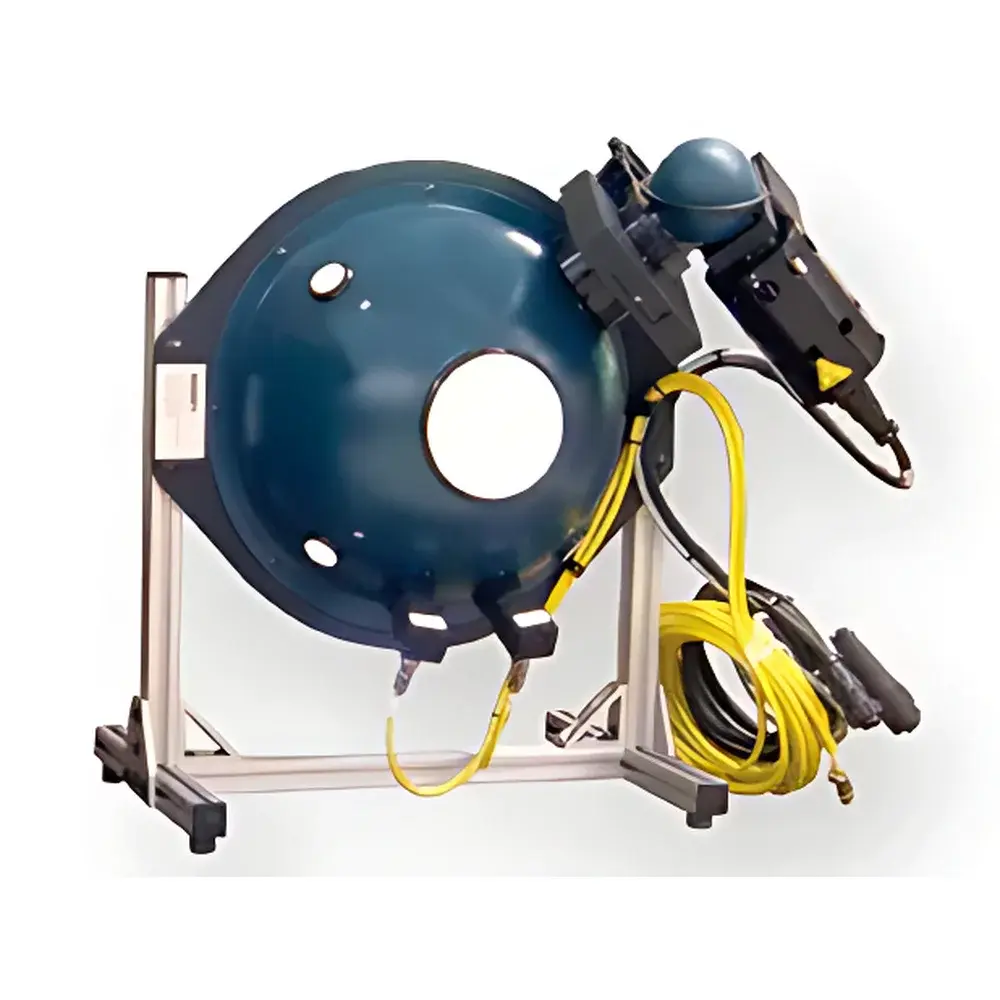
LabSphere USS-1200LL Low-Luminance Uniform Light Source System
| Brand | LabSphere |
|---|---|
| Origin | USA |
| Manufacturer Type | Authorized Distributor |
| Origin Category | Imported |
| Model | USS-1200LL |
| Pricing | Upon Request |
Overview
The LabSphere USS-1200LL Low-Luminance Uniform Light Source System is an engineered optical calibration platform designed to generate spatially uniform, spectrally stable, and precisely controllable low-intensity light fields. Operating on the principle of integrating sphere-based diffusion and collimated output conditioning, the system delivers radiometrically traceable irradiance levels ranging continuously from near-darkness (sub-10−5 W/m²) up to 10−1 W/m² — enabling faithful simulation of natural low-light environments such as starlight, moonlight, or bioluminescent emission. Its core architecture incorporates a thermally stabilized broadband tungsten-halogen source coupled with high-reflectance Spectralon® coating (>99% reflectance, 250–2500 nm), ensuring exceptional spatial uniformity (<±0.2% across output port) and temporal stability (<±0.15% over 8 hours). The USS-1200LL serves as a primary reference for absolute radiometric and photometric calibration of ultra-sensitive imaging systems, including scientific CMOS, EMCCD, and ICCD cameras used in fluorescence lifetime imaging (FLIM), single-molecule detection, and low-light spectral analysis.
Key Features
- Integrating sphere-based illumination delivering <±0.2% spatial uniformity at the output port, verified per ISO 9050 and CIE S 014/E:2006 standards
- Continuous luminance control from 10−5 to 10−1 W/m² (at 550 nm), achieved via motorized neutral density filter wheel and precision current-regulated lamp driver
- Integrated multi-position filter turret supporting up to six user-replaceable bandpass, longpass, or custom interference filters (25 mm diameter, mounted in SM1-threaded holders)
- Automated control interface via USB 2.0 and Ethernet (TCP/IP), compatible with LabVIEW™, Python (PyVISA), and MATLAB® scripting environments
- NIST-traceable factory calibration certificate included, covering spectral irradiance (W/m²/nm), total radiant flux (W), and photopic luminance (cd/m²) across the visible and NIR range (380–1050 nm)
- Thermal management system maintaining lamp color temperature stability within ±15 K over extended operation, critical for reproducible quantum efficiency validation
Sample Compatibility & Compliance
The USS-1200LL accommodates standard optical interfaces including C-mount, F-mount, and Ø25.4 mm lens adapters, facilitating direct coupling to microscope ports, spectrograph entrance slits, or camera objective mounts. It supports calibration workflows compliant with ASTM E308-23 (computing tristimulus values), ISO/IEC 17025:2017 (requirements for calibration laboratories), and FDA 21 CFR Part 11 (electronic records and signatures) when integrated with validated software environments. All delivered calibration data include uncertainty budgets per GUM (Guide to the Expression of Uncertainty in Measurement) and are documented with full chain-of-traceability to NIST Standard Reference Materials (SRMs) 2020, 2030, and 2065.
Software & Data Management
The system ships with LightSource Control Suite v3.2 — a Windows-based application enabling synchronized control of lamp power, ND filter position, filter selection, and shutter state. The software logs all operational parameters (timestamp, setpoint, measured output, ambient temperature, lamp hours) into encrypted SQLite databases, supporting GLP-compliant audit trails. Export options include CSV, HDF5, and XML formats with embedded metadata conforming to the IEEE 1851-2022 standard for optical measurement data interchange. Remote API access allows integration into automated test sequences governed by IEC 61508 functional safety protocols for regulated pharmaceutical QC environments.
Applications
- Calibration and linearity verification of low-light detectors in flow cytometry and confocal microscopy platforms
- Validation of dark current, read noise, and photon transfer curves in sCMOS sensors used in super-resolution imaging
- Traceable intensity scaling for quantitative fluorescence assays in drug discovery pipelines (e.g., high-content screening under physiologically relevant illumination)
- Reference source for inter-laboratory comparison studies in ophthalmic device testing (ISO 15004-2) and retinal illuminance modeling
- Stimulus generation in vision science experiments requiring controlled scotopic and mesopic luminance levels (CIE 191:2010)
FAQ
Is the USS-1200LL suitable for calibrating EMCCD cameras operating below 1 e−/pixel/s?
Yes — its minimum calibrated output corresponds to ~0.05 e−/pixel/s on a typical back-illuminated EMCCD with 95% QE and 6.5 µm pixel pitch.
Can the system be operated in a Class 100 cleanroom environment?
The enclosure meets ISO 14644-1 Class 5 particulate limits when installed with optional HEPA-filtered purge inlet; full cleanroom qualification documentation available upon request.
Does the NIST traceability cover both spectral and spatial uniformity?
Yes — the certificate includes spectral irradiance measurements at five wavelengths and spatial uniformity mapping performed at three intensity levels using a calibrated CCD-based imaging radiometer.
What is the recommended recalibration interval?
LabSphere recommends annual recalibration against NIST-traceable references; drift monitoring is supported via built-in reference photodiode and scheduled self-test routines.
Are custom spectral outputs (e.g., narrowband 488 nm) supported without external monochromators?
Yes — the filter turret accepts off-the-shelf 10 nm FWHM bandpass filters; custom coatings with OD6 blocking and <0.1 nm out-of-band leakage can be procured through LabSphere’s OEM services.




