
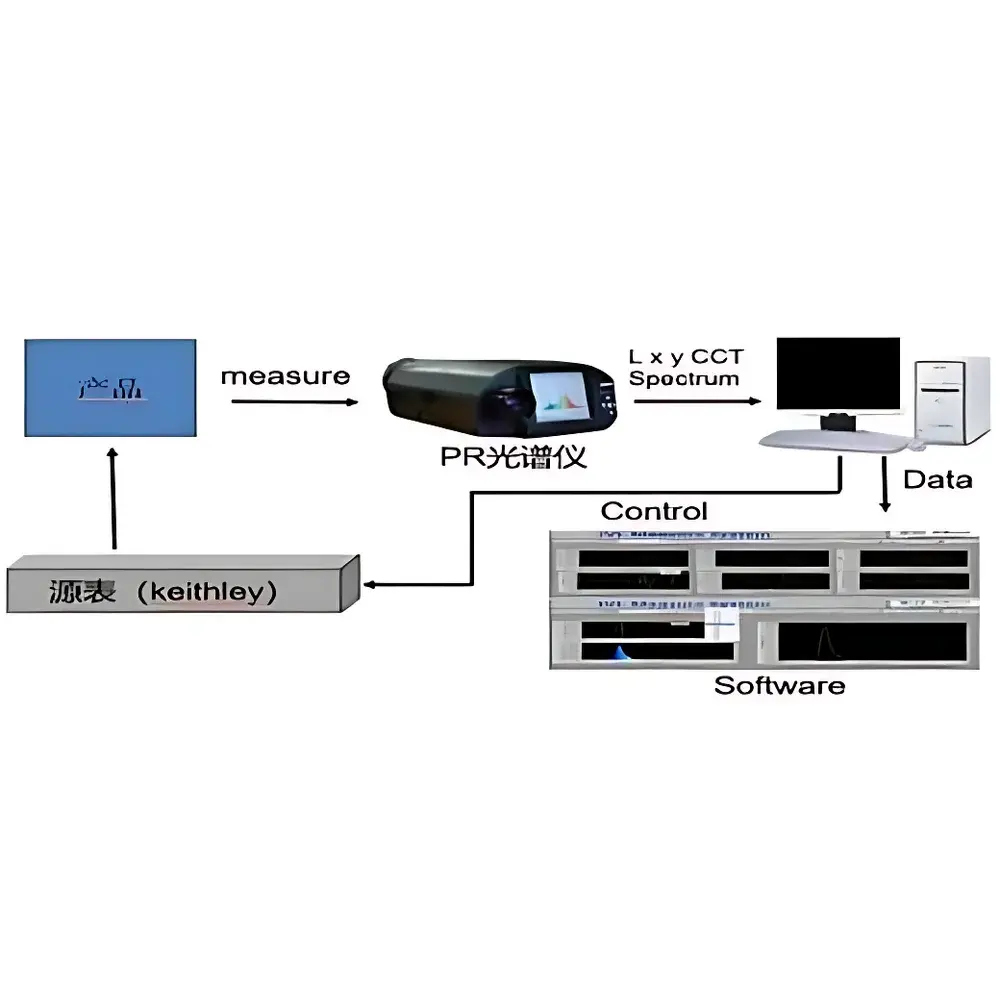
OLED Multi-Sample IVL Testing System
| Brand | TEO |
|---|---|
| Origin | Beijing, China |
| Model | Multi-Sample IVL |
| Price Range | USD 28,000 – 42,500 |
| Category | Optical Measurement Instrument for Emission Characterization of OLED Devices |
Overview
The OLED Multi-Sample IVL Testing System is a dedicated optical metrology platform engineered for high-throughput, repeatable characterization of current–voltage–luminance (IVL) performance and angular luminance distribution of organic light-emitting diode (OLED) devices. It operates on the fundamental principle of synchronized electrical stimulation and photometric acquisition: a precision source-measure unit (SMU) applies controlled DC or pulsed bias across multiple OLED samples while calibrated silicon photodiodes and/or spectroradiometric sensors capture absolute luminance (cd/m²), chromaticity (CIE x,y), and spectral power distribution (SPD) under programmable viewing angles. The system supports both static and dynamic angular sweeps (±85° horizontal/vertical), enabling full Lambertian analysis and viewing-angle-dependent efficiency mapping—critical for display qualification in mobile, automotive, and foldable OLED applications.
Key Features
- Multi-sample parallel testing architecture: Accommodates up to 12 standard OLED substrates (e.g., 150 mm × 150 mm or custom carriers) simultaneously, with independent electrical addressing and optical path isolation to eliminate crosstalk.
- Automated CCD-based sample alignment: Integrated high-resolution monochrome CCD camera with real-time image processing algorithms performs sub-pixel (<5 µm) registration of device active areas relative to photodetector apertures—ensuring measurement repeatability across production lots.
- Motorized goniometric stage: Precision rotary-tilt mechanism enables fully programmable angular sampling at user-defined intervals (0.1°–5° resolution), compliant with CIE Publication 127 and IEC 62341-6-3 for OLED luminance uniformity assessment.
- Modular thermal management interface: Optional Peltier-based temperature control unit (−20°C to +85°C, ±0.3°C stability) integrates directly into the sample stage, supporting reliability testing under thermal stress per JEDEC JESD22-A104 and accelerated lifetime evaluation.
- Hardware-synchronized triggering: All SMU output, photodetector integration gating, and stage positioning are governed by a centralized FPGA-based timing controller—eliminating jitter-induced measurement uncertainty during transient response analysis (e.g., turn-on delay, rise time).
Sample Compatibility & Compliance
The system accepts rigid and flexible OLED substrates with active area dimensions ranging from 5 mm × 5 mm to 200 mm × 200 mm, including bottom-emission, top-emission, and transparent OLED configurations. Electrical interfaces support probe card, ZIF socket, and spring-pin fixtures compatible with industry-standard wafer-level and module-level test formats. Optical calibration traceability follows NIST-traceable standards via factory-certified reference lamps (e.g., FEL-type) and calibrated photodiodes (NIST SRM 2252). The platform complies with ISO/IEC 17025 requirements for testing laboratories and supports audit-ready documentation for GLP/GMP environments—including full electronic records retention, user access controls, and FDA 21 CFR Part 11–compliant electronic signatures when paired with optional software modules.
Software & Data Management
Control and analysis are executed via TEO’s proprietary IVL-Studio software suite (Windows 10/11, 64-bit), featuring a modular GUI with role-based permissions (Operator, Engineer, Admin). Core capabilities include automated IVL curve generation (log-scale I–V, linear L–V, EQE calculation), angular luminance polar plots, luminance uniformity heatmaps (per IEC 62341-6-1), and batch statistical reporting (Cp/Cpk, SPC charts). Raw data is stored in HDF5 format with embedded metadata (timestamp, operator ID, environmental conditions, calibration IDs), ensuring long-term interoperability and FAIR data principles adherence. Export options include CSV, XML, and PDF reports conforming to internal QA templates or customer-specific formats (e.g., AEC-Q200 Annex G).
Applications
- Process development and yield optimization in OLED material synthesis (host, emitter, transport layers)
- In-line electrical–optical binning during TFT backplane and encapsulation integration
- Viewing angle performance validation for curved, micro-display, and AR/VR micro-OLED panels
- Luminance degradation tracking under constant-current stress (DC aging) and pulse-width-modulated (PWM) drive conditions
- Correlation studies between electroluminescent spectra and color gamut coverage (NTSC, DCI-P3, Rec.2020)
FAQ
What sample formats does the system support beyond standard glass substrates?
It accommodates flexible polyimide (PI) substrates, thin-film encapsulated devices, and bare-chip OLEDs mounted on ceramic or metal carriers—provided mechanical rigidity permits stable vacuum chucking.
Is spectral measurement capability built-in or optional?
A modular spectroradiometer (380–780 nm, FWHM ≤ 2 nm) is available as an add-on; base configuration uses calibrated photopic V(λ)-matched silicon photodiodes.
Can the system export data directly to MES or SAP QM modules?
Yes—via OPC UA server interface or RESTful API, enabling bidirectional data exchange with enterprise manufacturing execution systems and quality management databases.
Does the system meet Class 1 laser safety requirements for integrated alignment lasers?
All internal alignment lasers (650 nm red diode) are Class 1 enclosed systems per IEC 60825-1:2014, requiring no external interlocks or operator training.
What is the typical recalibration interval recommended for photometric sensors?
Annual recalibration against NIST-traceable standards is recommended; in-house verification using reference lamps can be performed daily or per shift per ISO/IEC 17025 clause 5.9.




