
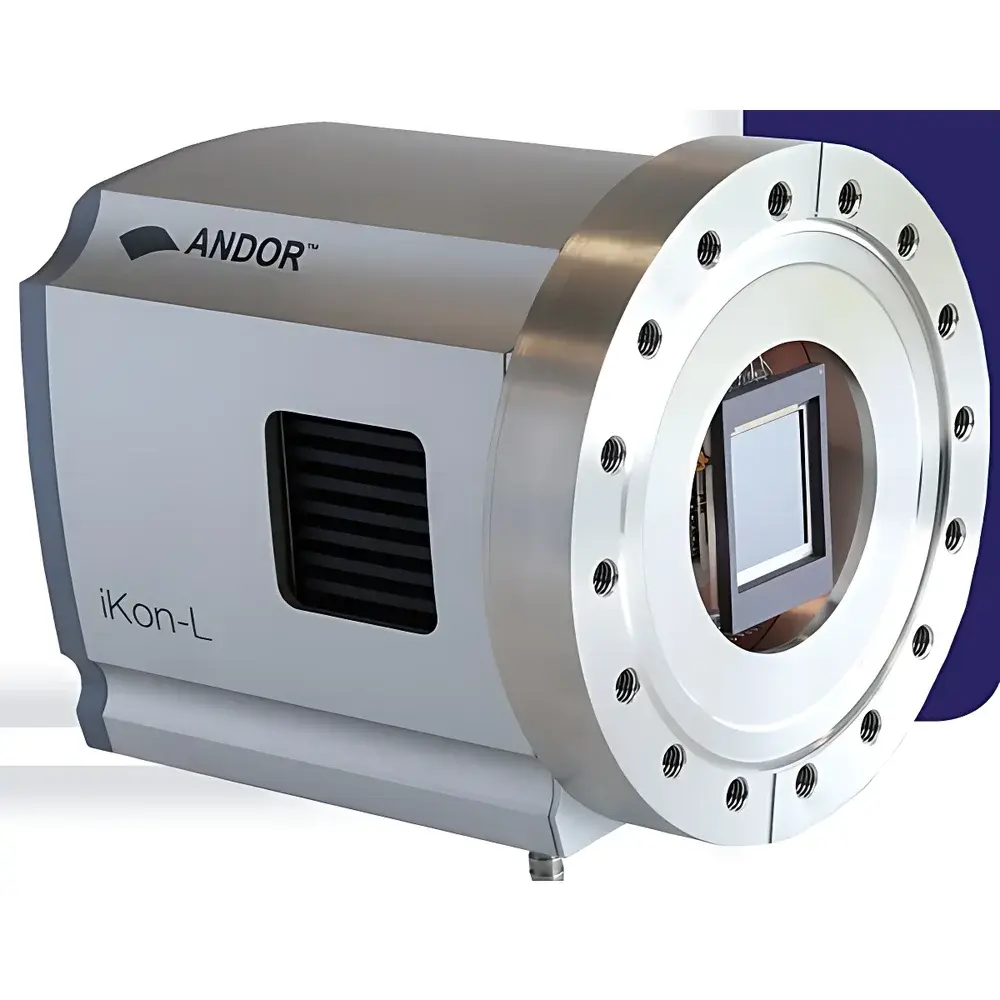
Andor Newton SO X-ray CCD Detector
| Brand | Andor |
|---|---|
| Model | Newton SO |
| Detector Type | Back-Illuminated, Deep-Depletion CCD |
| Vacuum Interface | 6-inch CF152 Conflat Flange (Rotatable Knife-Edge) |
| Quantum Efficiency | Up to 95% (at selected X-ray/EUV/VUV wavelengths) |
| Read Noise | <3 e⁻ RMS (typical, at slowest readout speed) |
| Cooling | Thermoelectric (TE) to –100°C (ambient-dependent) |
| Pixel Size | 13.5 µm |
| Readout Modes | Full Frame, Sub-Frame (Crop Mode), Multiple Region of Interest (ROI) |
| Maximum Frame Rate | >1,000 fps (in optimized Crop Mode) |
| Data Interface | USB 2.0 |
| Onboard Features | Integrated Filter Wheel Slot (mechanical, motorized optional), Shutter Control, Trigger I/O (TTL-compatible) |
| Compliance | CE, RoHS, UL/CSA recognized power supply |
Overview
The Andor Newton SO is a high-performance, vacuum-compatible back-illuminated CCD detector engineered specifically for demanding soft X-ray, extreme ultraviolet (EUV), and vacuum ultraviolet (VUV) spectroscopy applications. Unlike standard visible-light CCDs, the Newton SO integrates deep-depletion (DD), front-illuminated (FI), or borosilicate (BN)-coated sensor architectures—each optimized for distinct photon energy ranges and quantum efficiency profiles across 1–200 nm. Its core measurement principle relies on direct photoelectron generation in silicon under high-energy photon irradiation, followed by low-noise charge integration and digitization. The detector’s hermetic vacuum interface—featuring a rotatable 6-inch CF152 knife-edge flange—enables seamless integration into ultra-high vacuum (UHV) systems, synchrotron beamlines, plasma diagnostics chambers, and monochromator-based spectrometers. Designed for quantitative spectral radiometry and time-resolved line profiling, the Newton SO delivers high spatial resolution (13.5 µm pixels), exceptional signal fidelity, and long-term stability under continuous operation.
Key Features
- Vacuum-integrated architecture with rotatable 6-inch CF152 Conflat flange for flexible alignment and UHV compatibility (≤10⁻⁹ mbar)
- Selectable sensor options: Deep-depletion (DD) for enhanced red/NIR response and reduced fringing; front-illuminated (FI) for cost-effective EUV sensitivity; BN-coated variants for optimized soft X-ray quantum efficiency (QE up to 95% at 52.7 eV)
- Thermoelectric cooling to –100°C (dependent on ambient conditions), enabling sub-0.01 e⁻/pix/s dark current and minimizing thermal noise accumulation during long exposures
- Ultra-low read noise (<3 e⁻ RMS in slow-scan mode) achieved via correlated double sampling (CDS) and optimized clocking architecture
- Crop Mode operation supporting user-defined sub-regions for frame rates exceeding 1,000 fps—ideal for pump-probe experiments and transient plasma emission studies
- Integrated mechanical filter wheel slot accommodating up to 6 standard 25-mm filters; optional motorized version supports automated wavelength selection and background subtraction protocols
Sample Compatibility & Compliance
The Newton SO operates exclusively in vacuum-coupled configurations and is not intended for atmospheric or liquid-phase imaging. It is compatible with standard optical train components used in grazing-incidence spectrometers, toroidal mirror systems, and grating-based VUV monochromators. Sensor QE curves are traceably calibrated against NIST-traceable photodiodes for absolute radiometric accuracy. The system complies with CE marking requirements for electromagnetic compatibility (EMC Directive 2014/30/EU) and low-voltage safety (LVD Directive 2014/35/EU). Power supplies meet UL/CSA 61010-1 standards for laboratory instrumentation. While not FDA-certified, its data integrity features—including hardware timestamping, non-volatile configuration memory, and deterministic trigger latency—support GLP/GMP-aligned workflows where auditability is required.
Software & Data Management
Andor’s SOLIS software provides full native control of acquisition parameters, real-time image preview, spectral calibration, and multi-channel analysis. SOLIS supports TIFF, HDF5, and FITS export formats—ensuring interoperability with Python (Astropy, SciPy), MATLAB, and Igor Pro environments. All acquired datasets include embedded metadata: exposure time, temperature, sensor gain, ROI coordinates, and filter position. For regulated environments, SOLIS can be configured to generate electronic logs compliant with 21 CFR Part 11 requirements when deployed with appropriate network authentication and audit trail modules. Raw frame buffers are memory-mapped for zero-copy transfer, minimizing CPU overhead during high-speed acquisitions.
Applications
- Soft X-ray absorption spectroscopy (XAS) of transition metal L-edges in catalytic materials
- EUV lithography source metrology and spectral purity verification
- Time-resolved VUV emission from laser-produced plasmas and Z-pinch devices
- Atomic and molecular resonance fluorescence studies in beamline end-stations
- Calibration of synchrotron bending magnet and undulator spectra
- In situ monitoring of thin-film growth processes using reflection-mode VUV ellipsometry
FAQ
Is the Newton SO suitable for ambient-pressure optical microscopy?
No—the Newton SO requires vacuum coupling via its CF152 flange and is not rated for atmospheric operation.
Can the detector be used with pulsed X-ray sources such as XFELs?
Yes, when operated in external trigger mode with sub-microsecond jitter and programmable exposure gating, though single-shot dynamic range may require careful gain and binning optimization.
Does Andor provide NIST-traceable QE calibration data for each unit?
Yes—each Newton SO ships with a certified spectral responsivity curve measured at NIST-accredited facilities, referenced to Si photodiode standards.
What is the maximum sustainable vacuum pressure for continuous operation?
The detector maintains stable performance at pressures ≤1 × 10⁻⁹ mbar; bake-out capability up to 150°C is supported with proper flange conditioning.
Is remote operation over Ethernet supported?
USB 2.0 is the primary interface; Ethernet connectivity requires an external USB-over-IP bridge—Andor does not natively support GigE Vision or GenICam protocols.




