
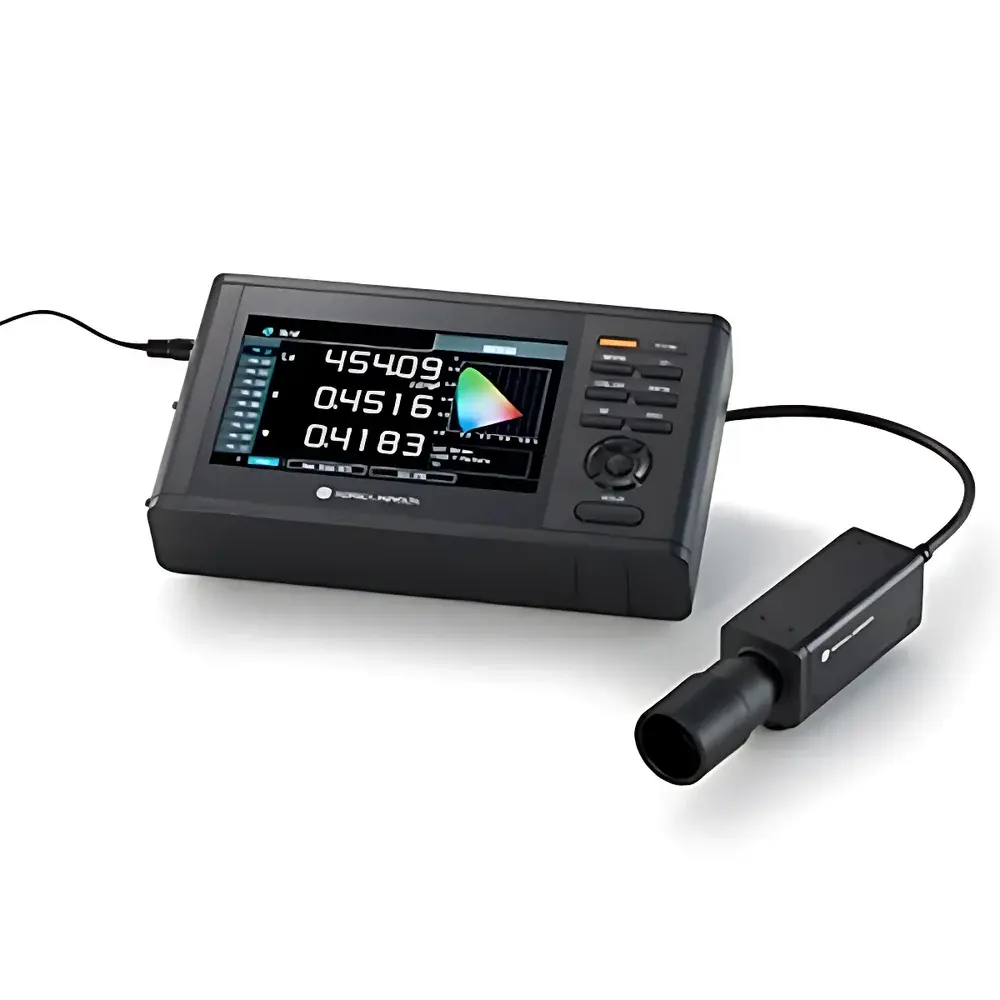
Konica Minolta CA-410 Color Analyzer
| Brand | Konica Minolta |
|---|---|
| Origin | Japan |
| Model | CA-410 |
| Brightness Range (Standard Probe) | 0.0003–30,000 cd/m² |
| Chromaticity Accuracy | Optimized to CIE 1931 2° Standard Observer & CIE 170-2:2015 |
| Measurement Apertures | Ø2 mm, Ø4 mm, Ø10 mm, Ø27 mm |
| Supported Metrics | Luminance (cd/m²), Chromaticity (x,y |
| Compliance | IEC 62341-6-3:2017/COR1:2019, CIE S 014-2/E:2006 |
| Interface | USB (Virtual COM), RS-232C |
| Software | CA-S40 (Windows/macOS), CA-SDK2 (COM-based API) |
| Data Processor Option | CA-DP40 (7″ touchscreen, battery-operated, multi-probe support) |
Overview
The Konica Minolta CA-410 Color Analyzer is a high-precision photometric and colorimetric instrument engineered for R&D laboratories, display manufacturing lines, and quality assurance facilities requiring traceable, repeatable measurement of luminance, chromaticity, and temporal emission characteristics. Based on the fundamental principles of CIE-standardized tristimulus colorimetry, the CA-410 employs spectrally optimized XYZ filter arrays—calibrated against LED-based standard sources—to closely approximate the CIE 1931 2° standard observer function, with optional probe variants (CA-P427C/CA-P410C) aligned to the updated CIE 170-2:2015 spectral matching function. Its core architecture integrates a high-sensitivity silicon photodiode array, low-noise analog front-end circuitry, and real-time digital signal processing to maintain metrological integrity across an exceptionally wide dynamic range—from 0.0003 cd/m² (enabled by VP-series ultra-low-light probes) up to 30,000 cd/m² (with H-series high-brightness probes). This capability directly addresses the evolving metrology demands of next-generation emissive displays, including OLED, microLED, and MiniLED backlit LCDs, where accurate gamma characterization, white point tuning, and flicker evaluation at sub-millicandela levels are critical for conformance to industry specifications such as ITU-R BT.2100, VESA DisplayHDR, and ISO 9241-307.
Key Features
- Ultra-wide luminance measurement range: 0.0003–30,000 cd/m², enabled by interchangeable probe families (VP, P, H, MP, and T-series) with calibrated aperture diameters of Ø2 mm, Ø4 mm, Ø10 mm, and Ø27 mm.
- Enhanced spectral fidelity: XYZ filter response optimized to match CIE 1931 2° observer; CIE 170-2:2015-compliant probes (CA-P427C/CA-P410C) available for applications requiring alignment with the latest CIE colorimetric standards.
- High-speed synchronized measurement modes: LTD (Low Time Delay) AUTO mode delivers accelerated acquisition without compromising accuracy; SF (Single Frame) mode enables user-defined integration time for precise phase-locked capture of pulsed or PWM-driven emissions.
- Production-ready system integration: USB-powered operation with virtual COM port compatibility; backward-compatible command protocol with CA-210/CA-310 systems; native support for CA-SDK2 (COM-based API) and low-voltage external sync (1.8 V TTL) for compact display automation.
- Dual-platform software ecosystem: CA-S40 measurement application supports Windows 10 and macOS, offering real-time waveform logging, automatic emission frequency detection, flicker analysis per JEITA-MITI, VESA FPDM2, and IEC 62341-6-3, plus configurable sensitivity weighting.
Sample Compatibility & Compliance
The CA-410 accommodates diverse emissive device geometries through its modular probe system. The Ø27 mm probe is suitable for large-area displays (≥5″), including monitors, TVs, and automotive center stacks; the Ø10 mm variant targets mid-size panels (2–10″), such as smartphones and instrument clusters; while the Ø2 mm and Ø4 mm probes enable pixel-level characterization of microdisplays, smartwatches, and AR/VR near-eye optics. All probes comply with IEC 62341-6-3:2017/COR1:2019 for OLED flicker measurement and reference CIE S 014-2/E:2006 for photometric calibration traceability. For regulated environments, CA-S40 and CA-DP40 support audit-ready data logging—including timestamped metadata, operator ID, and instrument configuration—aligning with GLP/GMP documentation expectations. Optional CA-DP40 data processor provides standalone operation with 7″ capacitive touchscreen, multilingual UI, and integrated rechargeable battery, supporting up to ten probes simultaneously for spatial uniformity mapping.
Software & Data Management
CA-S40 is the primary desktop application for direct PC-connected operation. It implements full IEC 62341-6-3 flicker sensitivity weighting curves and permits custom temporal windowing for waveform analysis. Measurement data—including luminance, chromaticity coordinates (x,y; u′,v′), correlated color temperature (CCT), dominant wavelength, excitation purity, and flicker percentage—export natively to CSV and XML formats. The CA-SDK2 software development kit includes a COM registration utility, enabling seamless migration of legacy CA-210/CA-310 automation scripts to the CA-410 platform without code revision. Firmware updates and CA-S40 binaries are distributed free-of-charge via Konica Minolta’s official support portal. No third-party drivers are required for USB connectivity; virtual COM enumeration ensures plug-and-play interoperability with LabVIEW, Python (pySerial), MATLAB, and custom SCADA frameworks.
Applications
- OLED and QD-OLED panel gamma calibration and uniformity verification during module aging and burn-in processes.
- MiniLED backlight local dimming zone characterization, including peak brightness, black level, and contrast ratio validation.
- Flicker assessment of variable-refresh-rate (VRR) displays under adaptive sync protocols (G-Sync, FreeSync).
- Color management in HDR content production pipelines, ensuring compliance with PQ (ST 2084) and HLG transfer functions.
- R&D of microLED arrays and transparent OLEDs, where sub-pixel-level luminance stability and chromaticity drift must be quantified over thermal and temporal stress cycles.
FAQ
Does the CA-410 support automated zero calibration?
Yes—automatic zero calibration is executed on power-up or via remote command. VP-series probes (e.g., CA-VP427A, CA-VP410A, CA-VP402) require ~10 seconds; standard P- and H-series probes complete zeroing in ~3 seconds.
Can the CA-410 measure flicker according to IEC 62341-6-3?
Yes—the CA-S40 software implements the full IEC 62341-6-3:2017/COR1:2019 sensitivity weighting function and supports user-defined temporal windows for flicker percentage, frequency, and modulation depth calculation.
Is CA-DP40 compatible with all CA-410 probes?
Yes—CA-DP40 accepts all CA-410 probe models via standard mini-B USB connection and supports simultaneous readout from up to ten probes in daisy-chain or hub configurations.
What operating systems are supported by CA-S40?
CA-S40 is certified for Windows 10 (64-bit) and macOS 11 (Big Sur) or later. No virtual machine or compatibility layer is required.
Are calibration certificates provided with each probe?
Each CA-410 probe ships with a factory calibration report traceable to NMIJ/AIST (Japan) standards. Accredited ISO/IEC 17025 calibration services are available through Konica Minolta authorized service centers.






