
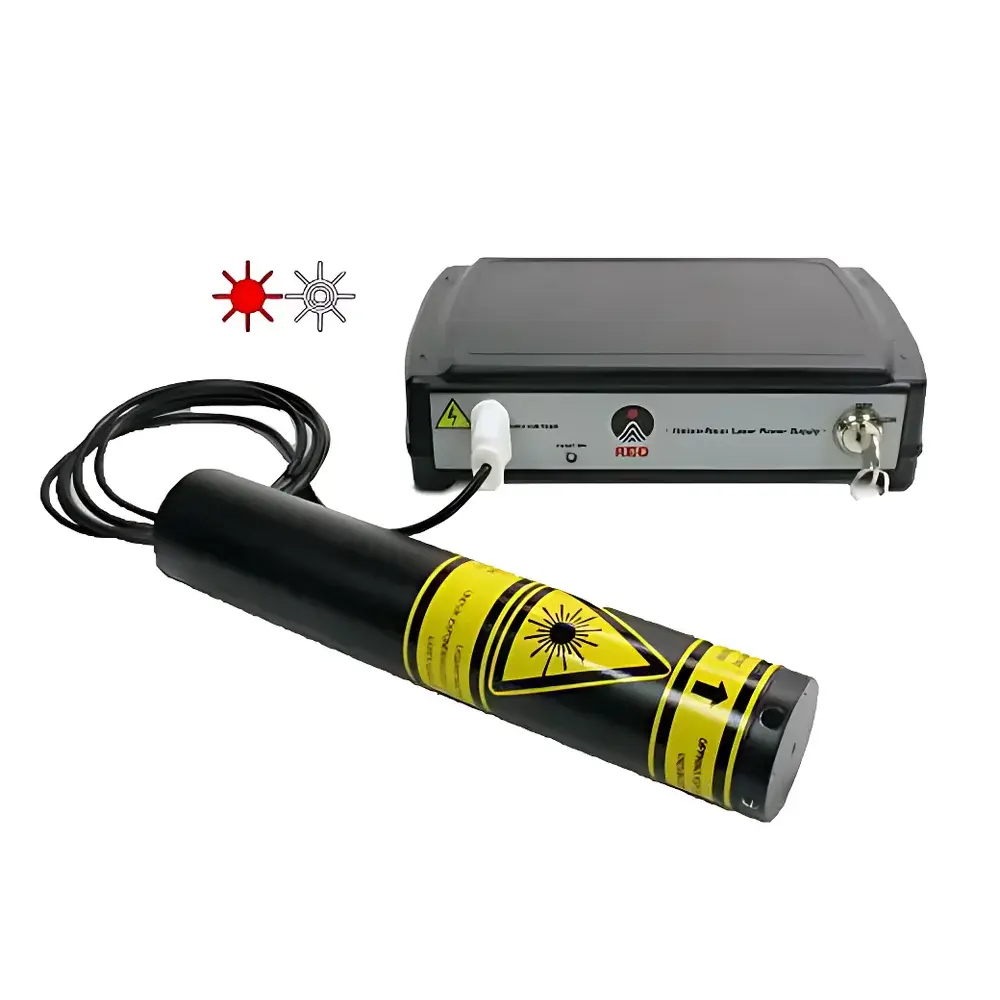
REO 633 nm High-Performance Helium-Neon Laser System
| Brand | REO (Research Electro-Optics) |
|---|---|
| Origin | USA |
| Type | Gas Laser System |
| Wavelength | 633 nm |
| Output Power Range | 0.5–35 mW |
| Polarization | Linear (>500:1) or Unpolarized |
| Beam Mode | TEM₀₀ |
| Power Rise Time | ≤3 s to 75% of rated output |
| Beam Diameter | 0.57–1.22 mm |
| Beam Divergence | 0.66–1.41 mrad |
| Longitudinal Mode Spacing | 163–1082 MHz |
| Frequency Stability (Stabilized Models) | ±1 MHz (1 hr), ±2 MHz (8 hr) |
| Power Stability (Stabilized Models) | ±0.1% (1 min), ±0.2% (1 hr) |
| Orthogonal Polarization Option | Dual-output, orthogonal linear polarization (Δθ = 90°, >500:1 extinction ratio) |
| Optional Wavelengths | 543 nm, 594 nm, 604 nm, 612 nm, 1.15 µm, 1.52 µm, 3.39 µm, dual-wavelength (e.g., 633/1.52 µm) |
Overview
The REO 633 nm High-Performance Helium-Neon Laser System is a precision-engineered gas laser platform designed for metrology-grade applications requiring exceptional beam quality, long-term power stability, and minimal pointing drift. Operating on the fundamental He-Ne transition at 633.0 nm, this laser leverages REO’s proprietary in-house mirror fabrication—spanning substrate polishing, multilayer dielectric coating, and cavity alignment—to achieve industry-leading optical efficiency and thermal robustness. Unlike conventional OEM suppliers, REO maintains full vertical integration: all high-reflectivity mirrors are polished and coated internally using ion-beam sputtering and magnetron deposition techniques optimized for ultra-low scatter (20,000 hours typical), and superior temporal and spatial coherence—critical for interferometric, holographic, and ellipsometric instrumentation.
Key Features
- TEM₀₀ transverse mode with M² < 1.05 across all standard power variants (0.5–35 mW)
- Beam pointing stability < 2 µrad/°C; power stability < ±0.2% over 1 hour (stabilized models)
- Fast thermal equilibration: ≥75% rated output achieved within 3 seconds after cold start
- In-house manufactured ultra-low-loss cavity mirrors enabling >30% higher wall-plug efficiency vs. industry benchmarks
- Multiple configuration options: free-running, frequency-stabilized, orthogonal-polarization dual-output, multi-wavelength tunable, and infrared variants (1.15 µm, 1.52 µm, 3.39 µm)
- Compliance-ready mechanical and electrical design: CE-marked, RoHS-compliant, UL-listed power supplies (115/230 VAC, 50/60 Hz)
Sample Compatibility & Compliance
The REO 633 nm laser system is engineered for integration into regulated analytical and industrial platforms where traceability, repeatability, and audit readiness are mandatory. Its stabilized variants meet key performance thresholds required by ISO/IEC 17025-accredited calibration laboratories for length metrology and interferometer verification. The laser’s frequency stability (±1 MHz over 1 hour) supports compliance with ISO 10110-5 (optical surface specification) and ASTM E2573 (interferometric surface characterization). For pharmaceutical and biotech instrumentation—including confocal microscopes and particle counters—the system conforms to FDA 21 CFR Part 11 data integrity requirements when paired with REO’s optional analog/digital interface module supporting timestamped power logging and remote interlock monitoring. All units undergo 72-hour burn-in and individual spectral certification per batch, with full traceability to NIST-traceable wavemeters and calibrated photodiodes.
Software & Data Management
While the core laser operates as a stand-alone analog device, REO provides optional digital control modules (LCS-633-DIG) enabling RS-232/USB communication for remote power modulation, temperature setpoint adjustment, and real-time diagnostics. Firmware supports IEEE 488.2 (GPIB) emulation and SCPI command syntax for seamless integration into LabVIEW, MATLAB, or Python-based automation frameworks. Power and temperature logs are exportable in CSV format with embedded UTC timestamps and instrument serial metadata—enabling GLP/GMP-aligned record retention. Audit trails include user access logs, parameter change history, and hardware fault events—all stored in non-volatile memory with write-protection. No cloud connectivity or proprietary runtime dependencies are introduced; all firmware updates are delivered via signed binary packages validated against SHA-256 checksums.
Applications
- Precision interferometry: unequal-arm Michelson and Mach-Zehnder configurations for displacement, vibration, and refractive index measurement
- Ellipsometry and scatterometry: thin-film thickness and optical constant determination in semiconductor and display manufacturing
- Confocal and super-resolution microscopy: excitation source for fluorescence correlation spectroscopy (FCS) and stimulated emission depletion (STED)
- Holography and optical testing: reference beam generation for wavefront analysis and aspheric lens validation
- Fluid dynamics: laser Doppler velocimetry (LDV) and particle image velocimetry (PIV) seeding illumination
- Calibration standards: primary wavelength reference for spectrometer and monochromator alignment per ISO 17025 Clause 6.4.10
FAQ
What distinguishes REO’s helium-neon lasers from other commercial He-Ne sources?
REO is the only manufacturer that fully controls mirror substrate polishing, dielectric coating, and cavity assembly in-house—enabling optimization of scattering loss, thermal lensing, and longitudinal mode suppression at the component level.
Are stabilization options compatible with existing optical tables and mounts?
Yes. All stabilized models retain standard 1-inch (25.4 mm) cylindrical housings with kinematic mounting flanges compliant with Thorlabs, Newport, and Standa mechanical interfaces.
Can the orthogonal-polarization model be used for heterodyne interferometry without external waveplates?
Yes. The dual-output port delivers two spatially overlapped, mutually orthogonal linear polarizations with >500:1 extinction ratio—eliminating need for external polarization optics in standard heterodyne setups.
Do infrared He-Ne variants (1.15 µm, 1.52 µm, 3.39 µm) share the same reliability profile as visible models?
Yes. All REO He-Ne lasers use identical plasma tube construction, gas fill protocols, and thermal management architecture—validated to >15,000 hours MTBF across spectral bands.
Is wavelength tuning in the multi-line model truly discrete, or does it involve mechanical grating rotation?
Tuning is accomplished via thermally actuated intracavity birefringent filter (BRF) with fixed-angle orientation—no moving parts, no hysteresis, and <10 ms switching between wavelengths.




