
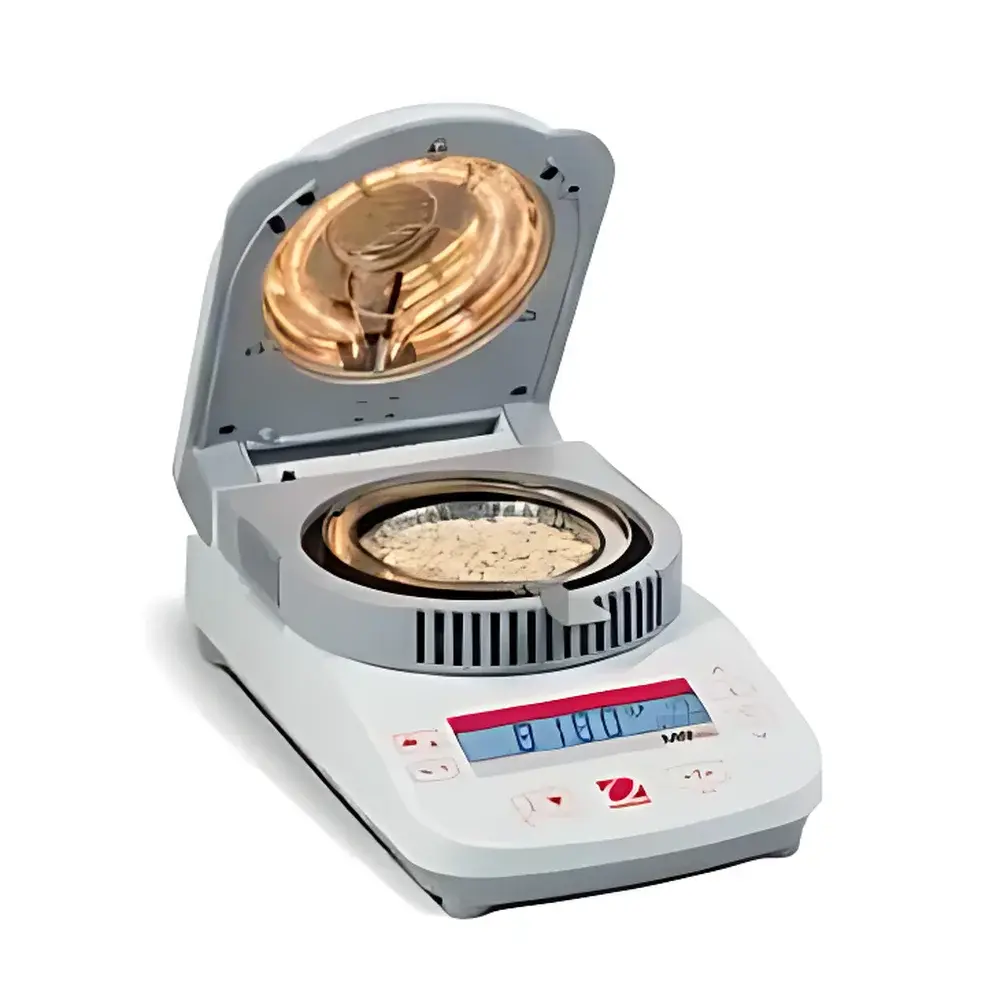
Ohaus MB25 Advanced Halogen Moisture Analyzer
| Origin | USA |
|---|---|
| Type | Imported Instrument |
| Model | MB25 |
| Capacity | 110 g / 99 g |
| Readability | 0.01 g / 0.005 g |
| Readability (for samples >10 g) | ±0.05% |
| Repeatability (3 g sample) | ±0.2% |
| Repeatability (10 g sample) | ±0.05% |
| Heating Temperature Range | 50–160 °C (in 5 °C increments) |
| Heating Time | 1–60 min (30-sec increments), 60–90 min (1-min increments) |
| Sample Pan Diameter | 90 mm |
| Minimum Sample Mass | 0.5 g |
| Recommended Sample Mass | 3–20 g |
| Operating Ambient Temperature | 10–30 °C |
| Communication Interface | Bidirectional RS232 |
| Display Content | Moisture %, Solid %, Weight, Time, Temperature |
| Dimensions (W×H×D) | 165 × 127 × 280 mm |
| Net Weight | 2.1 kg |
| Gross Weight | 4.2 kg |
| Heating Source | Halogen Lamp |
| End-point Detection | Timed or Automatic |
| Built-in Sample Pan Handle | Standard |
Overview
The Ohaus MB25 Advanced Halogen Moisture Analyzer is a precision laboratory instrument engineered for rapid, gravimetric determination of moisture content in solid and semi-solid materials using the loss-on-drying (LOD) principle. It employs a high-stability halogen lamp as the heating source, delivering uniform thermal energy across the sample surface while minimizing thermal lag and edge overheating—critical for achieving reproducible drying profiles. The analyzer integrates a thermally isolated weighing sensor architecture, which actively mitigates heat-induced drift during active drying, thereby preserving measurement integrity throughout the entire heating cycle. Designed for routine QC/QA environments in pharmaceutical, food, chemical, and polymer laboratories, the MB25 complies with fundamental method validation requirements outlined in USP , ASTM D4457, and ISO 5530-1, supporting documented, traceable moisture analysis under GLP and GMP-aligned workflows.
Key Features
- Backlit LCD display with high-contrast graphical interface—enables clear visualization of real-time moisture %, solid %, weight change, elapsed time, and current temperature without ambient light dependency.
- Intuitive six-button operation—eliminates hierarchical menu navigation; all functions—including start/stop, parameter entry, tare, and report output—are accessible via dedicated physical controls for reduced operator training time and minimized input error.
- Thermally decoupled electromagnetic force restoration (EMFR) weighing sensor—engineered with integrated thermal shielding to suppress convection currents and thermal expansion effects induced by halogen heating, ensuring consistent readability at 0.005 g (≤10 g load) and long-term stability.
- Programmable heating protocol—supports both fixed-duration and automatic endpoint detection modes; users may define custom ramp-and-hold sequences within the 50–160 °C range (5 °C resolution), with timing granularity down to 30 seconds for durations up to 60 minutes.
- Bidirectional RS232 serial interface—enables direct communication with label printers, external PCs, and LIMS systems; supports ASCII data streaming with timestamp, sample ID, and full result set (moisture %, solid %, initial/final mass, temperature profile).
Sample Compatibility & Compliance
The MB25 accommodates a broad spectrum of non-volatile and low-volatility matrices, including powders (e.g., APIs, excipients), granules, pellets, dried herbs, flour, starches, resins, and coated tablets. Its 90 mm stainless-steel sample pan—supplied with an ergonomic handle for safe hot-sample handling—ensures even heat distribution and facilitates rapid cooling between runs. While not suitable for highly volatile solvents or thermally labile compounds requiring inert-atmosphere drying, the MB25 meets essential regulatory expectations for routine moisture verification: its calibration traceability aligns with NIST-traceable mass standards, and its firmware supports user-defined audit trails (when paired with compliant PC software), satisfying foundational elements of FDA 21 CFR Part 11 for electronic records in regulated environments.
Software & Data Management
Although the MB25 operates autonomously without bundled PC software, its RS232 output is fully compatible with third-party data acquisition platforms—including Ohaus’ own Acquire™ Lite and industry-standard LabArchives or Empower—enabling automated report generation, statistical process control (SPC) charting, and batch-level trending. All transmitted data packets include device ID, date/time stamp, operator code (if entered), sample identifier, and full analytical metadata. For laboratories implementing 21 CFR Part 11 compliance, optional password-protected user accounts and electronic signature integration can be achieved via middleware solutions that interpret the native ASCII stream and enforce role-based access and audit logging.
Applications
The MB25 delivers reliable moisture quantification across multiple industrial quality control domains: verification of hygroscopicity in pharmaceutical raw materials per USP ; determination of residual solvent in lyophilized products; monitoring of drying endpoints in food processing (e.g., snack foods, dairy powders); assessment of moisture uptake in polymer pellets prior to extrusion; and validation of desiccant efficacy in packaging integrity studies. Its repeatability performance (±0.05% RSD at 10 g) meets the precision thresholds required for release testing in Tier-2 GMP manufacturing units, particularly where Karl Fischer titration is impractical due to sample throughput demands or matrix interference.
FAQ
What calibration standards are recommended for daily verification?
NIST-traceable Class M2 or Class F2 stainless-steel weights (e.g., 10 g, 50 g) are recommended for daily linearity and repeatability checks; internal calibration is not supported—external verification is mandatory per ISO/IEC 17025 Clause 6.5.
Can the MB25 be used for volatile organic solvent analysis?
No—the halogen heating mechanism does not provide inert-gas purging or condensation recovery; for volatile solvents, dedicated headspace GC or Karl Fischer methods remain the scientifically appropriate alternatives.
Is GLP-compliant data export possible without proprietary software?
Yes—ASCII-formatted RS232 output includes all critical metadata; when ingested into validated LIMS or ELN platforms with defined import protocols and audit trail activation, it satisfies GLP documentation requirements.
What maintenance intervals are specified for the halogen lamp and sensor assembly?
Halogen lamps are rated for ≥5,000 hours of operation; replacement is indicated by inconsistent drying curves or visible filament degradation. The weighing sensor requires no scheduled maintenance but must be protected from dust ingress and mechanical shock per Ohaus Service Bulletin MB25-SV-02.
Related Products




