
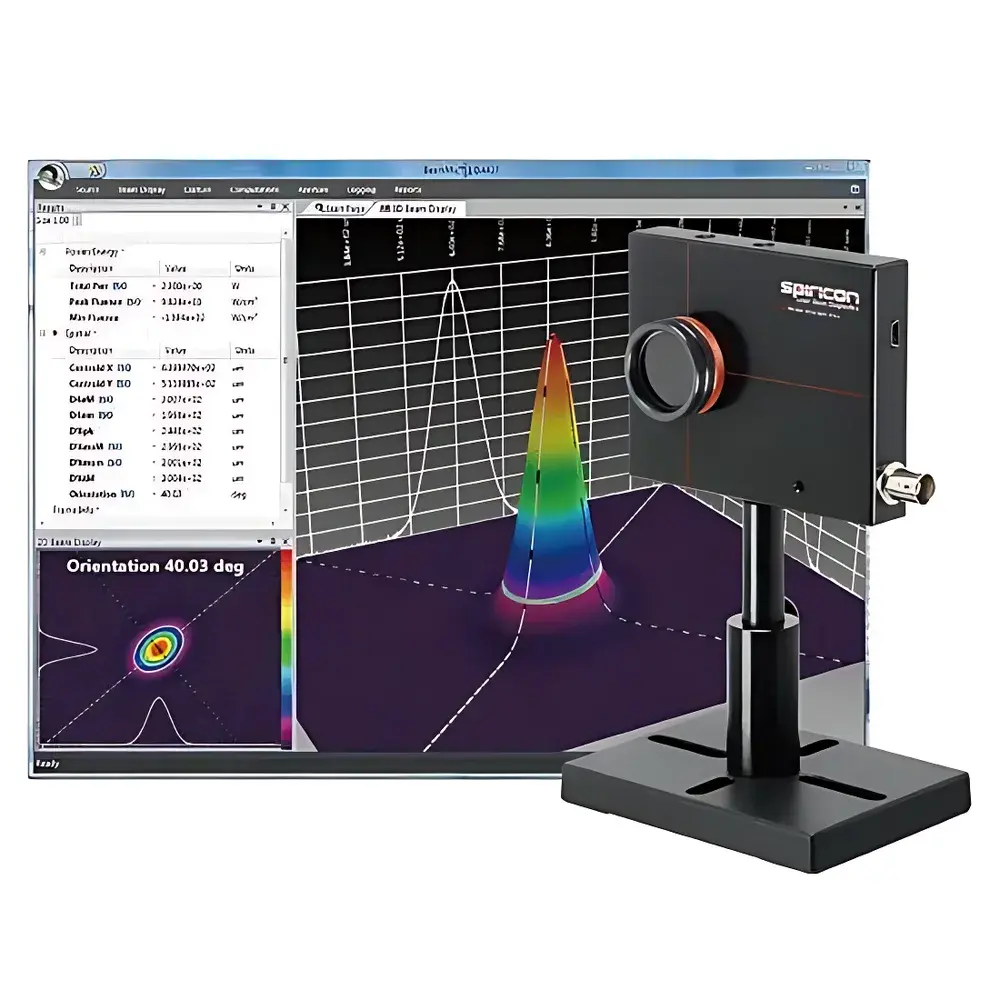
Spiricon SP620U Area-Scan Laser Beam Profiler
| Brand | Spiricon |
|---|---|
| Origin | USA |
| Manufacturer Type | Authorized Distributor |
| Product Category | Imported |
| Model | SP620U |
| Core Components | CCD-based beam profiling sensor, Ultracal™ background subtraction engine, ISO 11146-compliant analysis software suite |
| Spectral Range | 190 nm – 1100 nm (with optional UV converter for 13–190 nm) |
| Sensor Format | 1280 × 1024 pixels, 6.5 µm pixel pitch |
| Interface | USB 3.0 |
| Frame Rate | Up to 60 fps (full resolution), >1000 fps (ROI mode) |
| Dynamic Range | >60 dB (with Ultracal™) |
| Compliance | ISO 11146-1:2005, ISO 11146-2:2005, ISO 11146-3:2019, NIST-traceable calibration available |
Overview
The Spiricon SP620U Area-Scan Laser Beam Profiler is a high-resolution, CCD-based optical measurement instrument engineered for quantitative spatial characterization of continuous-wave (CW) and pulsed laser beams across the deep-ultraviolet to near-infrared spectrum (190–1100 nm). Unlike scanning-slit or knife-edge profilers, the SP620U employs a two-dimensional photosensitive array to capture the full intensity distribution—i.e., the irradiance profile I(x,y)—in a single exposure. This area-scan architecture enables direct computation of beam parameters defined in ISO 11146-1 and -2, including second-moment (D4σ) beam widths, centroid position, ellipticity, M² factor (when integrated with optional collimation and focusing stages), and beam propagation ratio. The system’s foundational measurement principle relies on photon-to-electron conversion within a scientific-grade monochrome CCD sensor, followed by calibrated digital signal processing under controlled thermal and electronic noise conditions. Its design prioritizes metrological traceability, repeatability, and compliance with international standards governing laser beam quality assessment in industrial, defense, and research environments.
Key Features
- Scientific-grade 1280 × 1024 pixel CCD sensor with 6.5 µm pixel pitch and high quantum efficiency (>60% at 532 nm)
- Ultracal™ real-time background noise subtraction algorithm—patented per ISO 11146-3:2019—enabling dynamic range enhancement beyond 60 dB without hardware averaging
- USB 3.0 interface supporting up to 60 fps at full resolution and region-of-interest (ROI) streaming at >1000 fps for transient pulse analysis
- Integrated thermoelectric stabilization to minimize dark current drift during extended acquisitions
- Modular optical path compatibility: supports direct imaging, relayed imaging, and fiber-coupled configurations via standardized C-mount and SM1-threaded interfaces
- NIST-traceable factory calibration certificate included; optional annual recalibration service aligned with ISO/IEC 17025 requirements
Sample Compatibility & Compliance
The SP620U accommodates a broad range of laser sources—including gas lasers (e.g., HeNe, Ar⁺, CO₂), solid-state lasers (Nd:YAG, Ti:Sapphire), diode lasers, and ultrafast femtosecond oscillators—provided beam power density remains within the sensor’s damage threshold (≤100 W/cm² CW, ≤1 J/cm² for ns pulses). For wavelengths below 190 nm (e.g., excimer lasers at 193 nm or 157 nm), an optional fused-silica UV converter enables down-conversion to visible photons detectable by the silicon CCD. All measurements adhere strictly to ISO 11146-1:2005 (determination of beam widths), ISO 11146-2:2005 (determination of divergence), and ISO 11146-3:2019 (test methods for background noise correction). The system satisfies documentation and audit requirements for GLP and GMP environments when deployed with Ophir’s BeamGage Enterprise Edition, which includes 21 CFR Part 11–compliant electronic signatures, audit trails, and user access controls.
Software & Data Management
BeamGage Professional software serves as the analytical core of the SP620U platform. Pre-acquisition, Ultracal™ performs adaptive baseline subtraction using multi-point reference frames to eliminate fixed-pattern noise and ambient thermal offset. During acquisition, the software computes ISO-compliant beam metrics—including D4σ width, beam area, peak irradiance, centroid displacement, and Gaussian fit residuals—in real time. Post-acquisition, data export supports HDF5, CSV, TIFF, and MATLAB .mat formats. Version-tiered licensing (Standard, Professional, Enterprise) governs functionality: Enterprise Edition adds automated report generation, SPC charting, batch analysis pipelines, and secure network deployment with role-based permissions. All versions maintain full backward compatibility with historical calibration files and support scripting via Python API for integration into automated test benches.
Applications
- Laser manufacturing QA/QC: verification of mode structure, pointing stability, and focusability prior to shipment
- Photolithography tool alignment: real-time monitoring of excimer laser homogeneity and energy uniformity across mask illumination fields
- Fiber-optic component testing: characterization of output modes from single-mode and multimode fibers, including LP₀₁ purity and modal noise
- Ultrafast laser diagnostics: temporal-spatial coupling analysis via single-shot pulse front tilt and chirp mapping (with optional autocorrelator synchronization)
- Medical laser system validation: compliance verification against IEC 60825-1 safety limits for beam divergence and irradiance profiles
- Defense EO/IR systems: M² and BPP validation of high-energy laser weapon demonstrators under field-representative thermal loading
FAQ
Does the SP620U support pulsed lasers with repetition rates above 1 MHz?
Yes—when operated in ROI mode, the sensor achieves effective frame rates exceeding 1000 fps, enabling statistical sampling of high-repetition-rate pulse trains. Full-frame capture is recommended for single-shot or low-repetition (<1 kHz) applications requiring complete spatial fidelity.
Can I measure beams smaller than 10 µm with this profiler?
Direct measurement of sub-20 µm features is limited by the 6.5 µm pixel pitch and optical diffraction constraints. For such cases, optional telecentric magnification optics (e.g., 5× or 10× beam expanders used in reverse) are recommended to achieve effective sampling at ≥3 pixels per FWHM.
Is calibration traceable to national metrology institutes?
Each unit ships with a NIST-traceable calibration certificate covering responsivity, pixel uniformity, and geometric distortion. Recalibration services follow ISO/IEC 17025 procedures and include uncertainty budgets per GUM guidelines.
How does Ultracal™ differ from conventional background subtraction?
Ultracal™ acquires multiple background frames at varying integration times and applies weighted polynomial fitting to decouple thermal drift, dark current, and stray light contributions—eliminating artifacts common in single-frame offset subtraction, especially critical for low-SNR UV and IR measurements.
What accessories are required for 193 nm ArF excimer laser profiling?
A vacuum-compatible UV-to-visible phosphor converter (e.g., Spiricon UVX-193) must be mounted in front of the sensor, coupled with reflective optics to avoid absorption losses. The converter shifts 193 nm photons to ~450 nm emission, enabling detection with standard silicon CCD quantum efficiency.



