
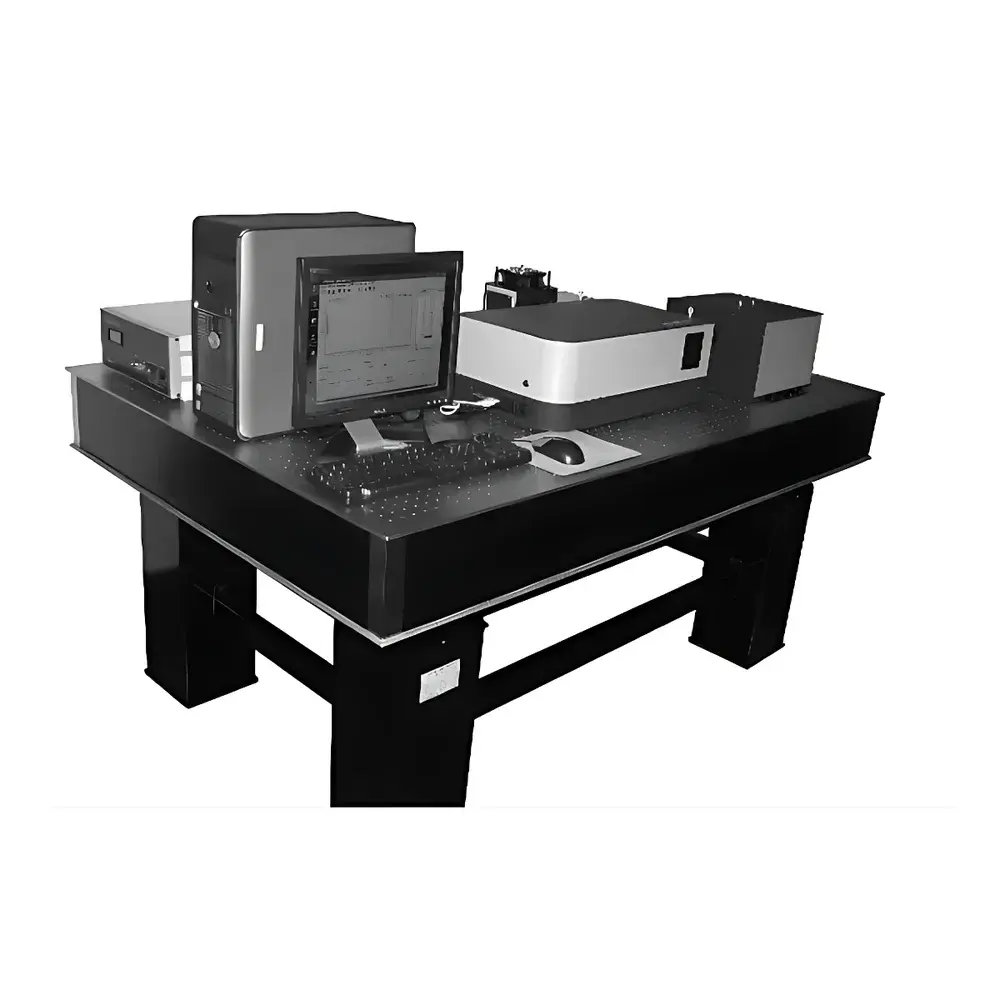
CEL-QPCE2010 Quantum Efficiency / Incident Photon-to-Current Efficiency (QE/IPCE) Measurement System for Silicon Solar Cells
| Brand | CEAULIGHT (Zhongjiaojinyuan) |
|---|---|
| Origin | Beijing, China |
| Manufacturer Type | OEM Manufacturer |
| Product Category | Domestic |
| Model | CEL-QPCE2010 QE/IPCE System |
| Light Source Type | Monochromatic Tunable Source with Chopped Xenon/Mercury Lamp |
| Illumination Mode | External Illumination |
| Spectral Range | 200–1100 nm |
| Wavelength Step Resolution | ≥1 nm, Continuously Adjustable |
| Scan Mode | Fully Automated Spectral Sweep |
| Repeatability | <0.3% (J<sub>sc</sub>) |
| AC Detection Mode | Lock-in Amplifier-Based Signal Recovery |
| Chopping Frequency Range | 5–1000 Hz |
| Temperature-Controlled Stage | 5–40 °C (±0.5 °C, Optional) |
| Bias Light Source | Optional Dual-Channel Configuration |
| Monochromator Options | 300 mm or 150 mm Focal Length |
Overview
The CEL-QPCE2010 Quantum Efficiency / Incident Photon-to-Current Efficiency (QE/IPCE) Measurement System is an engineered solution for high-fidelity spectral responsivity characterization of photovoltaic devices—primarily crystalline and multicrystalline silicon solar cells. It operates on the principle of monochromatic photocurrent spectroscopy, where incident photons of discrete wavelengths are sequentially delivered to the device under test (DUT), and the resulting photocurrent is measured under controlled bias and illumination conditions. The system integrates a tunable light source (Xe/Hg arc lamp coupled with a double-grating monochromator), precision optical chopping, lock-in amplification, calibrated reference detectors, and temperature-stabilized sample stage—all synchronized via proprietary control software. Its core function is to quantify the external quantum efficiency (EQE), defined as the ratio of collected electrons per incident photon at each wavelength, and derive related metrics including internal quantum efficiency (IQE), spectral transmittance, reflectance (with integrating sphere), and AM1.5G-weighted short-circuit current density (Jsc). Designed for laboratory-grade reproducibility, the system meets foundational requirements for PV R&D, quality assurance, and third-party validation in accordance with IEC 60904-8 and ASTM E1021 standards.
Key Features
- High-sensitivity AC detection architecture utilizing phase-sensitive lock-in amplification to extract weak photocurrent signals buried beneath broadband electronic and optical noise—enabling reliable EQE measurement down to 10−3 A/W even at sub-bandgap wavelengths.
- Fully automated spectral scanning from 200 nm to 1100 nm with step resolution ≥1 nm; real-time background subtraction and dark-current compensation integrated into acquisition protocol.
- Modular monochromator options: 300 mm focal length for enhanced spectral resolution (<0.5 nm FWHM at 500 nm) or 150 mm for higher throughput in routine screening applications.
- External illumination geometry compliant with IEC 60904-8 Annex B, minimizing stray light and enabling unambiguous separation of optical and electrical contributions to response.
- Temperature-controlled sample stage (5–40 °C, ±0.5 °C stability) supports thermal-dependent QE analysis and accelerated aging correlation studies.
- Optional dual-bias light configuration enables simultaneous application of white-light or LED-based forward bias during monochromatic probing—critical for IQE derivation and recombination analysis.
Sample Compatibility & Compliance
The CEL-QPCE2010 accommodates standard 156 mm × 156 mm and 166 mm × 166 mm c-Si wafers, as well as smaller research-scale cells (≥1 cm² active area). It supports both front- and rear-illuminated configurations via interchangeable sample holders. Reflectance measurements utilize a 6-inch integrating sphere with NIST-traceable Spectralon® standard (reflectance >99% from 250–2500 nm). Transmittance mode employs dual-detector referencing against a pre-calibrated Si photodiode. All optical calibrations adhere to ISO/IEC 17025 principles; system-level uncertainty budgets are documented per JCGM 100:2008. The platform is compatible with GLP-compliant data workflows when operated with audit-trail-enabled software extensions.
Software & Data Management
Control and analysis are performed via QESoft v4.x—a Windows-based application supporting fully scriptable measurement sequences, real-time spectral plotting, batch processing, and export to CSV, HDF5, or MATLAB-compatible formats. Raw lock-in output (X, Y, R, θ), normalized EQE, IQE, T(λ), R(λ), and JscAM1.5G are stored with full metadata (date/time, lamp hours, monochromator slit width, chopping frequency, stage temperature). Software includes built-in AM1.5G spectral weighting engine (ASTM G173-03 reference spectrum) and supports user-defined irradiance profiles. Data integrity is preserved through timestamped binary logging and optional 21 CFR Part 11-compliant electronic signature modules.
Applications
- Quantitative EQE mapping for process optimization in PERC, TOPCon, and heterojunction silicon cell fabrication lines.
- IQE analysis to isolate bulk vs. surface recombination losses—particularly valuable for passivation layer evaluation.
- Spectral transmittance profiling of anti-reflective coatings, encapsulants, and front glass substrates.
- Reflectance-limited IQE correction using co-located R(λ) measurements—eliminating need for separate spectrophotometer integration.
- Temperature-dependent QE studies to assess thermal activation energies of defect states.
- Calibration transfer between reference cells and production-line testers (e.g., for flash tester spectral mismatch correction).
FAQ
What light sources are supported for monochromatic excitation?
The system is configured with a stabilized Xe/Hg short-arc lamp; optional UV-enhanced or NIR-extended lamp variants are available upon request.
Can the system measure thin-film or perovskite solar cells?
Yes—provided the active area exceeds 1 cm² and the device exhibits stable photocurrent under chopped illumination; contact resistance and series resistance effects must be accounted for in post-processing.
Is spectral calibration traceable to national standards?
Yes—wavelength calibration uses Hg/Ne emission lines; irradiance calibration is performed against a NIST-traceable thermopile detector and Si photodiode reference standard.
How is dark current compensated during scanning?
Automated zero-current baseline acquisition is executed before each wavelength step, with adaptive integration time adjustment to maintain signal-to-noise consistency across the UV–NIR range.
Does the system support in-situ biasing during measurement?
Yes—optional programmable DC or pulsed bias voltage up to ±10 V is available, synchronized with lock-in reference phase for transient photocurrent analysis.



