
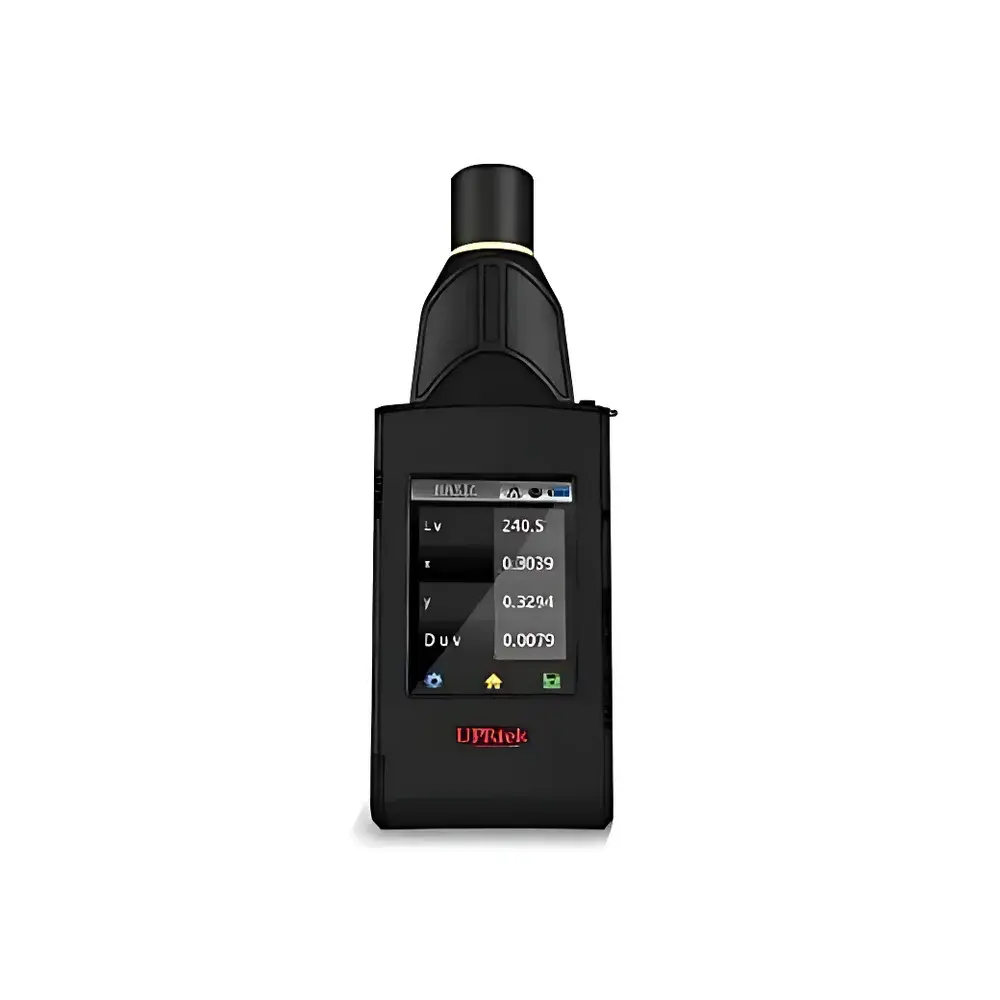
UPRtek MK550T Handheld Spectroradiometer and Luminance Meter
| Brand | UPRtek |
|---|---|
| Origin | Taiwan |
| Manufacturer Type | Authorized Distributor |
| Regional Classification | Asia-Pacific Manufactured |
| Model | MK550T |
| Price Range | USD 6,800 – 13,600 |
Overview
The UPRtek MK550T is a handheld spectroradiometer and luminance meter engineered for high-accuracy, portable optical characterization of self-emissive and backlit display technologies. It operates on the principle of grating-based spectral dispersion coupled with a calibrated CMOS linear image sensor, enabling full-spectrum radiometric and photometric analysis from 380 nm to 780 nm at 1 nm wavelength resolution. Unlike filter-based colorimeters, the MK550T captures complete spectral power distributions (SPDs), allowing traceable calculation of CIE tristimulus values (X, Y, Z), chromaticity coordinates (x, y; u′, v′), correlated color temperature (CCT), Duv, luminance (cd/m²), illuminance (lux), dominant wavelength, purity, and flicker metrics (flicker percentage, flicker index). Its real-time spectral acquisition architecture supports measurement speeds of ≤0.5 s per reading — critical for inline process verification in display module manufacturing, R&D lab validation, and QA/QC of OLED, microLED, MiniLED, LCD, and AR/VR near-eye displays.
Key Features
- Integrated spectroradiometric and photometric functionality in a single handheld unit — no external PC or software required for basic operation
- Calibrated spectral response with NIST-traceable factory calibration certificates (valid for 12 months)
- High dynamic range luminance measurement: 0.0001–1,000,000 cd/m², with ±2% accuracy at 10 cd/m² and above
- Chromaticity repeatability: Δu′v′ ≤ 0.0015 (at 100 cd/m², 10 readings, CIE 1976 UCS)
- On-device color space visualization: CIE 1931 xy, CIE 1976 u′v′, and CIE 2015 u₀v₀ diagrams with pass/fail tolerance zones
- Gamma evaluation mode with user-defined target gamma curves (γ = 1.8–2.6) and deviation reporting in ΔE₂₀₀₀
- USB-C and Bluetooth 5.0 connectivity for firmware updates, data export, and remote control via UPRtek’s SpectraMagic™ PC software
- IP54-rated enclosure with rubberized grip and anti-reflective lens hood for field use under variable ambient conditions
Sample Compatibility & Compliance
The MK550T is validated for quantitative optical assessment of planar and curved emissive surfaces including smartphone OLED panels, TV-grade QD-OLED modules, transparent microLED arrays, VR headset microdisplays (LCoS, OLED-on-Si), and automotive HUD combiners. It complies with ISO/CIE standard geometries: f/2.8 aperture (2° field of view), 12 mm measurement spot diameter at 300 mm working distance, and cosine-corrected input optics meeting CIE S 023/E:2013 requirements. Measurement protocols align with industry-relevant standards including IEC 62341-6-3 (OLED optical testing), VESA DisplayHDR™ test methodology, and JEITA CP-3409 for display luminance uniformity. Data integrity meets GLP audit requirements through built-in timestamping, operator ID tagging, and encrypted CSV/Excel export with metadata headers.
Software & Data Management
UPRtek’s SpectraMagic™ software (Windows/macOS) provides comprehensive post-processing capabilities: spectral comparison overlays, multi-point uniformity mapping, temporal flicker waveform analysis, and automated report generation compliant with internal QA templates or customer-specific formats (e.g., PDF with company logo, Excel with statistical summaries). The MK550T stores up to 1,000 spectra locally with full EXIF-style metadata (date/time, GPS coordinates optional, instrument serial, calibration ID, user notes). All exported datasets include embedded calibration traceability information and adhere to ASTM E308-23 conventions for spectral data exchange. For regulated environments, SpectraMagic™ supports 21 CFR Part 11-compliant user access controls, electronic signatures, and audit trail logging when deployed on validated network servers.
Applications
- Display manufacturing: Inline gamma tuning, white point verification, and Mura defect screening during TFT/OLED panel final test
- R&D laboratories: Spectral characterization of novel emitter materials (e.g., TADF, QD-LEDs), viewing angle dependency studies, and angular luminance profiling
- AR/VR hardware development: Near-eye display luminance homogeneity mapping, chromatic aberration quantification, and eyebox-integrated photometry
- Lighting design validation: Spectral quality assessment of human-centric lighting (HCL) systems using melanopic EDI and circadian stimulus metrics
- Academic optics education: Hands-on instruction in CIE colorimetry, spectral radiometry fundamentals, and display metrology best practices
FAQ
Does the MK550T require annual recalibration?
Yes — UPRtek recommends recalibration every 12 months against NIST-traceable standards to maintain photometric accuracy and chromaticity traceability. Calibration services are available through authorized regional service centers.
Can the MK550T measure pulsed or PWM-driven displays?
Yes — it supports synchronized gated integration mode for accurate luminance and chromaticity capture of displays using high-frequency PWM dimming (up to 240 Hz) or global shutter synchronization for microsecond-level pulse width analysis.
Is spectral data export compatible with MATLAB or Python workflows?
Yes — raw SPD data is exported as ASCII text (.txt) or CSV files with wavelength (nm) and irradiance (µW/cm²/nm) columns, enabling direct ingestion into SciPy, Pandas, or custom spectral modeling pipelines.
What is the battery life under continuous measurement mode?
Up to 8 hours of active spectral acquisition (1 reading/sec) on a full charge; battery status is displayed in real time on the OLED screen and logged with each measurement.
Does the device support third-party API integration?
Yes — UPRtek provides documented USB HID and Bluetooth SPP command protocols for OEM integration into automated test fixtures or MES systems, including SCPI-like syntax for remote triggering and data polling.




