
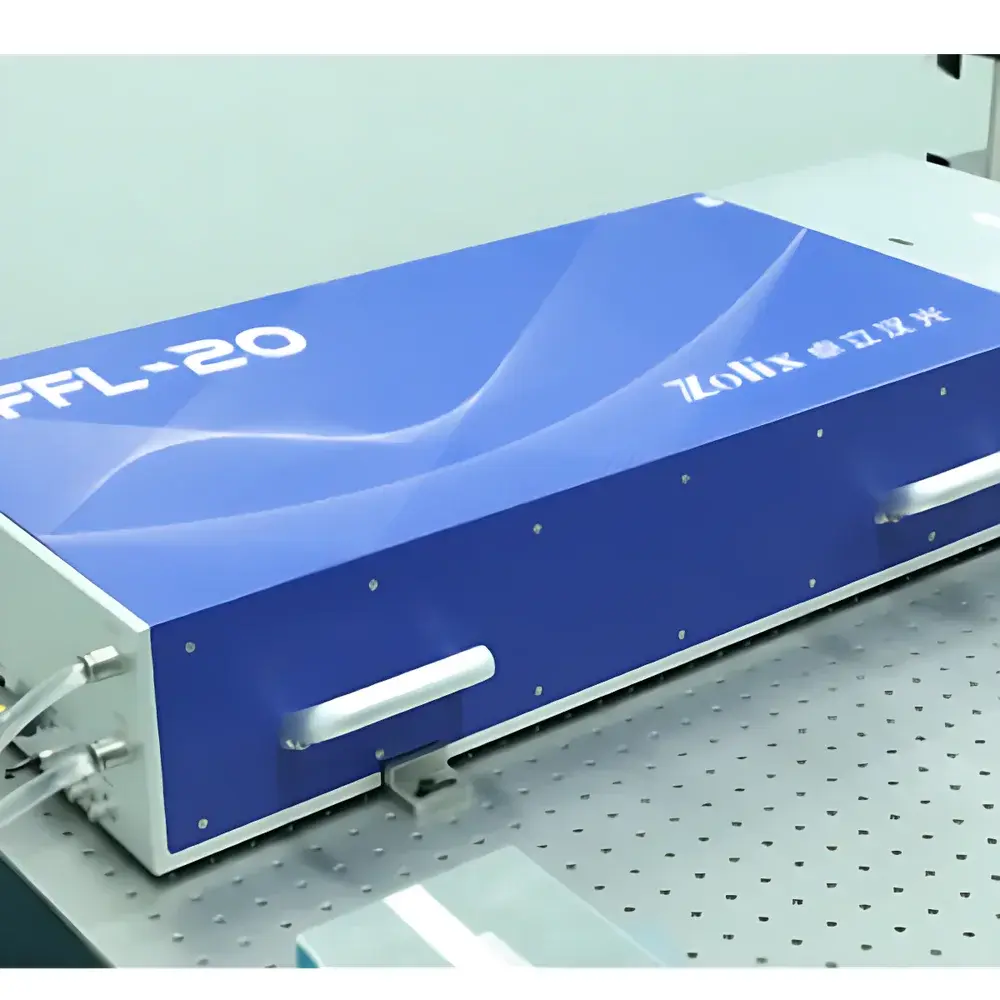
ZOLIX FFL-20 Fiber-Based Femtosecond Laser System
| Brand | ZOLIX |
|---|---|
| Origin | Beijing, China |
| Manufacturer Type | Authorized Distributor |
| Product Origin | Domestic (PRC) |
| Model | FFL-20 |
| Pricing | Upon Request |
| Repetition Rate | 1 Hz – 1 MHz (software-tunable) |
| Pulse Width | 350 fs – 10 ps (software-tunable) |
| Output Configuration | Dual-variant — HE (High-Energy) and HR (High-Repetition-Rate) versions |
Overview
The ZOLIX FFL-20 Fiber-Based Femtosecond Laser System is an industrial-grade, turnkey ultrafast laser source engineered for robust performance in research laboratories and precision manufacturing environments. Built on all-fiber chirped-pulse amplification (CPA) architecture, the FFL-20 delivers transform-limited, carrier-envelope-phase (CEP)-stable pulses with high temporal contrast and excellent pulse-to-pulse stability. Its fully integrated design eliminates free-space alignment, enabling reliable operation without cleanroom or active temperature stabilization—making it suitable for integration into OEM systems, vacuum chambers, or shared-core facility infrastructure. The system operates at a central wavelength of 1030 nm (fundamental), with optional harmonic generation modules (e.g., 515 nm, 343 nm) available via external nonlinear crystals. As a Class 4 laser product, it complies with IEC 60825-1:2014 and incorporates interlocked shuttering, beam path containment, and real-time power monitoring for full regulatory alignment with ISO 11551 and ANSI Z136.1 safety standards.
Key Features
- Fully software-controlled repetition rate tuning from single-shot (1 Hz) to 1 MHz, enabling flexible synchronization with pump-probe delay stages, streak cameras, or data acquisition systems.
- Digitally adjustable pulse duration spanning 350 fs to 10 ps, achieved via intracavity dispersion management and post-compressor fine-tuning—preserving spectral phase integrity across the entire range.
- Dual operational configurations: HE variant optimized for pulse energy up to 20 µJ at 100 kHz (typ.), and HR variant delivering >2 W average power at 1 MHz with sub-400 fs pulse width.
- Integrated Ethernet and USB 2.0 interfaces supporting remote control via SCPI commands and native LabVIEW, Python (PyVISA), and MATLAB drivers.
- Passive thermal management with conduction-cooled fiber amplifier stages; no external chiller required—reducing footprint, acoustic noise, and total cost of ownership.
- Built-in real-time diagnostics including pulse energy monitor (±2% accuracy), beam pointing stability <5 µrad RMS over 8 hours, and automated self-calibration routines for output power and repetition rate verification.
Sample Compatibility & Compliance
The FFL-20 is designed for direct interfacing with ultrafast diagnostic tools—including synchroscan and synchro-cameras (e.g., Hamamatsu C5680, Hadland Imacon series), transient absorption spectrometers (e.g., Helios, Light Conversion ORPHEUS), and time-resolved photoelectron spectrometers. Its low-amplitude noise (<0.3% RMS, 10 Hz–1 MHz) and jitter <100 fs (rms) ensure high-fidelity temporal gating in pump-probe experiments. All optical outputs meet ISO 10110 surface quality specifications (scratch-dig 10-5), and beam delivery is compatible with standard SMF-28 or polarization-maintaining PM980 fiber coupling. The system conforms to CE marking requirements under Directive 2014/30/EU (EMC) and 2014/35/EU (LVD), and its firmware architecture supports audit-ready logging for GLP/GMP-aligned workflows where traceable laser parameter history is mandated.
Software & Data Management
ZOLIX provides the FFL-Control Suite—a cross-platform application (Windows/Linux/macOS) that enables full parameter orchestration, script-based sequence execution, and synchronized hardware triggering. The software implements deterministic timestamping for each emitted pulse (via internal FPGA logic), ensuring precise correlation between laser events and external detectors. All configuration states, calibration logs, and operational records are stored in HDF5 format with embedded metadata (including UTC timestamps, environmental sensor readings, and firmware revision IDs). Export options include CSV, MATLAB .mat, and ASCII-compatible formats compatible with third-party analysis pipelines (e.g., Igor Pro, OriginLab, Python SciPy stack). For regulated environments, optional 21 CFR Part 11 compliance packages are available—including electronic signatures, role-based access control, and immutable audit trails.
Applications
- Laser micromachining of transparent dielectrics (e.g., fused silica, sapphire) and polymeric substrates with minimal heat-affected zones—leveraging nonlinear absorption thresholds enabled by sub-500 fs pulses.
- Pump-probe spectroscopy platforms requiring tunable delay lines and multi-channel detection, particularly in transient absorption imaging of perovskite photovoltaics and 2D material heterostructures.
- Time-resolved terahertz generation and electro-optic sampling, where stable carrier-envelope offset (CEO) frequency and low timing jitter are critical for field reconstruction fidelity.
- Two-photon polymerization and direct laser writing systems demanding high spatial resolution and voxel consistency across extended print durations (>10 hr).
- Seed source for Ti:sapphire amplifier systems or OPCPA front-ends, providing broadband spectrum seeding with controlled dispersion pre-compensation.
FAQ
Is the FFL-20 compatible with vacuum-integrated experimental chambers?
Yes—the laser head is sealed and rated IP52; all electronics are housed in a separate rack-mount controller unit. Fiber-coupled output allows feedthrough via standard CF flanges using vacuum-compatible collimators.
Can pulse duration be adjusted during continuous operation?
Yes—pulse width tuning is implemented via motorized grating compressors with closed-loop position feedback; changes are applied without interrupting lasing or requiring realignment.
Does the system support external synchronization to a master clock?
Yes—TTL-compatible SYNC IN/OUT ports provide bidirectional 10 MHz reference locking and programmable trigger delay (0–100 ns, 1 ps resolution) for multi-laser coherence control.
What maintenance is required over a 5-year operational lifetime?
None beyond periodic inspection of fiber connectors and cleaning of output collimator optics per ISO 10110 cleaning protocols; the all-fiber architecture eliminates consumables such as flashlamps or dye solutions.
Is OEM integration supported with custom mechanical or electrical interfaces?
Yes—ZOLIX offers mechanical drawings (STEP/IGES), pinout schematics, and SDK documentation under NDA; custom housing, cooling interface, and form-factor adaptations are available upon engineering review.




