
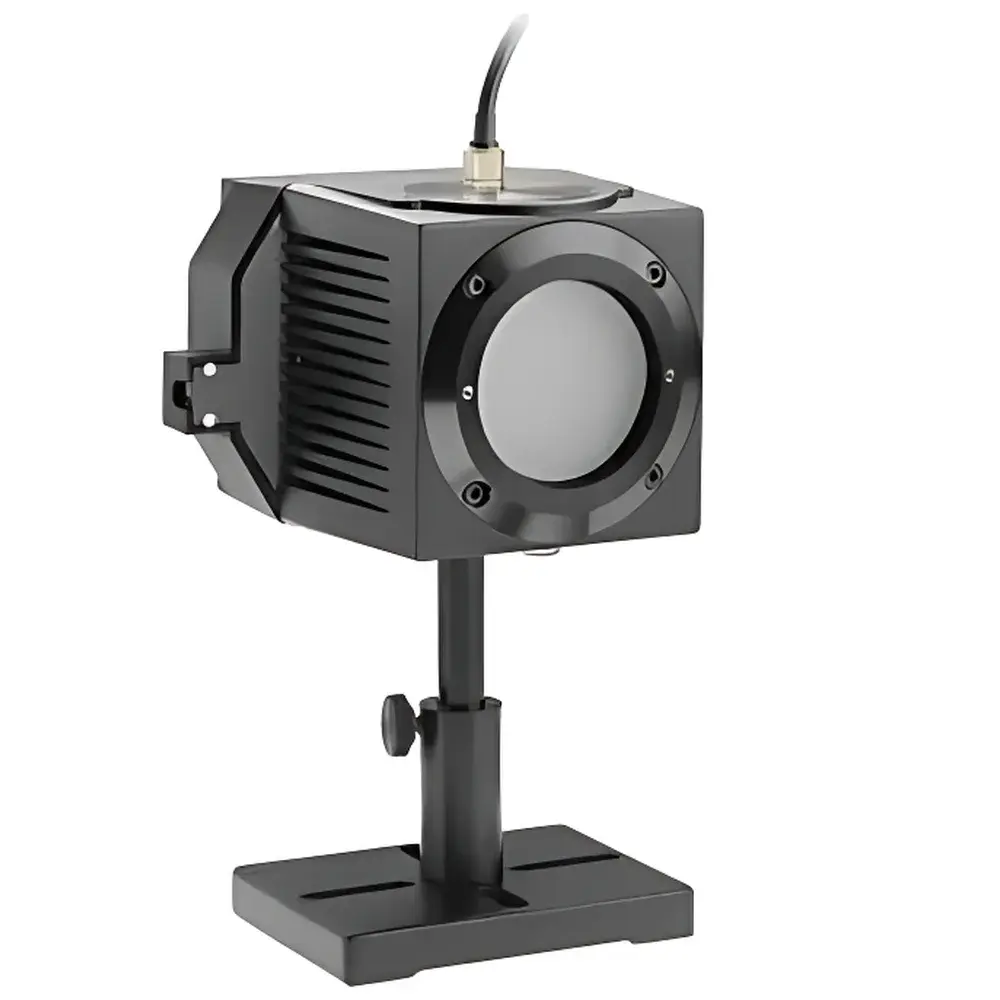
Ophir F100A-PF-DIF-18 High-Power Thermopile Sensor
| Brand | Ophir |
|---|---|
| Origin | Israel |
| Model | F100A-PF-DIF-18 |
| Power Range | 50 mW – 100 kW |
| Wavelength Range | 0.15–20 µm |
| Cooling | Forced-air & Water-cooled |
| Aperture | 18 mm |
| Damage Threshold | Up to 39 kW/cm² |
| Response Time | 1.5–2.5 s |
| Calibration | Multi-wavelength (NIST-traceable) |
| Compliance | ISO/IEC 17025 accredited calibration available |
| Output | Analog (BNC), Digital (via Ophir StarLab or Nova II interface) |
Overview
The Ophir F100A-PF-DIF-18 is a high-power, broadband thermopile-based optical power and energy sensor engineered for precision radiometric measurement of continuous-wave (CW), pulsed, and quasi-CW laser sources across an exceptionally wide spectral range—from deep ultraviolet (150 nm) to far-infrared (20 µm). Unlike photodiode-based detectors, thermopiles operate on the principle of thermal absorption: incident radiation is uniformly absorbed by a blackened, spectrally flat coating on a thermally isolated junction array; the resulting temperature gradient generates a voltage proportional to incident power via the Seebeck effect. This fundamental physics enables inherently wavelength-independent responsivity—critical for multi-laser systems, broadband sources (e.g., IPL, supercontinuum), and applications requiring traceable, absolute power measurement without spectral correction factors. The F100A-PF-DIF-18 belongs to Ophir’s PF-DIF (Pulsed/Fiber-Diffuse) series, featuring a calibrated diffuser surface optimized for uniform spatial response and high damage resistance—making it suitable for divergent beams, fiber-coupled outputs, and non-Gaussian intensity profiles common in industrial, medical, and research lasers.
Key Features
- Broadband spectral response: 0.15–20 µm with <±2% flatness across UV-VIS-NIR-MIR—validated per ISO 11554 and NIST SRM protocols
- Three-tier thermal management architecture: integrated fan-assisted convection cooling for low-to-moderate power (50 mW–500 W), optional water jacket for sustained operation up to 1500 W, and high-flow water-cooling capability rated for continuous 100 kW exposure
- DIF-18 diffuser optic: 18 mm active aperture with proprietary pyrolytic graphite absorber and fused silica diffuser—engineered to withstand peak power densities up to 39 kW/cm² (for ns–ms pulses) and CW irradiance exceeding 10 kW/cm²
- Fast thermal stabilization: typical rise time of 1.5 s (fan-cooled) and 2.5 s (water-cooled), enabling efficient throughput in production-line verification and R&D beam characterization
- Modular interface compatibility: analog output via BNC (1 V/W scaling, ±0.5% linearity), digital communication via USB or RS-232 using Ophir StarLab v3.x or Nova II firmware—supporting real-time logging, averaging, and statistical analysis
- Traceable calibration: supplied with individual NIST-traceable certificate (ISO/IEC 17025 accredited), including multi-point wavelength verification at 1064 nm, 10.6 µm, 532 nm, 355 nm, and 193 nm
Sample Compatibility & Compliance
The F100A-PF-DIF-18 accommodates diverse beam geometries—including free-space collimated/divergent beams, fiber-delivered outputs (with optional SMA/FC adapters), and highly non-uniform IPL flashlamp spectra. Its diffuser design mitigates speckle and hot-spot sensitivity, ensuring reproducible readings under GLP-compliant laser safety testing (IEC 60825-1) and medical device validation (FDA 21 CFR Part 11–compliant data audit trails when used with StarLab). The sensor meets mechanical and environmental specifications per MIL-STD-810G for shock/vibration resistance and operates reliably within ambient temperatures of 15–35°C and relative humidity ≤80% non-condensing. All calibration data are archived in Ophir’s secure cloud platform, supporting full GMP audit readiness and instrument lifecycle traceability.
Software & Data Management
Ophir StarLab v3.30+ provides full control, visualization, and export functionality—including real-time power/energy histograms, statistical summaries (mean, std dev, min/max), pass/fail threshold alerts, and CSV/PDF report generation. The software supports automated calibration file loading, multi-sensor synchronization, and integration into LabVIEW™, Python (via PyOphir SDK), and MATLAB® environments. Data integrity is preserved through timestamped metadata embedding, electronic signatures, and configurable user access levels—enabling compliance with FDA 21 CFR Part 11 requirements for electronic records and signatures in regulated laboratories.
Applications
- Industrial laser processing: real-time monitoring of CO₂, fiber, and diode laser output stability during cutting, welding, and additive manufacturing
- Medical laser systems: quantitative verification of IPL, Nd:YAG, Er:YAG, and diode laser energy delivery in dermatology and ophthalmology devices
- R&D photonics labs: broadband source characterization (e.g., supercontinuum, ASE, QCLs), M² system validation, and LIDAR transmitter calibration
- Defense & aerospace: high-energy laser (HEL) weapon system power verification, directed energy test range instrumentation
- Standards laboratories: reference-grade transfer standards for national metrology institutes conducting inter-laboratory comparisons under CIPM MRA frameworks
FAQ
What is the maximum pulse energy this sensor can measure?
For single-shot measurements, the F100A-PF-DIF-18 supports energies from 120 mJ up to 200 J, depending on pulse duration and repetition rate—within its specified thermal time constant envelope.
Can it be used with femtosecond lasers?
Yes—provided average power remains within range and peak fluence does not exceed the damage threshold; however, for sub-ns pulses, consult Ophir’s pulse energy derating curves for optimal absorber selection.
Is water cooling mandatory for 100 kW operation?
Yes—continuous 100 kW measurement requires high-flow, temperature-stabilized water cooling (minimum 4 L/min at ΔT ≤ 5°C) with dedicated heat exchanger integration.
Does the sensor require periodic recalibration?
Ophir recommends annual recalibration per ISO/IEC 17025 guidelines; field verification using a stable reference source is advised before critical measurements.
Are fiber-optic adapters included?
No—SMA-905, FC/PC, and bare-fiber coupling adapters are optional accessories, each calibrated separately to maintain NIST traceability.




