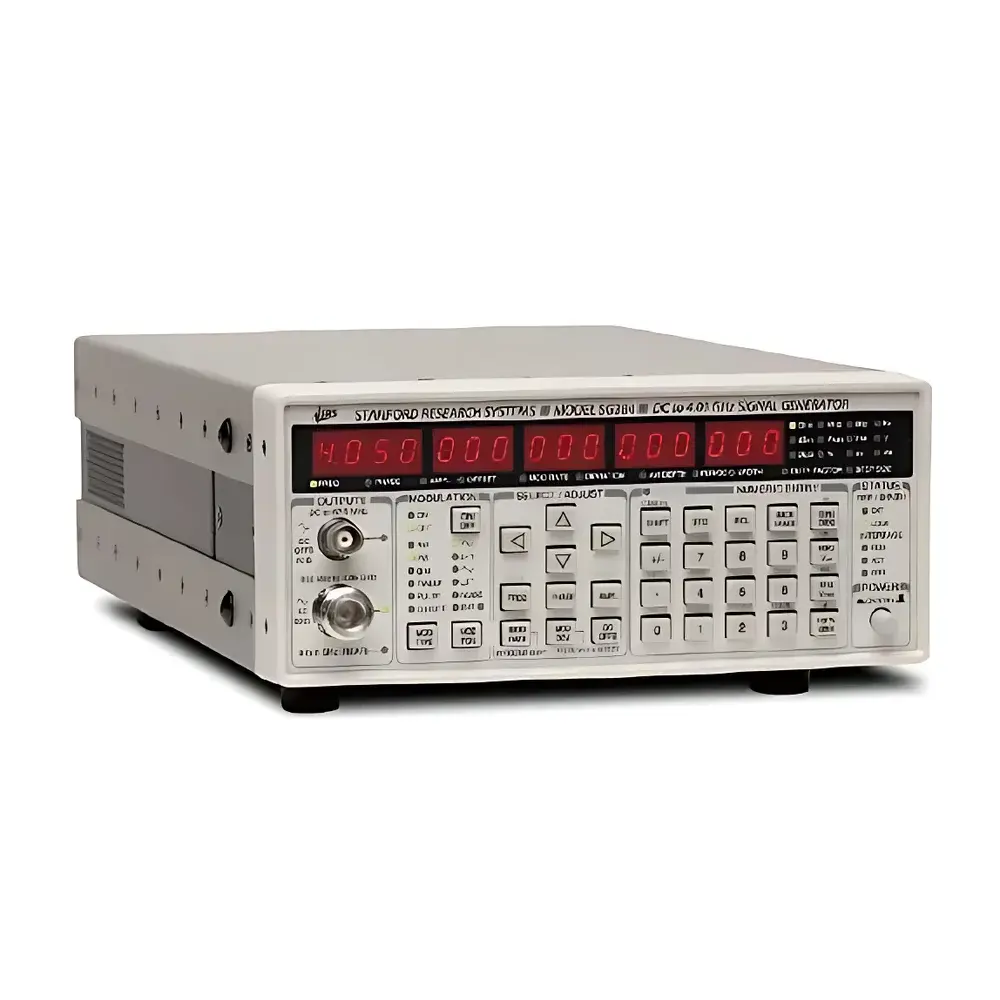
Stanford Research Systems SG396 Vector Signal Generator
| Brand | SRS/Stanford Research Systems |
|---|---|
| Origin | USA |
| Manufacturer Type | Authorized Distributor |
| Origin Category | Imported |
| Model | SG396 |
| Pricing | Available Upon Request |
| Frequency Range | DC to 6.075 GHz |
| Frequency Resolution | 1 µHz |
| Phase Noise | –116 dBc/Hz @ 1 GHz |
| Modulation Types | AM, FM, I/Q (300 MHz RF bandwidth), ASK, FSK, MSK, PSK, QAM, VSB, Custom I/Q |
| Standard Waveform Sets | GSM, EDGE, W-CDMA, APCO-25, DECT, NADC, PDC, ATSC-DTV, TETRA |
| Interfaces | Ethernet, GPIB, RS-232 |
Overview
The Stanford Research Systems SG396 Vector Signal Generator is a high-performance, laboratory-grade RF signal source engineered for precision modulation synthesis and spectral purity in research, development, and compliance testing environments. Based on direct digital synthesis (DDS) architecture augmented by analog upconversion stages, the SG396 delivers stable, low-noise continuous-wave (CW) and complex modulated signals from DC to 6.075 GHz. Its 1 µHz frequency resolution enables sub-Hz tuning stability essential for phase-sensitive applications such as lock-in detection, atomic physics experiments, and quantum control systems. The instrument achieves –116 dBc/Hz phase noise at 1 GHz offset by 10 kHz — a specification aligned with metrology-grade oscillators — making it suitable for characterizing low-phase-noise receivers, evaluating PLL loop dynamics, and supporting coherent communication system prototyping.
Key Features
- Ultra-fine frequency resolution of 1 µHz across full DC–6.075 GHz range, supporting precise sweep and step-tuning protocols.
- Low phase noise performance: –116 dBc/Hz typical at 1 GHz carrier, 10 kHz offset; optimized for spectral purity-critical applications.
- Integrated I/Q modulation engine with 300 MHz real-time RF bandwidth, supporting baseband sampling rates up to 600 MSa/s.
- Comprehensive digital modulation library including ASK, FSK, MSK, PSK (BPSK, QPSK), π/4-DQPSK, 16/64/256-QAM, VSB, and user-defined I/Q waveforms.
- Preset communication standards: GSM, EDGE, W-CDMA (UMTS), APCO-25 (P25), DECT, NADC (IS-54), PDC, ATSC-DTV, and TETRA — each configured per ITU-R and ETSI spectral masks and timing templates.
- Front-panel and remote programmability via IEEE-488 (GPIB), RS-232, and 10/100Base-T Ethernet with SCPI command compliance (IEEE 488.2, SCPI-1999).
- Internal arbitrary waveform memory (up to 16 Mpoints) with non-volatile storage for user-defined modulation sequences and calibration correction tables.
Sample Compatibility & Compliance
The SG396 is designed for integration into automated test systems operating under GLP, GMP, and ISO/IEC 17025 frameworks. Its traceable calibration path follows NIST-traceable standards, and factory calibration certificates include uncertainty budgets per ANSI/NCSL Z540-1. All preset waveforms adhere to published regulatory specifications: GSM/EDGE per ETSI EN 300 910; W-CDMA per 3GPP TS 25.104; ATSC-DTV per A/74 and A/53; and TETRA per ETSI EN 300 392-2. The instrument supports audit-ready operation through configurable event logging and timestamped output state reporting — compatible with FDA 21 CFR Part 11 requirements when deployed with validated software controls and electronic signature workflows.
Software & Data Management
SRS provides the SG396 Control Suite — a cross-platform application (Windows/macOS/Linux) supporting waveform generation, modulation parameter scripting, and real-time spectrum visualization. The suite exports I/Q data in industry-standard formats (MATLAB .mat, CSV, HDF5) and imports IQX, .wv, and .csv files for playback or offline analysis. Remote control is implemented via TCP/IP sockets or VISA-compliant drivers, enabling seamless integration with LabVIEW, Python (PyVISA), MATLAB Instrument Control Toolbox, and TestStand. Firmware updates are delivered via signed binary packages with SHA-256 verification, ensuring integrity and version traceability. All configuration states can be saved as XML-based project files, preserving modulation settings, trigger configurations, and calibration offsets.
Applications
- R&D validation of RF front-ends, mixers, and wideband ADCs/DACs requiring clean, modulated stimuli with known spectral occupancy.
- Characterization of phase-locked loops (PLLs), frequency synthesizers, and clock recovery circuits using precisely defined jitter and phase-step stimuli.
- Testing of SDR (Software-Defined Radio) platforms and cognitive radio prototypes with real-time reconfigurable modulation schemes.
- Education and training in digital communications labs, where students analyze constellation diagrams, EVM, ACLR, and spectral regrowth under controlled conditions.
- EMI/EMC pre-compliance testing using standardized modulated interference sources per CISPR 16-1-1 and MIL-STD-461G Annexes.
- Atomic, molecular, and optical (AMO) physics setups requiring ultra-stable, tunable microwave or RF fields for ion trapping, Rydberg excitation, or spin resonance control.
FAQ
What is the maximum I/Q baseband sample rate supported by the SG396?
The SG396 accepts I/Q input signals with a real-time RF bandwidth of 300 MHz, corresponding to an effective baseband sampling rate of up to 600 MSa/s (complex samples).
Does the SG396 support external reference locking?
Yes — it accepts 10 MHz and 100 MHz external reference inputs via SMA, with phase-lock capability and adjustable reference divider ratios.
Can the SG396 generate multi-carrier signals (e.g., OFDM) natively?
While not an OFDM-specific generator, its arbitrary waveform memory and real-time I/Q engine allow loading and playback of precomputed OFDM symbols compliant with IEEE 802.11a/g/n/ac standards.
Is firmware upgrade available remotely?
Yes — firmware updates are performed over Ethernet or GPIB using authenticated, digitally signed binaries provided through SRS’s secure customer portal.
What documentation is included with the instrument?
Each unit ships with a printed quick-start guide, comprehensive user manual (PDF and printed), calibration certificate, SCPI command reference, and waveform specification datasheets for all embedded standards.