
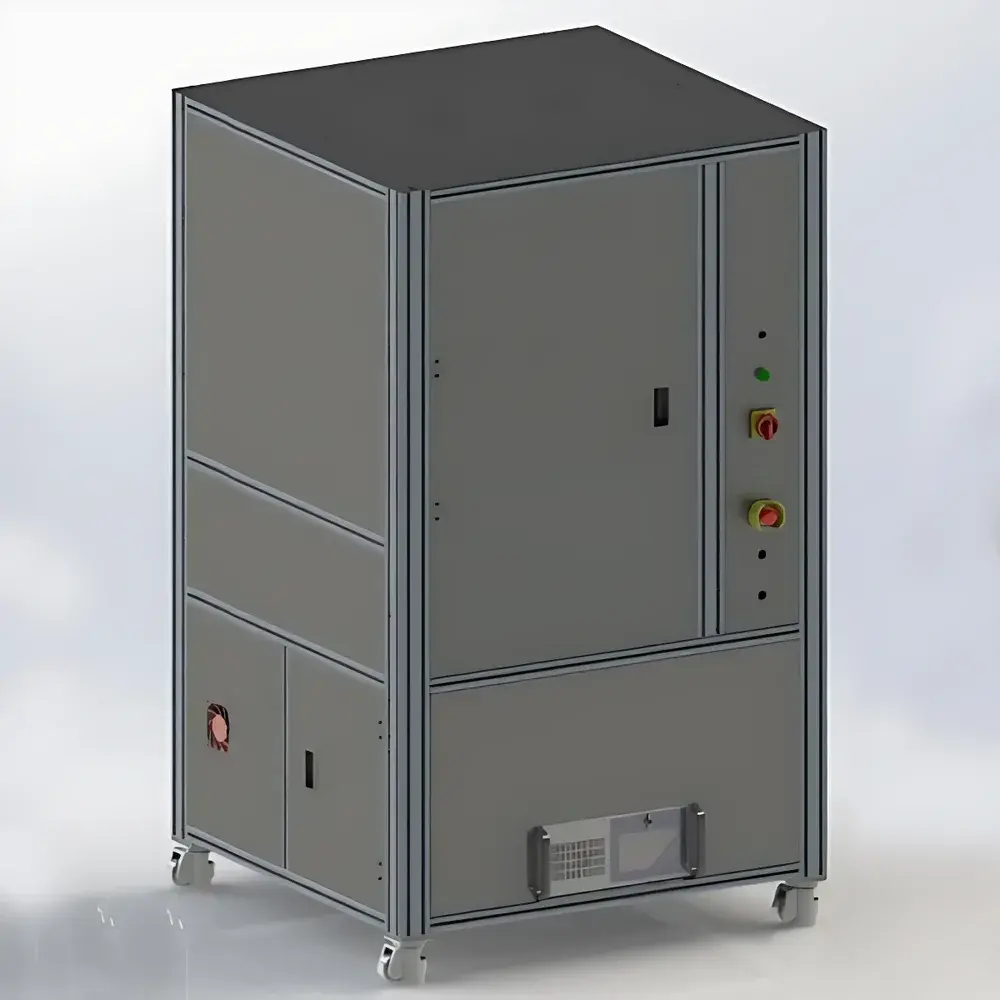
ZOLIX Multi-Channel Calibration and Inspection System for Ambient Lighting Modules
| Brand | ZOLIX |
|---|---|
| Model | Multi-Channel Calibration & Inspection System |
| Origin | Beijing, China |
| Type | Integrated Optical Calibration Platform |
| Core Components | Integrating Sphere + Light-Tight Enclosure + Fiber-Optic Spectrometer + Precision Linear Motion Stage + Industrial Control Computer + Custom Calibration Software |
| Measurement Parameters | Luminance (cd/m²), Chromaticity (CIE x,y / u'v'), Luminous Flux (lm), CCT (K), CRI (Ra), Dominant Wavelength (nm) |
| Positioning Accuracy | ±0.01 mm |
| Operation Modes | In-line and Off-line |
| Compliance | ISO/CIE Standard Illumination Geometry (4π/2π), ASTM E308, CIE 15:2018, IEC 62471 (Photobiological Safety) |
| Data Traceability | Full audit trail with timestamped measurement records, sample ID linkage, and user-access logging |
Overview
The ZOLIX Multi-Channel Calibration and Inspection System for Ambient Lighting Modules is an integrated optical metrology platform engineered for high-throughput photometric and colorimetric characterization of LED-based lighting modules—particularly PCBA-level assemblies used in automotive interior lighting, smart home ambient systems, and architectural lighting panels. Built upon fundamental principles of spectral radiometry and CIE-standardized photopic response modeling, the system combines calibrated spectral acquisition with spatially registered multi-point sampling to deliver traceable, repeatable measurements of luminance, chromaticity, correlated color temperature (CCT), color rendering index (CRI), dominant wavelength, and luminous flux. Its architecture adheres to the geometric constraints defined in CIE 15:2018 for integrating sphere photometry and ensures compliance with measurement conditions specified in ASTM E308 for color computation. The system operates under controlled dark-room conditions (light-tight enclosure) to eliminate ambient stray light interference, enabling sub-1% relative uncertainty in luminance reproducibility across repeated measurements.
Key Features
- Precision multi-axis linear motion stage with ±0.01 mm repeatability, ensuring consistent spatial registration between fiber-optic probe positions and target LED emitters across up to 16 independent channels.
- Modular integrating sphere configuration (1.5 m diameter standard; optional 0.5 m and 2.0 m variants) compliant with CIE 127:2007 and IES LM-79-19 for total luminous flux measurement.
- Fiber-coupled spectroradiometer with 0.2 nm optical resolution (FWHM), 350–1050 nm spectral range, and NIST-traceable calibration certificate included.
- Automated pass/fail decision engine applying user-defined tolerance bands for each photometric and colorimetric parameter, with real-time visual feedback and binary OK/NG output via industrial I/O interface.
- Unified software framework supporting both continuous in-line integration (via Ethernet/IP or Modbus TCP) and discrete off-line batch analysis with full GLP-compliant metadata capture.
Sample Compatibility & Compliance
The system accommodates PCB-mounted LED arrays, COB (chip-on-board) modules, and flexible LED strips with active area dimensions ranging from 2 mm × 2 mm to 200 mm × 200 mm. Fixture adaptability is achieved through programmable Z-height adjustment and interchangeable sample holders. All optical measurements conform to international standards including ISO/CIE S 014:2022 (photometry), IEC 62471 (LED photobiological safety classification), and USP (analytical instrument qualification). Audit trails comply with FDA 21 CFR Part 11 requirements for electronic records and signatures when configured with role-based access control and digital signature workflows.
Software & Data Management
The proprietary ZOLIX OptiCal Suite provides a Windows-based GUI with dual-mode operation: engineering mode (for method development, calibration maintenance, and uncertainty budgeting) and production mode (locked-down interface for operators). Data export supports CSV, XML, and HDF5 formats. Each measurement record includes embedded metadata: spectrometer calibration date, sphere coating reflectance history, motion stage encoder logs, environmental temperature/humidity (optional sensor input), and operator ID. Database archiving supports SQL Server or SQLite backends with configurable retention policies aligned with ISO/IEC 17025 documentation requirements.
Applications
- Final QA verification of automotive ambient lighting modules prior to vehicle assembly.
- R&D validation of tunable white and RGBW LED arrays under varying drive currents and thermal loads.
- Process capability analysis (Cp/Cpk) for luminance uniformity across multi-emitter PCBAs.
- Color binning support for post-manufacturing sorting based on CIEDE2000 ΔE₀₀ thresholds.
- Support for ISO 14572-compliant aging studies using synchronized thermal chamber integration.
FAQ
What spectral calibration standards are supported?
NIST-traceable tungsten halogen and deuterium lamps are supplied with each system; customer-specific calibration against reference LEDs or plasma sources can be implemented per ISO/IEC 17025 procedures.
Can the system validate flicker metrics (e.g., SVM, PstLM)?
Yes—when equipped with a high-speed spectroradiometer option (10 kHz sampling), the system computes IEEE 1789-compliant temporal light modulation metrics.
Is remote diagnostics and firmware update capability available?
Yes—via secure TLS-enabled web interface with SSH tunneling; all updates undergo SHA-256 signature verification prior to installation.
How is measurement uncertainty quantified and reported?
Uncertainty budgets follow JCGM 100:2008 (GUM) methodology and include contributions from spectral responsivity drift, sphere wall degradation, positioning error, and ambient temperature coefficient of the detector.
Does the system support integration with MES or SAP QM modules?
Native OPC UA server implementation enables bidirectional data exchange with enterprise manufacturing execution systems without custom middleware.





