
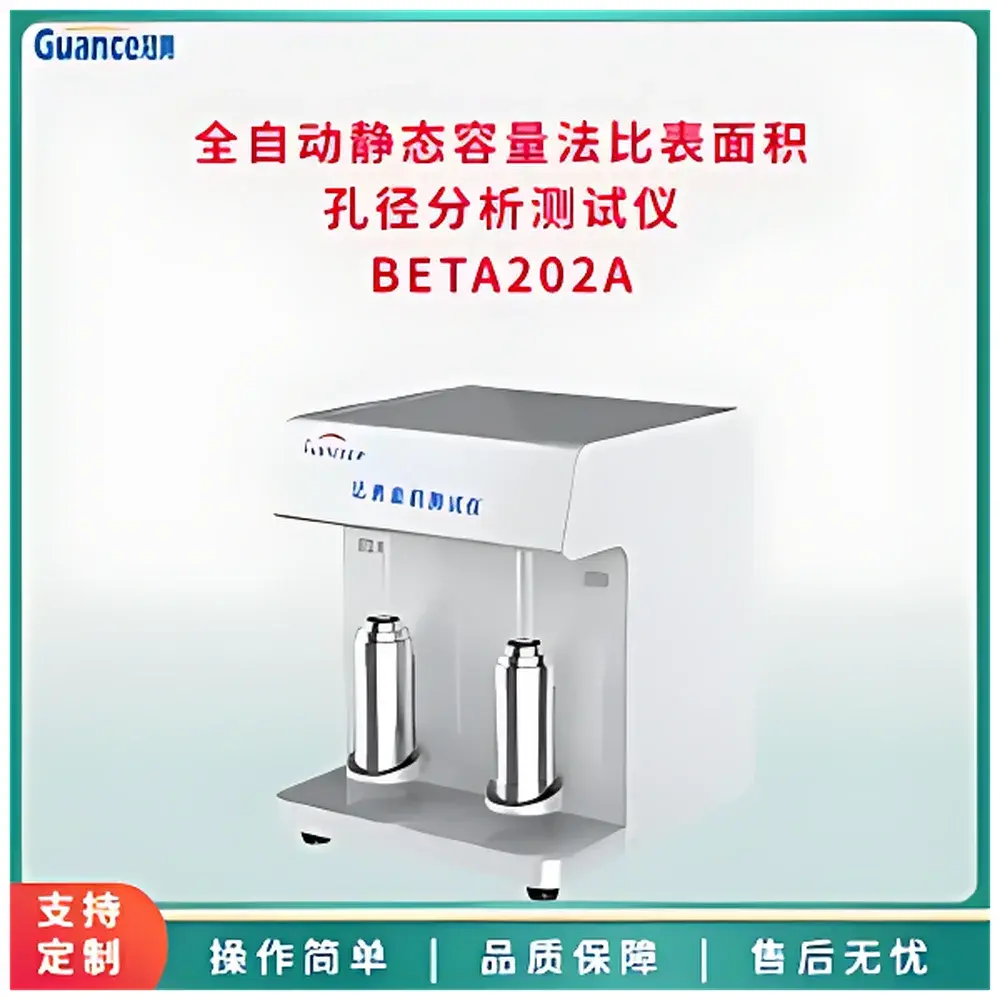
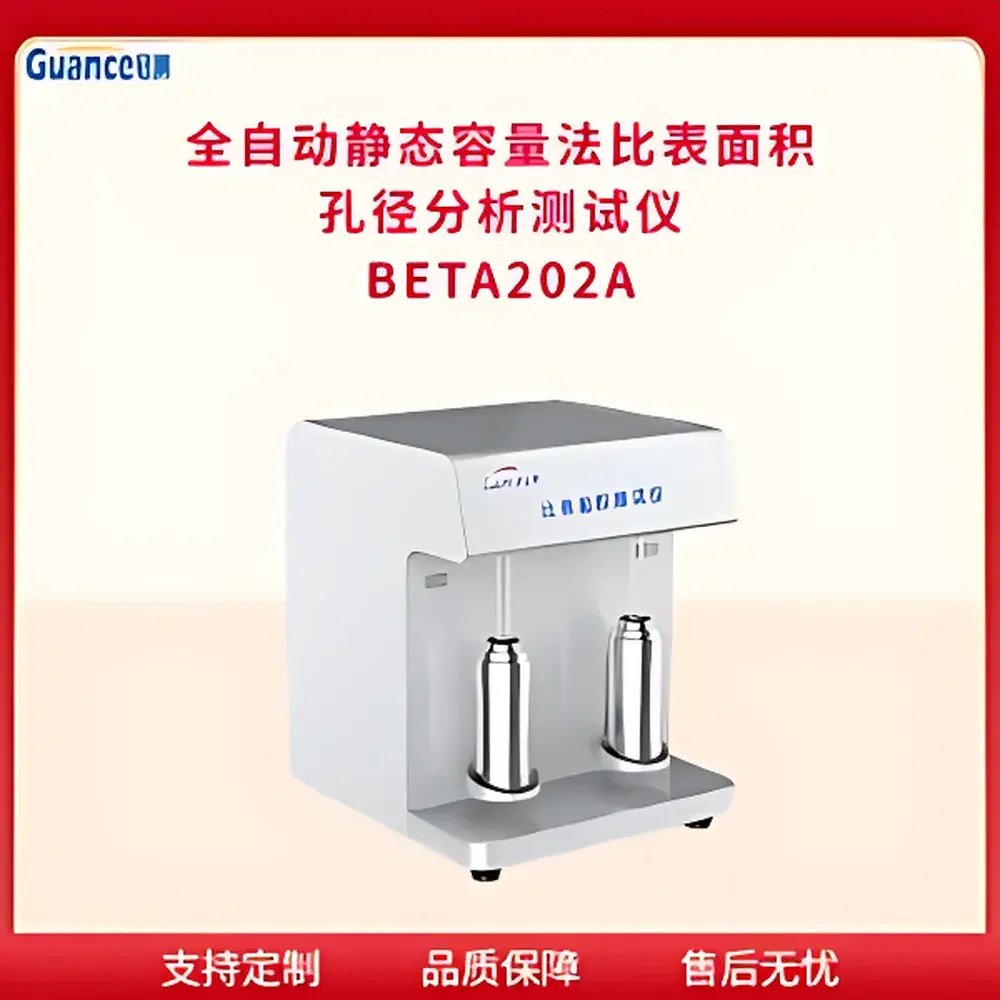
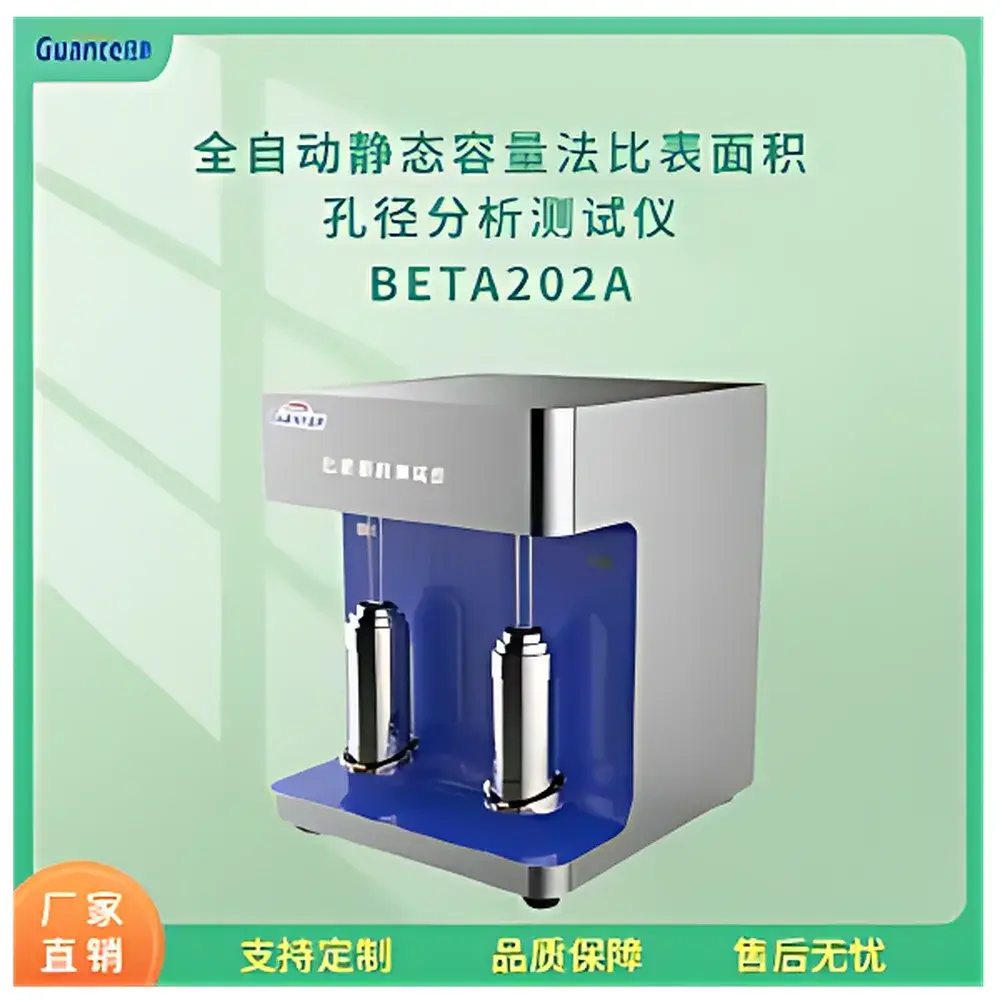
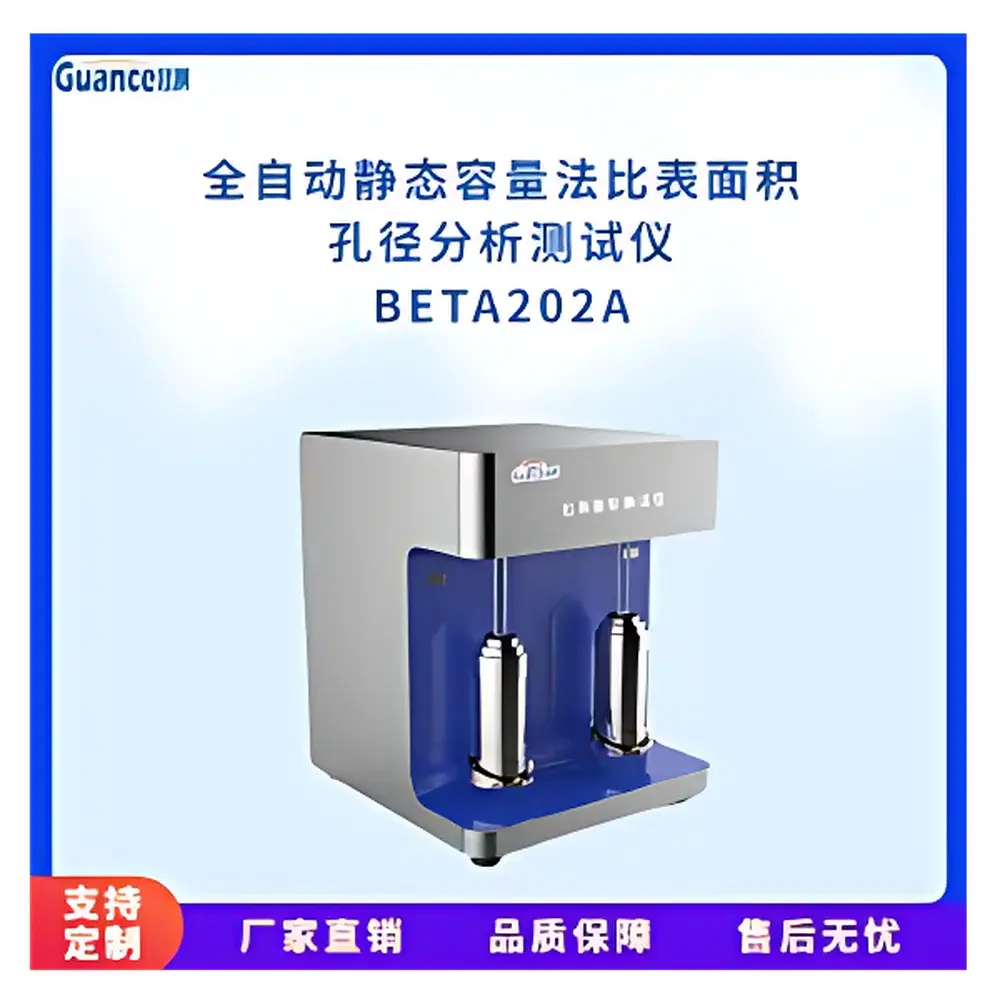
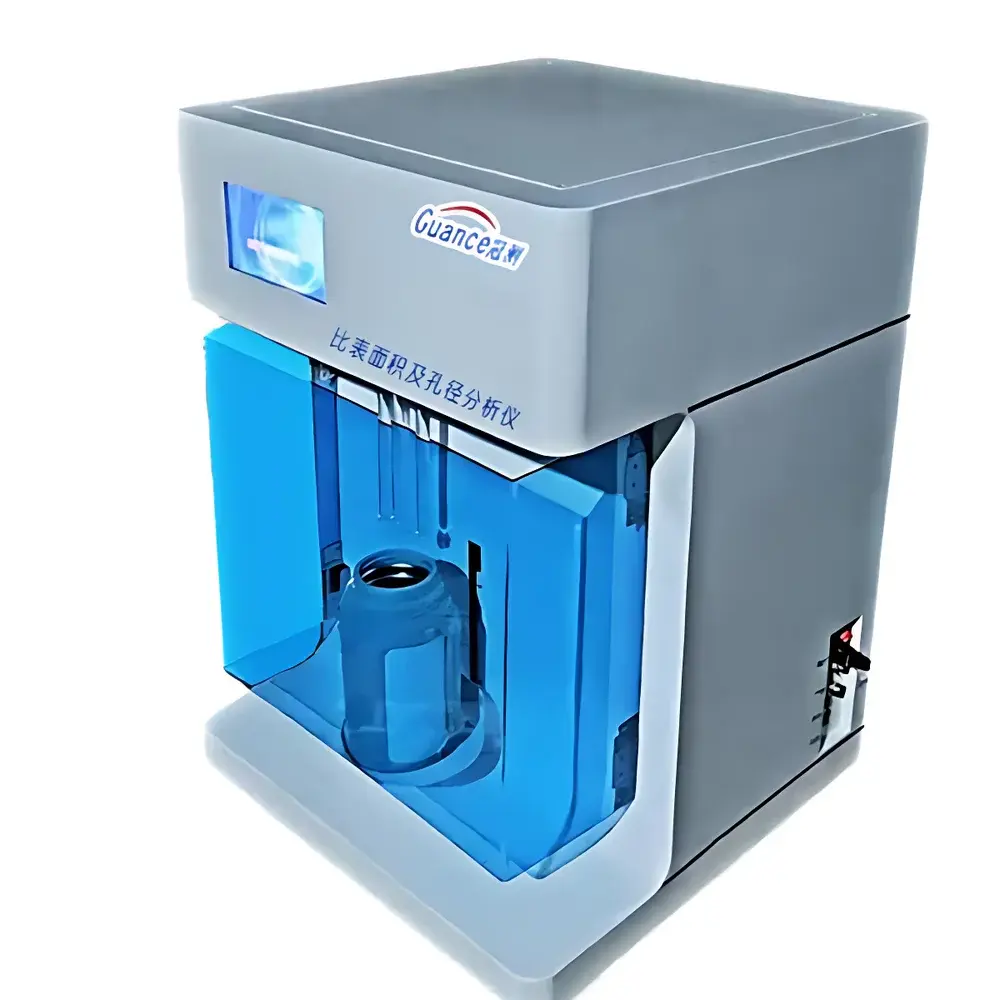
GuanCe Instruments BETA202A Specific Surface Area and Pore Size Analyzer
| Brand | GuanCe Instruments |
|---|---|
| Origin | Beijing, China |
| Model | BETA202A |
| Instrument Type | Specific Surface Area and Pore Size Analyzer |
| Principle | Static Volumetric Method (BET & DFT/NLDFT) |
| Analysis Stations | 1 dedicated station (optional dual-station configuration with 3 pressure transducers) |
| Surface Area Range | 0.0001 m²/g (using Kr adsorption) to unlimited |
| Pore Size Range | 0.35 nm – 500 nm |
| Pressure Range | 0–133 kPa (0–1000 Torr) |
| Repeatability | ±1% |
| Detection Limit for Pore Volume | 0.0001 cm³/g (N₂) |
| P/P₀ Resolution | down to 1×10⁻⁷ |
| Ultimate Vacuum | ≤1×10⁻⁸ Torr (with optional turbomolecular pump) |
| Thermal Control | Liquid nitrogen isothermal jacket + 70-hour Dewar capacity |
| Gas Compatibility | N₂, Ar, Kr, CO₂, NH₃, H₂, CO, O₂, CH₄, C₄H₁₀ (non-corrosive only) |
| Data Acquisition | 24-bit ADC, capacitive absolute pressure transducers (0.1% full-scale accuracy) |
Overview
The GuanCe Instruments BETA202A is a high-precision static volumetric gas adsorption analyzer engineered for rigorous determination of specific surface area, pore size distribution, pore volume, and pore geometry in heterogeneous solid materials. It operates on the foundational principles of Brunauer-Emmett-Teller (BET) theory for monolayer surface area calculation and Non-Local Density Functional Theory (NLDFT) or Density Functional Theory (DFT) kernel models for quantitative micropore/mesopore characterization. The instrument employs a rigorously validated static capacity method—where equilibrium gas uptake is measured at precisely controlled relative pressures (P/P₀) under ultra-high vacuum conditions—to deliver metrologically traceable results compliant with ISO 9277, ASTM D3663, and IUPAC recommendations. Designed for laboratory environments requiring long-duration unattended operation, the BETA202A integrates a dual-path vacuum architecture, metal-sealed stainless-steel manifold, and real-time P₀ referencing to eliminate systematic drift and ensure inter-laboratory reproducibility.
Key Features
- Triple independent pressure transducer system: one dedicated P₀ reference line and two parallel analysis channels—enabling simultaneous measurement of two samples with fully decoupled calibration and zero cross-contamination.
- Ultra-high vacuum capability: base pressure ≤1×10⁻⁸ Torr achieved via a multi-stage vacuum architecture featuring electropolished stainless-steel piping, metal-gasketed flanges, silver-plated internal surfaces, and an outer vacuum guard layer—minimizing outgassing and thermal transients.
- Intelligent vacuum management: adaptive pump cycling algorithm reduces mechanical wear, acoustic noise, and power consumption while maintaining <1×10⁻⁶ Torr during equilibration phases.
- Integrated isothermal control: liquid nitrogen Dewar (70-hour hold time) combined with a precision-machined thermal jacket ensures ΔT < ±0.1°C over full adsorption/desorption cycles—critical for accurate DFT model fitting.
- No-handling sample workflow: unified heating/de-gassing and analysis station eliminates air exposure; a patented three-way valve isolates desorption byproducts from the analytical manifold, preserving sensor integrity and vacuum stability.
- Full remote operability: Ethernet interface supports secure remote monitoring, diagnostic logging, multi-instrument orchestration via standard TCP/IP, and audit-trail-enabled session recovery after unexpected power loss.
Sample Compatibility & Compliance
The BETA202A accommodates powders (e.g., battery cathodes, MOFs, zeolites), granules, monoliths, fibers, and thin films—provided they are thermally stable under vacuum and chemically inert toward selected adsorbates. Sample holders accept standard 6–12 mm OD quartz tubes. Regulatory alignment includes support for 21 CFR Part 11-compliant electronic records (via optional software module), GLP/GMP-ready audit trails, and raw data export in vendor-neutral formats (CSV, XML). All pressure and temperature measurements are NIST-traceable through factory calibration certificates. The system meets ISO/IEC 17025 requirements for testing laboratories when operated within defined environmental and procedural controls.
Software & Data Management
GuanCe’s proprietary analysis suite provides bilingual (English/Chinese) GUI with role-based access control, automated report generation (PDF/Excel), and comparative overlay of isotherms across batches or timepoints. It embeds >30 pre-validated analysis protocols—including single-point/multi-point BET, t-plot, αs-method, BJH, DH, HK, and NLDFT kernels for carbon, silica, and alumina templates. Raw isotherm data (≥1000 P/P₀ points per run) is stored with full metadata: ambient conditions, degas parameters, transducer calibration IDs, and vacuum history logs. The database architecture supports custom method creation, version-controlled protocol libraries, and integration with LIMS via ODBC. Emergency recovery preserves partial isotherms post-interruption, enabling resumption without recalibration.
Applications
This analyzer serves QC labs validating catalyst support surface area (e.g., Pt/Al₂O₃), R&D teams optimizing porous carbons for supercapacitors, battery material developers quantifying SEI layer porosity, pharmaceutical scientists assessing excipient surface energetics, and geoscientists characterizing shale matrix permeability. Its Kr-adsorption mode extends reliable surface area measurement below 0.1 m²/g—essential for low-surface-area metals, dense ceramics, and geological specimens. CO₂ adsorption at 0°C enables accurate ultramicropore (<0.7 nm) profiling in activated carbons and MOFs, while Ar at 87 K improves resolution in narrow mesopores (2–10 nm).
FAQ
Does the BETA202A require helium for free space calibration?
No. The instrument uses nitrogen as the primary adsorbate and determines dead volume via integrated P₀ referencing and pressure-step manometry—eliminating dependence on helium and reducing operational cost and supply chain complexity.
Can it perform DFT pore size analysis without external software licensing?
Yes. NLDFT kernel libraries for carbon, silica, and γ-alumina are embedded in firmware and do not require third-party subscriptions or dongles.
What is the minimum detectable pore volume?
0.0001 cm³/g using nitrogen at 77 K, verified against certified reference materials (e.g., NIST SRM 2973) under ISO 9277-defined conditions.
Is vacuum pump oil contamination mitigated?
Yes. A cryo-trap and dual-stage foreline filtration system prevent backstreaming; all wetted parts contacting sample gas are metal-sealed and bakeable to 150°C.
How is data integrity ensured during extended overnight runs?
The system logs timestamped vacuum pressure, temperature, and valve actuation events every 100 ms; all raw sensor outputs are written to redundant storage with SHA-256 checksum validation.



