
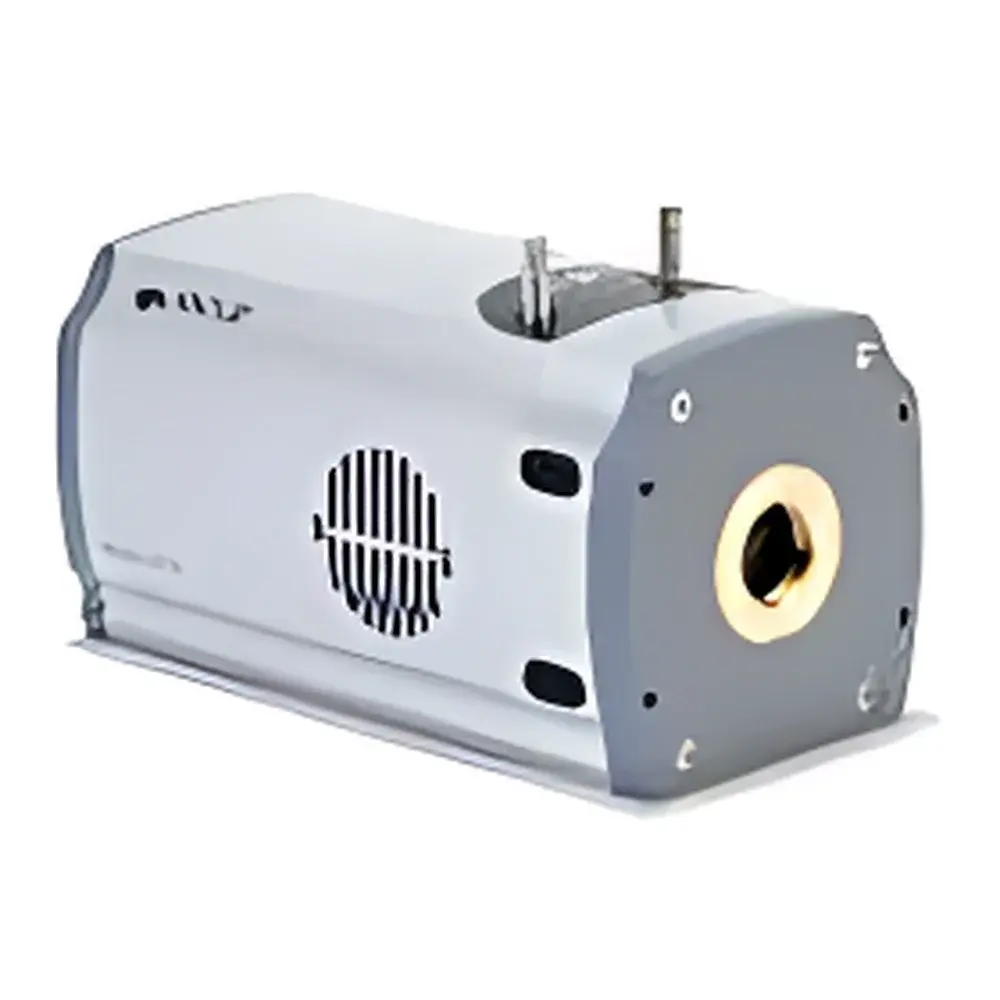
Andor iKon-M Deep-Cooling Scientific CCD Camera
| Brand | Andor |
|---|---|
| Origin | United Kingdom |
| Model | iKon-M Deep-Cooling |
| Cooling | UltraVac™ TE to –100 °C |
| Quantum Efficiency | up to 95% |
| Read Noise | exceptionally low (model-dependent, e.g., <3 e⁻ rms for 934) |
| Pixel Formats | 512×512, 1024×1024 |
| Pixel Size | 13 µm × 13 µm or 24 µm × 24 µm |
| Readout Speed | up to 8.0 MHz full-frame (model-specific) |
| Sensor Type | front-illuminated or deep-depletion back-illuminated CCD |
| Compliance | CE, RoHS, FDA 21 CFR Part 11-ready software support |
Overview
The Andor iKon-M is a high-performance, deep-cooling scientific CCD camera engineered for demanding low-light imaging applications in physics, astronomy, life sciences, and materials characterization. Based on charge-coupled device (CCD) technology operating under ultra-stable thermal conditions, the iKon-M leverages thermoelectric (TE) cooling via Andor’s proprietary UltraVac™ vacuum encapsulation to achieve sensor temperatures as low as –100 °C. This extreme cooling suppresses dark current to sub-0.001 e⁻/pixel/sec levels—critical for long-exposure quantitative imaging where signal integrity and dynamic range are paramount. The camera employs either front-illuminated or deep-depletion back-illuminated CCD sensors, with quantum efficiency exceeding 95% in the visible range and extended responsivity into the near-infrared (NIR) spectrum (700–1100 nm) for the deep-depletion variants. Its architecture supports both full-frame and frame-transfer readout modes, enabling flexibility between maximum sensitivity and minimal smear in time-resolved experiments.
Key Features
- UltraVac™ thermoelectric cooling to –100 °C, ensuring ultra-low dark current and high stability over multi-hour acquisitions
- Quantum efficiency up to 95% (back-illuminated models), with deep-depletion options delivering enhanced NIR response and fringe suppression
- Multi-MHz pixel readout speeds (up to 8.0 MHz depending on model), balancing speed and noise performance for dynamic studies
- Flexible sensor configurations: 512×512 and 1024×1024 formats with pixel pitches of 13 µm or 24 µm, supporting resolution vs. field-of-view trade-offs
- Low-noise electronics design achieving read noise as low as <3 e⁻ rms (typical for model iKon-934), optimized for photon-starved applications
- OEM-friendly compact housing (120 × 110 × 95 mm) with USB 2.0 plug-and-play connectivity—no external power supply or controller required
- Firmware-upgradable architecture supporting future feature enhancements and calibration refinements
Sample Compatibility & Compliance
The iKon-M is compatible with standard C-mount and F-mount optical interfaces, enabling seamless integration into microscopes, spectrographs, telescopes, and custom optical benches. Its vacuum-sealed sensor chamber eliminates condensation risks during cryogenic or humid ambient operation. From a regulatory standpoint, the camera system—including its bundled Solis™ acquisition software—is designed to support compliance with GLP and GMP environments. Solis™ provides full audit trail functionality, electronic signatures, and 21 CFR Part 11–compliant data handling when configured with appropriate IT infrastructure. All iKon-M units conform to CE marking requirements for electromagnetic compatibility (EMC Directive 2014/30/EU) and safety (LVD Directive 2014/35/EU), and meet RoHS 2011/65/EU restrictions on hazardous substances.
Software & Data Management
Andor Solis™ software serves as the primary control and analysis platform for the iKon-M, offering intuitive hardware synchronization, real-time histogram visualization, region-of-interest (ROI) binning, and non-uniformity correction (NUC). Raw image data is saved in industry-standard 16-bit TIFF or FITS format, preserving full bit-depth for downstream processing in MATLAB, Python (via PyAndor or Andor SDK), or ImageJ. The Andor Software Development Kit (SDK) provides comprehensive C/C++, .NET, and LabVIEW APIs, enabling full OEM integration and automation within custom experimental control suites. Time-series acquisition supports precise trigger timing (external TTL or internal programmable), with metadata (exposure time, temperature, gain, timestamp) embedded directly into image headers per IEEE 1789-2015 standards.
Applications
- Astronomical photometry and spectroscopy requiring high SNR over extended integrations
- Fluorescence lifetime imaging (FLIM) and Förster resonance energy transfer (FRET) microscopy
- Raman and fluorescence spectroscopy with weak emission signals
- Plasma diagnostics and laser-induced breakdown spectroscopy (LIBS)
- Time-resolved diffraction and pump-probe experiments using frame-transfer capability
- Quantitative western blotting and chemiluminescence detection in molecular biology
- Particle tracking and single-molecule localization microscopy (SMLM) workflows
FAQ
What cooling method does the iKon-M use, and how is it maintained?
The iKon-M employs solid-state thermoelectric (Peltier) cooling combined with UltraVac™ vacuum insulation to sustain stable –100 °C sensor temperatures without liquid nitrogen or mechanical cryocoolers.
Is the iKon-M suitable for spectroscopic applications?
Yes—the deep-depletion models (e.g., iKon-934-BRDD) offer reduced etaloning and high QE across 400–1100 nm, making them ideal for UV-Vis-NIR spectroscopy and hyperspectral imaging.
Can the camera be integrated into automated production inspection systems?
Absolutely—the compact form factor, USB 2.0 interface, SDK support, and deterministic exposure timing make it well-suited for OEM machine vision and QC instrumentation.
Does the system support hardware triggering and synchronization with other instruments?
Yes—dedicated TTL input/output ports enable precise external triggering, gate control, and synchronization with lasers, shutters, or motion stages.
How is calibration handled for quantitative intensity measurements?
Each unit ships with factory-measured gain, offset, and linearity calibration; Solis™ applies these corrections automatically, and raw uncorrected data remains accessible for advanced metrology workflows.






