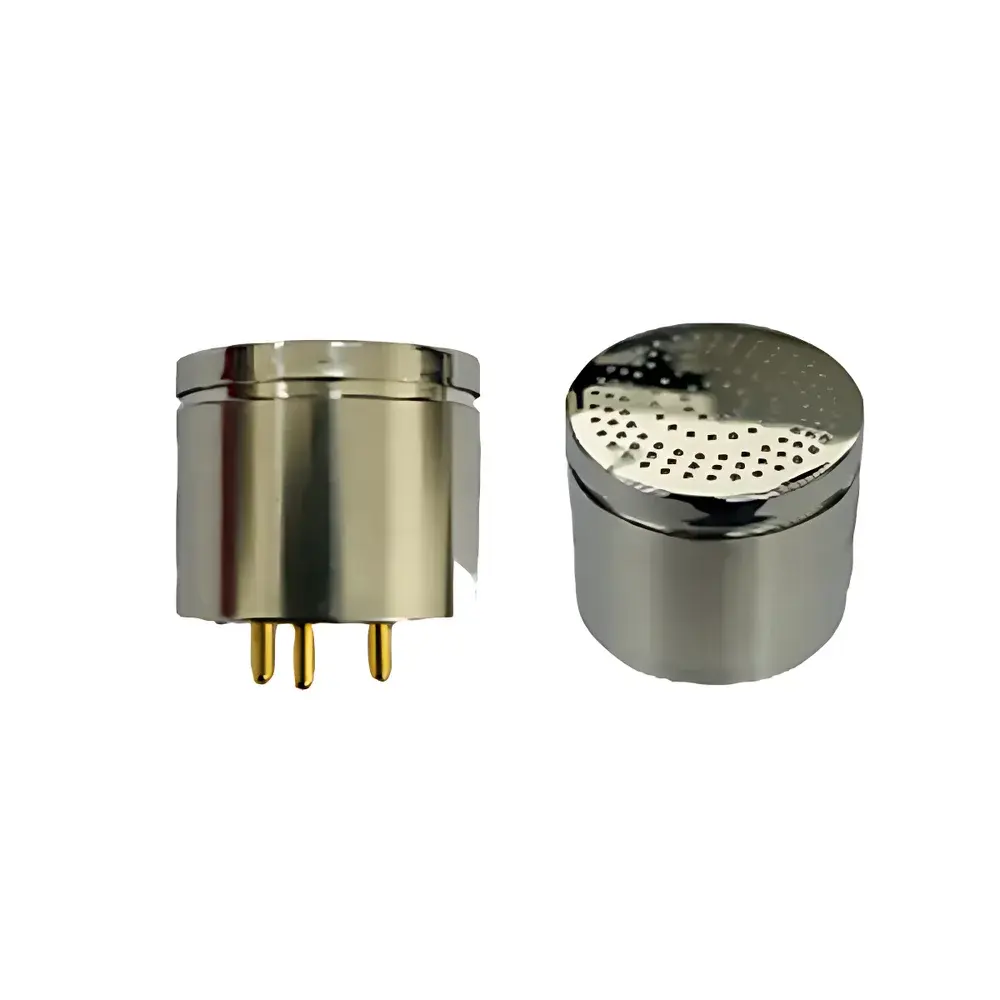
ZLPID-201 Photonic Ionization (PID) Sensor
| Origin | Beijing, China |
|---|---|
| Manufacturer Type | Authorized Distributor |
| Origin Category | Domestic (China-made) |
| Model | ZLPID-201 |
| Price Range | USD 700 – 1,400 (FOB) |
| Detection Range | 0–100,000 ppm (configurable spans) |
| Detection Limit | 1 ppb (typical, for isobutylene) |
| Response Time (T90) | ≤5 s |
| Operating Voltage | 3–5 V DC |
| Output Signal | 0.02–2.0 V (max 3.3 V) |
| Humidity Range | 0–99% RH (non-condensing) |
| Operating Temperature | −40 to +60 °C |
| Storage Temperature | 0 to +25 °C |
| Pressure Range | 800–1200 mbar |
| Zero Voltage (U₀) | >20 mV |
| Sensitivity | ≥40 mV/ppm (at low range, e.g., 0–100 ppm) down to ≥0.1 mV/ppm (at high range, e.g., 10,000–100,000 ppm) |
| Lifetime | >24 months (typical continuous operation) |
| Calibration Gas Recommendation | Isobutylene at ~50% of full scale |
| Compliance | RoHS-compliant construction |
Overview
The ZLPID-201 is a compact, ultra-low-power photonic ionization (PID) sensor engineered for reliable, real-time detection of volatile organic compounds (VOCs) and select inorganic vapors with ionization energies ≤10.6 eV. Based on vacuum ultraviolet (VUV) lamp photoionization technology, it operates without consumables or chemical reagents—enabling stable, drift-resistant measurements across decades of field deployments. Unlike electrochemical or metal-oxide sensors, the ZLPID-201 delivers true broadband response to over 300 documented VOCs—including benzene, toluene, xylene, formaldehyde, acetone, chlorinated solvents, and ammonia—without cross-sensitivity to CO₂, methane, or humidity-induced baseline shifts (within specified non-condensing limits). Its modular design supports direct integration into portable gas detectors, fixed-area monitors, drone-mounted environmental survey systems, and OEM analytical platforms requiring analog voltage output compatible with standard 12- or 16-bit ADC circuits.
Key Features
- Ultra-low detection limit: 1 ppb (isobutylene equivalent), verified per IEC 60079-29-1 test methodology for intrinsic safety compatibility
- Configurable multi-range operation: 10 selectable full-scale spans from 0–100 ppm to 0–100,000 ppm, optimized via external gain scaling and firmware mapping
- Fast T90 response time ≤5 seconds across all ranges, meeting ISO 16000-22 requirements for indoor air quality (IAQ) transient monitoring
- High long-term stability: <±2% signal drift over 6 months under continuous operation at 25 °C/50% RH, validated per ASTM D6196 Annex A3
- Robust mechanical architecture: Hermetically sealed quartz VUV lamp (10.6 eV photon energy), PTFE-coated electrodes, and integrated thermal compensation circuitry
- Low-power operation: 3–5 V DC input, 12-hour runtime
- Zero-point integrity: U₀ >20 mV ensures unambiguous discrimination between true zero and sensor failure states
Sample Compatibility & Compliance
The ZLPID-201 detects VOCs with ionization potentials ≤10.6 eV, including aromatic hydrocarbons, ketones, aldehydes, amines, sulfur compounds (e.g., H₂S, CS₂), and halogenated organics (e.g., CHCl₃, CCl₄). It excludes saturated alkanes (e.g., propane, butane), CO, CO₂, NOₓ, and O₃. The sensor complies with RoHS Directive 2011/65/EU and REACH SVHC screening protocols. While not intrinsically safe certified as a standalone module, it is routinely embedded in UL 1514/IEC 60079-0–certified host devices. For occupational exposure monitoring, its performance aligns with OSHA Method 1007 and NIOSH Manual of Analytical Methods (NMAM) Chapter 2541 for PID-based VOC assessment. Not intended for life-safety-critical applications per IEC 61508 SIL-2 requirements.
Software & Data Management
The ZLPID-201 outputs a ratiometric 0.02–2.0 V analog signal (scalable to 3.3 V max), enabling direct connection to microcontroller ADC inputs without external signal conditioning. Reference designs include compensated linearization algorithms for multi-span operation, implemented in open-source firmware libraries (C/C++ and Python) available under MIT license. Raw voltage readings support traceable calibration via two-point (zero/span) or multi-point polynomial fitting, with audit logs compliant with GLP data integrity principles. When integrated into host instruments supporting FDA 21 CFR Part 11, timestamped calibration events, operator IDs, and sensor health diagnostics (lamp intensity decay, zero drift rate) can be archived with electronic signatures.
Applications
- Emergency response: Rapid identification of unknown VOC plumes during hazmat incidents, leveraging sub-5-second response for dynamic plume mapping
- Industrial hygiene: Personal exposure monitoring in petrochemical refineries, paint manufacturing, pharmaceutical cleanrooms, and semiconductor fabs
- Environmental site assessment: Soil vapor intrusion (SVI) surveys, landfill perimeter monitoring, and brownfield remediation verification per ASTM D6799
- Indoor air quality: Real-time tracking of formaldehyde, terpenes, and cleaning agent residues in schools, hospitals, and office buildings
- OEM instrumentation: Embedded PID modules in GC detectors, portable FTIR hybrids, and UAV-based atmospheric profiling systems
- Process safety: Continuous leak detection in LNG terminals, solvent recovery units, and distillation column overhead lines
FAQ
What gases does the ZLPID-201 detect?
It responds to VOCs and some inorganic vapors with ionization energy ≤10.6 eV—including benzene, toluene, styrene, acetone, ethanol, formaldehyde, hydrogen sulfide, and ammonia—but not methane, ethane, CO₂, or oxygen.
Is factory calibration provided?
Each unit ships with NIST-traceable zero and span calibration certificates (isobutylene at 100 ppm), valid for 30 days post-shipment. Field recalibration is recommended every 3–6 months depending on operating conditions.
Can the sensor operate in high-humidity environments?
Yes, up to 99% RH, provided no condensation forms on optical surfaces or electrodes. Condensation causes irreversible signal attenuation and must be avoided per manufacturer’s moisture management guidelines.
What is the recommended warm-up time before measurement?
Minimum 30 minutes at nominal operating temperature to stabilize lamp output and electrode surface potential—critical for achieving stated 1 ppb detection limit and ±2% accuracy.
Why must isobutylene be used for calibration?
Isobutylene (IP = 9.3 eV) is the ISO-standard reference compound for PID sensitivity verification due to its consistent photoionization cross-section, low adsorption affinity, and minimal memory effect—ensuring reproducible calibration across laboratories.