
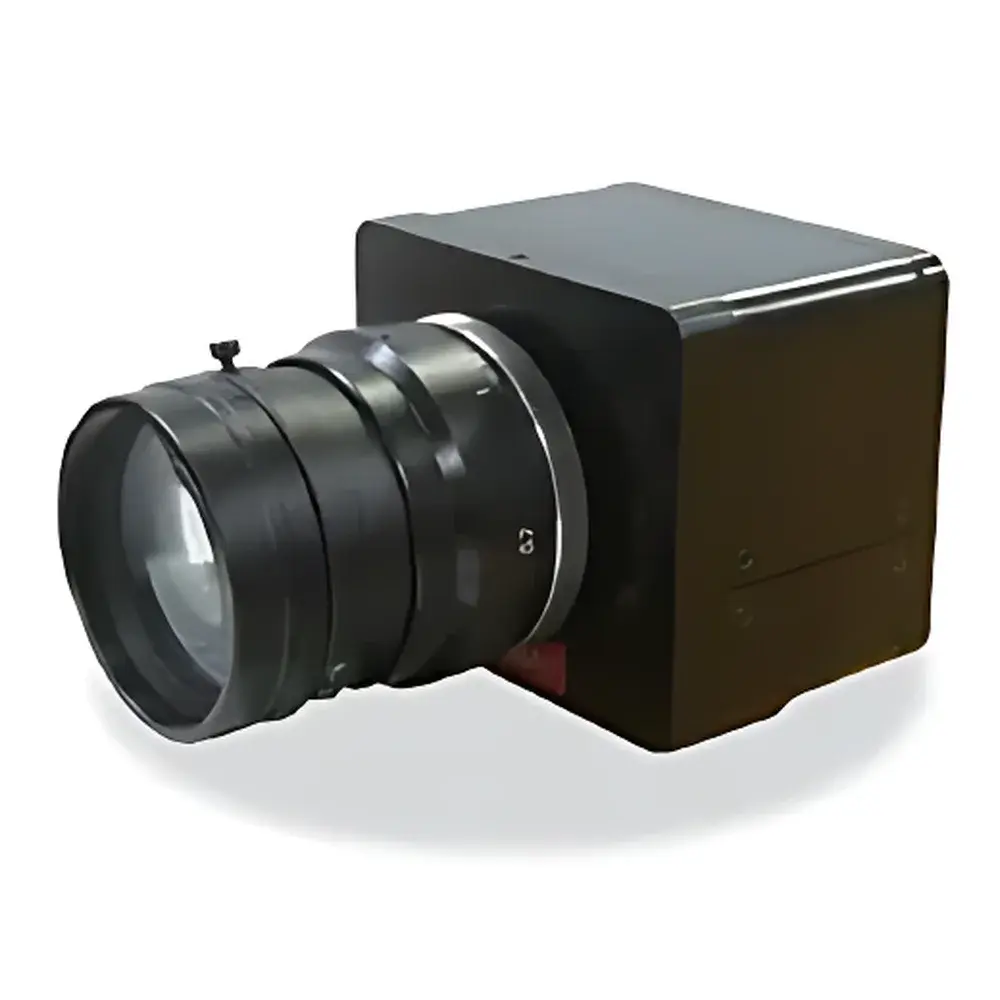
Artray ARTCAM-2020UV-USB3 Back-Illuminated UV CMOS Camera
| Brand | Artray |
|---|---|
| Origin | Japan |
| Model | ARTCAM-2020UV-USB3 |
| Sensor Type | Back-Illuminated CMOS |
| Shutter Type | Rolling Shutter |
| Resolution | 2048 × 2048 |
| Pixel Size | 6.5 µm |
| A/D Bit Depth | 12-bit |
| Frame Rate | 45 fps |
| Spectral Range | 200–400 nm (UV) |
| Interface | USB 3.0 |
Overview
The Artray ARTCAM-2020UV-USB3 is a high-sensitivity, back-illuminated CMOS imaging sensor designed specifically for ultraviolet (UV) spectral detection in the 200–400 nm range. Unlike front-illuminated sensors, its back-illuminated architecture maximizes quantum efficiency across the deep UV and near-UV bands—critical for applications where photon flux is inherently low due to atmospheric absorption, optical material limitations, or sample attenuation. Engineered for scientific and industrial UV imaging, the camera leverages a monolithic 2048 × 2048 pixel array with 6.5 µm square pixels, delivering spatial fidelity suitable for high-magnification fluorescence microscopy, UV lithography alignment, semiconductor wafer inspection, and UV-curable resin process monitoring. Its USB 3.0 interface ensures sustained 45 fps full-frame readout with minimal latency and deterministic data transfer—essential for time-resolved UV experiments and automated inline quality control systems.
Key Features
- Back-illuminated CMOS sensor optimized for 200–400 nm spectral response, achieving >50% peak QE in the 254–365 nm band without external phosphor conversion
- True 2048 × 2048 resolution with on-chip binning support (2×2, 4×4) to enhance signal-to-noise ratio in low-light UV conditions
- 12-bit analog-to-digital conversion with programmable gain and offset, enabling dynamic range optimization for both weak fluorescence and intense UV reflection signals
- Rolling shutter operation with hardware-triggered exposure control (TTL-compatible), supporting precise synchronization with pulsed UV sources (e.g., xenon flash lamps, nitrogen lasers)
- Thermally stable housing with passive heat dissipation—designed for continuous operation in cleanroom and vacuum-compatible environments (optional mounting flange available)
- USB 3.0 Vision-compliant interface with GenICam-compatible register map, ensuring interoperability with third-party acquisition software (e.g., HALCON, LabVIEW IMAQ, MATLAB Image Acquisition Toolbox)
Sample Compatibility & Compliance
The ARTCAM-2020UV-USB3 is compatible with standard C-mount and F-mount UV-transmissive optics (e.g., quartz, CaF₂, MgF₂ lenses) and integrates seamlessly into optical setups requiring UV-grade illumination and filtering. It supports ISO 10110-compliant surface inspection protocols and meets mechanical and electrical requirements for integration into ASTM E2912-22 (Standard Practice for UV Imaging in Nondestructive Testing) workflows. While not certified as medical device hardware, its firmware architecture supports audit-trail-capable metadata logging (timestamp, exposure, gain, temperature), facilitating GLP-compliant documentation in R&D laboratories. No internal battery or wireless components; fully compliant with CE, FCC Part 15 Subpart B, and RoHS directives.
Software & Data Management
Artray provides a native SDK (C/C++, Python bindings) and GUI-based acquisition software with real-time histogram analysis, region-of-interest (ROI) statistics, and non-uniformity correction (NUC) calibration routines. Raw image data is output in lossless 12-bit TIFF or memory-mapped binary formats, preserving full bit depth for post-processing. The SDK supports multi-camera synchronization via software trigger or external TTL input, enabling stereo UV imaging or multi-angle defect mapping. All metadata—including sensor temperature (monitored via on-die diode), exposure duration, and gain settings—is embedded in TIFF headers per EXIF 2.31 specification. For regulated environments, optional firmware enables write-once metadata tagging aligned with FDA 21 CFR Part 11 electronic record requirements.
Applications
- UV fluorescence imaging of biological samples stained with DAPI, Hoechst, or other UV-excitable dyes under mercury or LED excitation
- In-line monitoring of UV-cured adhesives, coatings, and 3D-printed photopolymers during manufacturing
- Inspection of semiconductor photomasks, EUV pellicles, and micro-optical elements using 248 nm or 365 nm illumination
- Plasma diagnostics in fusion research, where UV line emissions (e.g., Hα at 656 nm is out-of-band; but C IV at 155 nm and O VI at 103 nm require UV-optimized sensors)
- Forensic document analysis involving UV-induced fluorescence of security inks, paper additives, or latent fingerprints
- Environmental UV radiometry calibration reference when paired with NIST-traceable broadband or narrowband UV sources
FAQ
Is the sensor sensitive below 200 nm (vacuum UV)?
No—the ARTCAM-2020UV-USB3 is optimized for 200–400 nm. Below 200 nm, atmospheric oxygen absorption and quartz window cutoff limit effective transmission; operation in vacuum UV requires specialized magnesium fluoride windows and electron-bombarded sensors.
Does the camera support global shutter mode?
No—it employs a rolling shutter. For applications requiring motion-freeze capture of fast UV events, external strobe synchronization and short exposure timing (<100 µs) are recommended.
Can it be used with standard microscope objectives?
Yes—with appropriate UV-transmissive relay optics. Standard glass objectives absorb strongly below 350 nm; use of Nikon UV-Nikkor, Mitutoyo UV M Plan Apo, or custom CaF₂ couplers is required for optimal throughput.
What is the typical dark current at room temperature?
Measured median dark current is ≤0.5 e⁻/pixel/s at 25°C ambient, verified per EMVA 1288 standard; cooling is not integrated but external Peltier mounts (sold separately) reduce dark current by ~50% per 10°C drop.
Is SDK support available for Linux?
Yes—full C API and Python ctypes wrappers are provided for Ubuntu 20.04+ and CentOS 7+, including udev rules for plug-and-play USB 3.0 enumeration.



