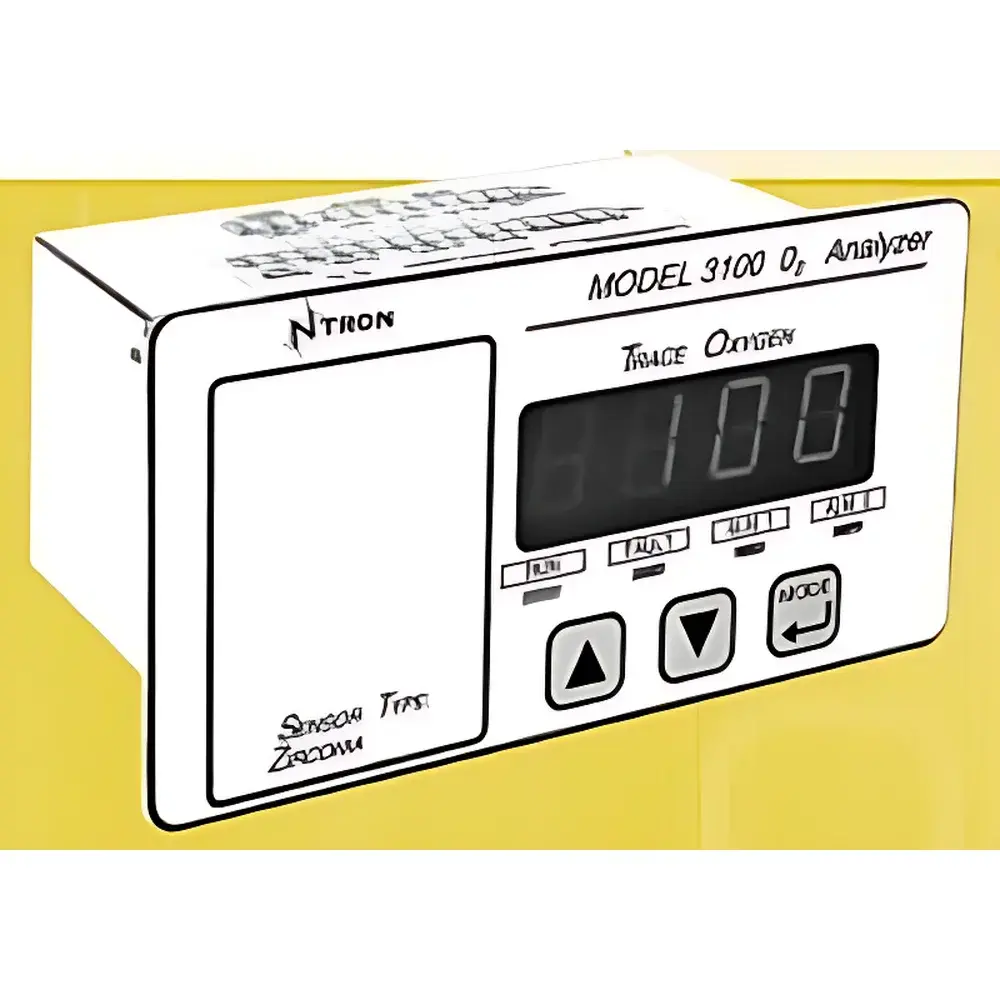
Neutronics Model 3100 Zirconia-Based Oxygen Analyzer
| Brand | Neutronics |
|---|---|
| Origin | USA |
| Model | Model 3100 |
| Sensor Type | High-Stability Zirconia Electrolyte Sensor |
| Measurement Ranges | 0–10 ppm, 0–100 ppm, 0–1,000 ppm, or 0–100% O₂ (auto-ranging or fixed-range configuration) |
| Display | 0.75" (19.05 mm) LED numeric display with status LEDs (green = normal/online, yellow = fault), dual alarm indicators |
| Response Time | <10 seconds (T₉₀) |
| Accuracy | ±2% FS at constant temperature |
| Operating Temperature | 5–45 °C |
| Output Signals | RS-232 serial interface |
| Alarm Outputs | Two programmable SPDT relay outputs (configurable for high/low/alarm latching or trip functions) |
| Sample Inlet | 1/4" compression fitting |
| Electrical Connection | Plug-in terminal block |
| Power Supply | 5 W, 115/230 VAC 50/60 Hz or 12–30 VDC |
| Enclosure Rating | Front panel: NEMA 4 / IP66 |
| Housing | NEMA 1 / IP20 |
| Expected Sensor Lifetime | 5–10 years under typical industrial conditions |
| Compliance | Designed for continuous emission monitoring and process safety applications in accordance with general industrial instrumentation standards (IEC 61000-6-2/6-4, UL 61010-1, CE) |
Overview
The Neutronics Model 3100 is a robust, field-deployable zirconia-based oxygen analyzer engineered for continuous, real-time measurement of trace to bulk oxygen concentrations in industrial process streams. Utilizing a high-temperature, stabilized zirconium dioxide (ZrO₂) electrochemical cell operating at ~700 °C, the instrument measures oxygen partial pressure via the Nernst equation—delivering stable, drift-resistant performance without consumables or external reference gases. Its design targets demanding environments including inert atmosphere furnaces, reflow soldering ovens, heat treatment systems, and controlled-atmosphere packaging lines where precise O₂ control directly impacts product quality, metallurgical integrity, and safety compliance. Unlike paramagnetic or electrochemical sensors, the zirconia platform offers inherent immunity to background gas interference (e.g., CO₂, H₂O vapor, hydrocarbons), long-term calibration stability, and minimal maintenance requirements—making it suitable for unattended operation over extended intervals.
Key Features
- Zirconia electrolyte sensor with integrated heater and thermocouple for precise temperature control and compensation
- Four selectable measurement ranges: 0–10 ppm, 0–100 ppm, 0–1,000 ppm, and 0–100% O₂—switchable manually or configured for automatic range optimization based on signal magnitude
- Fast T₉₀ response time of less than 10 seconds ensures timely detection of process excursions or purge failures
- Dual independent alarm relays with user-defined thresholds and hysteresis settings support fail-safe integration into plant safety instrumented systems (SIS)
- Front-panel LED status indicators provide immediate visual diagnostics: green for operational readiness, yellow for fault conditions (e.g., sensor open-circuit, temperature deviation, signal saturation)
- Modular electrical interface with pluggable terminal block simplifies field wiring, replacement, and system integration
- NEMA 4/IP66-rated front panel ensures resistance to dust ingress, water spray, and corrosive atmospheres typical in manufacturing floor environments
Sample Compatibility & Compliance
The Model 3100 is compatible with dry or moderately humid sample gases across a wide thermal and compositional spectrum. It tolerates non-condensing moisture levels up to 80% RH and is unaffected by common process gases such as N₂, Ar, H₂, CO, CO₂, and hydrocarbon vapors—provided no catalytic poisons (e.g., silicones, halogenated compounds, heavy metal fumes) are present in the sample stream. While not intrinsically rated for hazardous locations, its enclosure meets IEC 61000 electromagnetic compatibility (EMC) standards and carries UL 61010-1 certification for laboratory and industrial use. The analyzer supports traceability and audit readiness through optional data logging and timestamped calibration records—aligning with GLP and GMP documentation expectations for regulated thermal processing operations.
Software & Data Management
Though primarily a stand-alone hardware analyzer, the Model 3100 includes an RS-232 serial interface enabling bidirectional communication with host SCADA, DCS, or PC-based monitoring software. ASCII protocol commands allow remote reading of live O₂ concentration, sensor temperature, status flags, and alarm states. Analog outputs (4–20 mA and 0–10 VDC) are fully isolated and scalable per user-defined engineering units, facilitating direct integration into legacy PLC architectures. Calibration history—including date, operator ID, standard gas concentration, and post-calibration deviation—is retained in non-volatile memory and can be retrieved via serial command. All digital and analog outputs comply with IEC 60079-27 for functional safety interfaces in non-explosive zones.
Applications
- Reflow soldering profile verification and nitrogen purge validation in PCB assembly lines
- Oxygen monitoring in vacuum brazing, sintering, and annealing furnaces to prevent oxidation of stainless steel, titanium, and copper alloys
- Atmosphere control in continuous belt furnaces used for powder metallurgy and ceramic firing
- Leak detection and integrity verification in sealed gloveboxes and inert-gas glove enclosures
- Process validation in pharmaceutical lyophilization and sterile packaging where residual O₂ affects drug stability
- Quality assurance in food packaging lines utilizing modified atmosphere packaging (MAP) systems
FAQ
What calibration gases are recommended for routine verification?
Certified zero gas (e.g., high-purity N₂ or Ar) and span gas matching the intended measurement range (e.g., 10 ppm O₂ in N₂ for trace applications) are required. Neutronics recommends annual calibration or after any suspected sensor exposure to contaminants.
Can the Model 3100 operate continuously at elevated ambient temperatures?
The electronics housing is rated for 5–45 °C ambient. For installations exceeding 45 °C, external cooling or heat shielding of the front panel is advised to maintain sensor thermal stability and measurement accuracy.
Is the zirconia sensor replaceable in the field?
Yes—the sensor module is designed as a field-serviceable cartridge with standardized mounting and electrical interface, allowing full replacement without specialized tools or factory recalibration.
Does the analyzer support Modbus RTU or other industrial protocols?
No native Modbus support is included; however, third-party protocol converters may be used to translate RS-232 ASCII commands into Modbus RTU for DCS integration.
How does the auto-ranging function affect measurement uncertainty?
Auto-ranging switches between internal gain stages without altering sensor physics. Uncertainty remains consistent within each range segment and conforms to the ±2% FS specification at stable temperature—no additional error is introduced during range transitions.
Related Products