
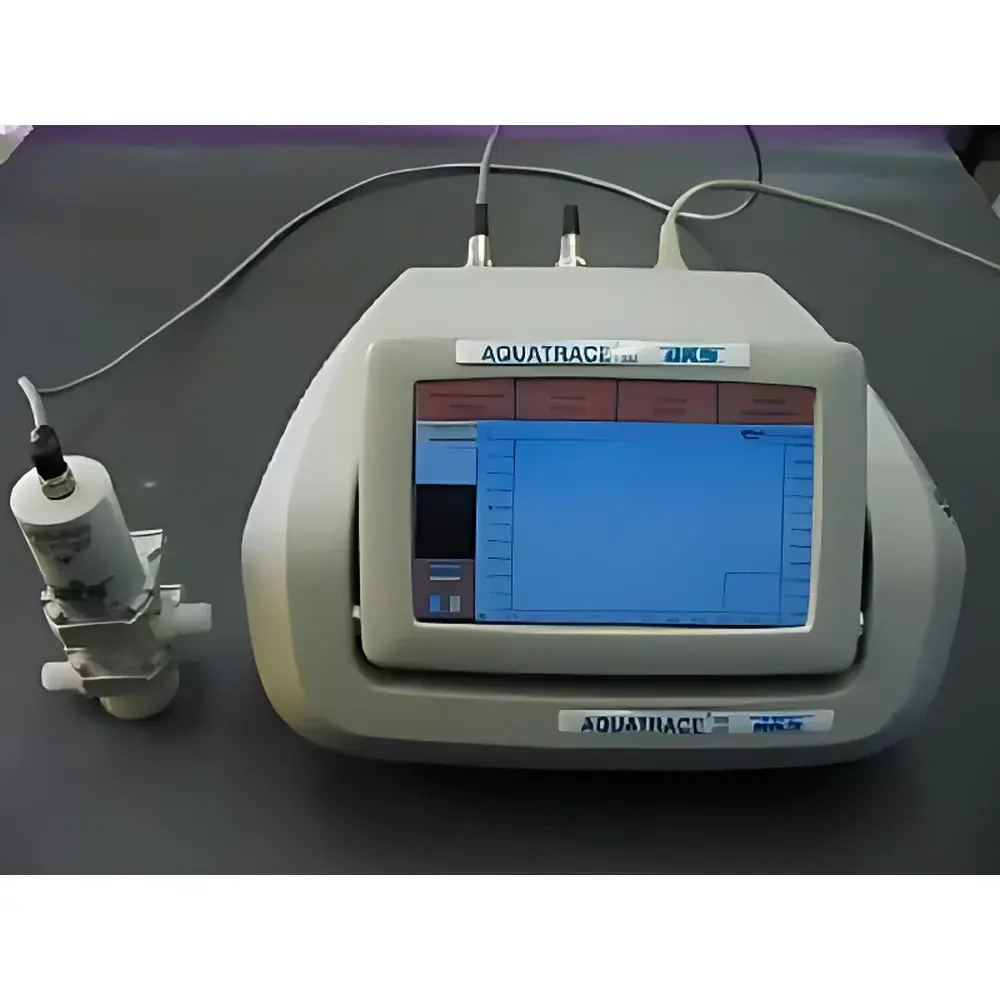
DKS AQUATRACE Corrosive Gas Moisture Analyzer
| Brand | DKS |
|---|---|
| Origin | Germany |
| Model | AQUATRACE |
| Detection Limit | 0.05 vppm |
| Measurement Range | 0–2000 vppm |
| Resolution | 0.1 vppm |
| Accuracy | ±5% of reading (≥0.4 vppm) |
| Response Time (T10–T90) | <1 s (moisture event), ≤2 min (return to baseline) |
| Reproducibility | ±2% at 20.0 vppm |
| Measuring Gas Flow | 20 Nl/h |
| Gas Temperature Range | +5 to +65 °C |
| Max. Gas Pressure | 200 mbar g |
| Sensor Body Material | PVDF & stainless steel |
| Sensor Electrode Material | Noble metal |
| Analog Output | 4–20 mA (freely scalable) |
| Alarm Output | Relay (NO/NC), freely scalable |
| Status Relays | 3 × NAMUR-compliant |
| Gas Inlet | 6 mm locking ring |
| Cell Connector | 5-pole Binder plug |
| Standard Cable Length | 1.5 m (max. 100 m) |
| Auto Sensor Detection & Self-Check Function | Yes |
Overview
The DKS AQUATRACE Corrosive Gas Moisture Analyzer is a high-stability, electrochemical impedance-based trace moisture measurement system engineered specifically for continuous, real-time monitoring of water vapor in aggressive industrial process gases. Unlike conventional chilled-mirror or aluminum oxide sensors—whose performance degrades rapidly in the presence of HF, HCl, Cl₂, SO₂, or ammonia—the AQUATRACE employs a proprietary noble-metal catalytic sensor housed in chemically inert PVDF and 316 stainless steel, enabling reliable operation in highly corrosive environments without frequent recalibration or sensor replacement. Its measurement principle relies on the quantitative correlation between the dielectric relaxation behavior of adsorbed water monolayers on the sensor surface and the resulting complex impedance shift, providing linear, drift-resistant response across the full 0.05–2000 vppm range. Designed for integration into critical gas purification loops, semiconductor bulk gas delivery systems, and specialty chemical synthesis lines, the analyzer meets the demanding stability and repeatability requirements of ISO 8573-8, ASTM D7443, and IEC 61511 functional safety frameworks.
Key Features
- Corrosion-resistant wetted path: PVDF body with 316L stainless steel fittings and noble-metal sensing electrodes ensure long-term integrity in HCl, HF, Cl₂, and other halogenated or acidic gas streams
- Ultra-low detection limit of 0.05 vppm with sub-second dynamic response (T₁₀–T₉₀ < 1 s for step increase; ≤120 s for return to baseline at T₉₀)
- High reproducibility: ±2% deviation at 20.0 vppm under controlled flow and temperature conditions over 30-day validation cycles
- Integrated sensor diagnostics: Automatic sensor identification, real-time impedance health check, and fault logging compliant with NAMUR NE43 signaling standards
- Flexible analog and digital interfacing: Freely scalable 4–20 mA output, three NAMUR-status relays, and configurable alarm relay (NO/NC) supporting SIL 2-capable system architectures
- Robust mechanical design: IP65-rated enclosure, 6 mm push-lock gas inlet, and Binder 5-pole connector for measuring cell—enabling rapid field service and sensor exchange without tools
Sample Compatibility & Compliance
The AQUATRACE is validated for use with non-condensing, non-particulate, non-oxidizing corrosive gases including hydrogen chloride (HCl), hydrogen fluoride (HF), chlorine (Cl₂), sulfur dioxide (SO₂), nitrogen trifluoride (NF₃), and silane (SiH₄) mixtures. It is not suitable for reducing atmospheres containing phosphine (PH₃) or arsine (AsH₃), nor for gases exceeding 200 mbar(g) pressure or containing condensable hydrocarbons above 1 ppmv. All wetted materials comply with FDA 21 CFR §177.2415 (PVDF) and ASTM A240 (316L SS). The instrument conforms to EMC Directive 2014/30/EU, Low Voltage Directive 2014/35/EU, and carries CE marking for industrial use. Optional factory calibration certificates are traceable to PTB (Physikalisch-Technische Bundesanstalt) reference standards.
Software & Data Management
The AQUATRACE operates as a standalone field device with no embedded operating system or remote software dependency. All configuration—including analog scaling, alarm thresholds, relay logic, and status reporting—is performed via front-panel membrane keys or local RS-485 Modbus RTU interface (addressable up to 247 units per bus). Configuration changes are logged with timestamp and user ID (if connected to external SCADA with audit trail capability). While the unit itself does not store historical data, its 4–20 mA output supports connection to DCS historian systems compliant with ISA-84 or FDA 21 CFR Part 11 when paired with third-party data acquisition hardware featuring electronic signature and change control functionality. Firmware updates require physical access and are delivered via encrypted USB stick with SHA-256 checksum verification.
Applications
- Semiconductor fab: Monitoring moisture in NF₃ etch gas cylinders and Cl₂ delivery lines prior to chamber injection
- Fluorochemical production: Real-time control of HF purity during fluorination reactor purge cycles
- Pharmaceutical excipient drying: Verification of residual moisture in nitrogen sparge gas used for lyophilization
- Specialty gas blending: Certification of ultra-dry argon or helium carrier gas for GC-MS and ICP-MS instrumentation
- Carbon capture pilot plants: Tracking water breakthrough in amine scrubber off-gas streams containing CO₂/H₂S mixtures
FAQ
Does the AQUATRACE require zero gas or span gas for routine operation?
No. The sensor is self-referencing and does not require periodic zeroing with dry nitrogen or calibration with certified moisture standards under normal operating conditions. Field verification using NIST-traceable permeation tubes is recommended annually or after sensor replacement.
Can the measuring cell be cleaned in situ?
No. The sensor element is sealed and non-serviceable. Exposure to solvents, ultrasonic cleaning, or mechanical abrasion will permanently damage the noble-metal electrode. Contamination-induced drift is mitigated by upstream particulate filtration (≤0.1 µm) and coalescing traps.
What is the maximum allowable cable length between the transmitter and sensor?
The standard measuring cable is 1.5 m. With low-noise shielded twisted pair (STP) cabling and proper grounding, extension up to 100 m is supported without signal degradation—provided ambient EMI remains below 3 V/m and ambient temperature stays within –10 to +50 °C.




