
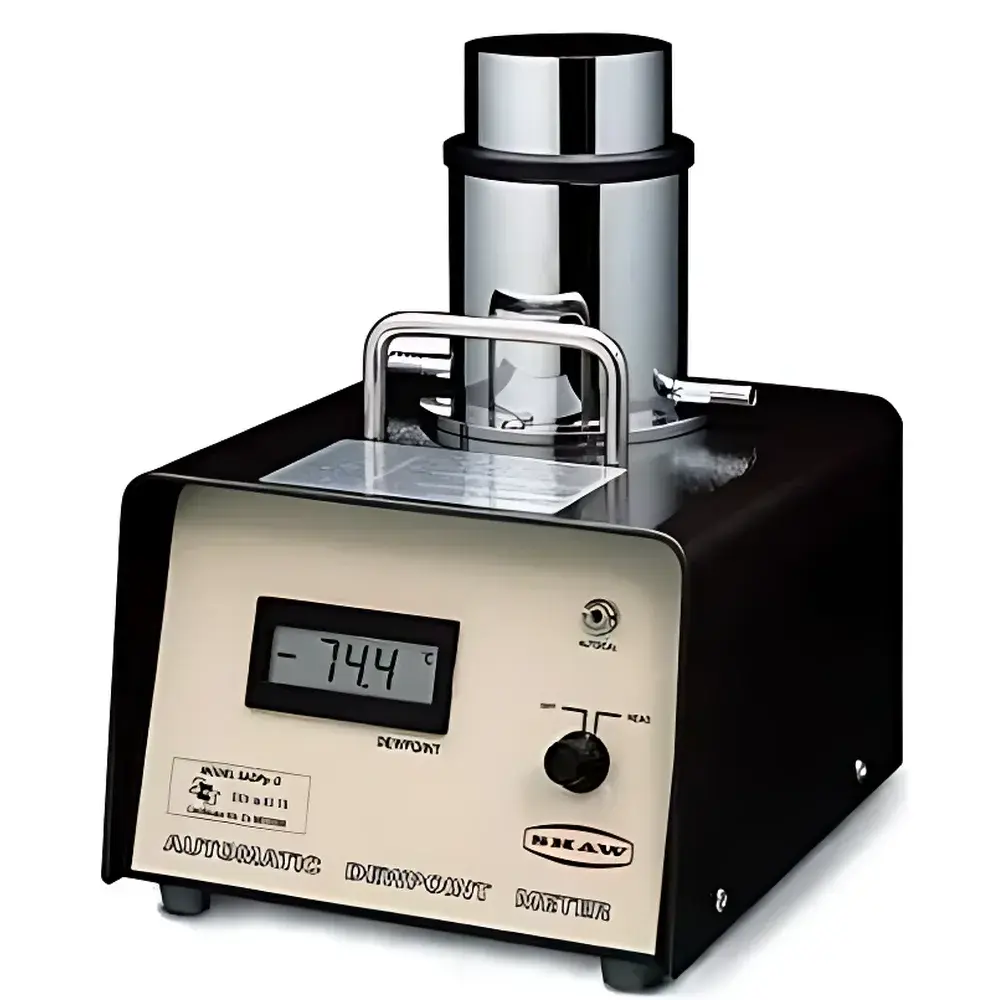
Alpha Moisture SADPu-D Portable Dew Point Meter
| Brand | Alpha Moisture |
|---|---|
| Origin | UK |
| Model | SADPu-D |
| Type | Portable Dew Point Meter |
| Measurement Principle | Aluminum Oxide Capacitive Sensor |
| Operating Temperature | -20 to +50 °C |
| Accuracy | ±2 °C DP |
| Repeatability | ±0.5 °C DP |
| Dew Point Range | Standard –80 to 0 °C DP (0–6000 ppmv, plus extended low-range 0–10 ppmv option) |
| Response Time | <20 s to 90% of final reading |
| Power Supply | 6 × C-cell alkaline batteries (≥150 h continuous operation |
| Weight | 5.5 kg net / 7 kg gross |
| Dimensions | 224 × 202 × 275 mm |
| Ingress Protection | IP65 |
| Explosion Protection | EEx ia IIC T5 |
| Storage Temperature | –50 to +70 °C |
| Humidity Range | 0–98% RH (non-condensing) |
| Display | LCD, dual units (°C DP and ppmv) |
Overview
The Alpha Moisture SADPu-D is a portable, intrinsically safe dew point meter engineered for high-reliability moisture measurement in industrial gas streams. It employs a stabilized aluminum oxide (Al₂O₃) thin-film capacitive sensor — a mature, field-proven technology compliant with ISO 8573-1 Annex B and ASTM D6304 methodologies for trace moisture analysis. Unlike chilled-mirror or tunable diode laser systems, the Al₂O₃ sensor operates on dielectric constant variation induced by water vapor adsorption, delivering stable, drift-resistant performance across wide dynamic ranges without cryogenic cooling or optical alignment. Its design targets applications where rapid deployment, intrinsic safety, and long-term calibration stability are critical — particularly in compressed air networks, specialty gas distribution, and high-purity process lines in regulated environments.
Key Features
- Intrinsically safe certification (EEx ia IIC T5) enables safe operation in Zone 0/1 hazardous areas including natural gas processing, hydrogen infrastructure, and SF₆-insulated switchgear maintenance.
- True portable architecture: self-contained unit with integrated sensor, electronics, display, and battery power — no external controllers, purge gas, or calibration gases required for routine operation.
- Field-calibratable via built-in zero-reference function using dry nitrogen or ambient air (with known dew point), supporting user-initiated verification and adjustment per ISO/IEC 17025-compliant procedures.
- Dual-unit real-time display (°C dew point and ppmv H₂O) with automatic range switching between standard (–80 to 0 °C DP) and ultra-low (0–10 ppmv) modes — optimized for both bulk drying validation and high-purity gas certification.
- Robust mechanical construction: IP65-rated enclosure with stainless-steel sensor housing, designed for vibration resistance and thermal shock tolerance in mobile field use.
- Low-power electronics architecture ensures ≥150 hours of continuous logging or >1 year of intermittent field use on six C-cell alkaline batteries — eliminating dependency on rechargeable systems in remote locations.
Sample Compatibility & Compliance
The SADPu-D is validated for direct, in-line or spot-check measurement of moisture in non-corrosive and mildly acidic gases including compressed air, N₂, O₂, H₂, CO₂, CO, CH₄, C₂H₄, SF₆, and all noble gases. It is not recommended for use with halogenated solvents, ammonia, or highly reactive species that may chemically degrade the alumina sensing layer. The instrument meets EN 60079-0 and EN 60079-11 for intrinsic safety, conforms to EMC Directive 2014/30/EU, and supports traceability under ISO/IEC 17025 when operated with documented calibration records. Its measurement uncertainty budget aligns with ISO 8573-1 Class 2–4 requirements for compressed air quality auditing.
Software & Data Management
While the SADPu-D operates as a standalone field instrument, optional USB interface (AlphaLink™ adapter) enables data export to CSV format for integration into LIMS or QA databases. Timestamped readings include dew point, ppmv, temperature, pressure (if external transducer connected), and instrument status flags. Audit trails — including calibration events, battery voltage logs, and sensor health indicators — are stored onboard for GLP/GMP-aligned review. No proprietary software installation is required; exported files comply with FDA 21 CFR Part 11 data integrity expectations when paired with controlled electronic record workflows.
Applications
- Compressed air system validation in pharmaceutical manufacturing (ISO 8573-1 Class 2–4 compliance checks).
- Moisture monitoring during pipeline commissioning and blow-down of natural gas and hydrogen transport systems.
- On-site verification of SF₆ purity prior to re-filling high-voltage circuit breakers (IEC 60480 guidelines).
- Quality control of inert gas blankets in semiconductor fabrication and aerospace component storage.
- Preventive maintenance of desiccant dryers and membrane nitrogen generators across petrochemical facilities.
- Field verification of moisture content in LNG carrier cargo hold purge gas prior to loading.
FAQ
What gases can be measured without risking sensor damage?
The SADPu-D is compatible with dry, non-aggressive gases such as air, N₂, O₂, H₂, CO₂, CO, CH₄, C₂H₄, SF₆, and noble gases. Avoid exposure to chlorine, ammonia, HF, or solvent vapors.
Is periodic recalibration required?
Yes — annual verification against a certified reference standard is recommended per ISO/IEC 17025. The built-in zero-reference function allows user-performed field checks, but full two-point calibration requires traceable standards.
Can the instrument operate continuously in sub-zero ambient conditions?
Yes — it functions reliably from –20 °C to +50 °C ambient. However, sample gas must be above its dew point to prevent condensation upstream of the sensor inlet.
Does the SADPu-D support pressure compensation?
No — it reports dew point at actual line pressure. For absolute moisture concentration (ppmv), users must input static line pressure manually or integrate an optional pressure transducer.
What is the expected service life of the sensor?
Under normal operating conditions and avoidance of liquid water or chemical contaminants, the Al₂O₃ sensor typically maintains specification for 10+ years with no scheduled replacement.





