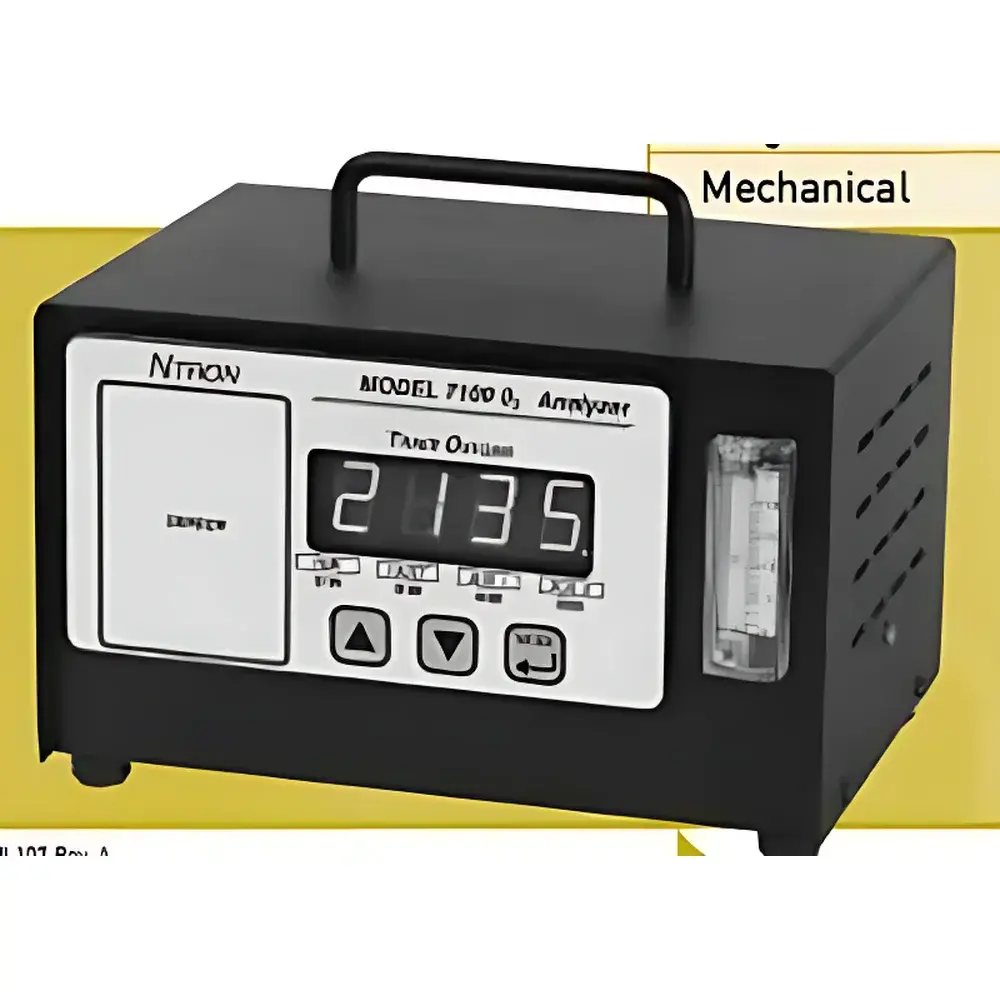
Neutronics Model 7100P Portable Oxygen Analyzer
| Brand | Neutronics |
|---|---|
| Origin | USA |
| Model | 7100P |
| Sensor Type | Miniature Heated Zirconia |
| Measurement Range | 0–1000 ppm O₂ (max 1% O₂) |
| Display | 0.75" (19.05 mm) High-Brightness LED, Resolution: 0.1 ppm |
| Response Time | <15 s (T90, at 500 mL/min flow) |
| Accuracy | ±3 ppm (0–50 ppm, two-point calibration) |
| Operating Temperature | 0–45 °C |
| Storage Temperature | −15–+50 °C |
| Humidity | 0–95% RH non-condensing |
| Sample Flow Rate | 0.4–1 L/min (constant pressure) |
| Power Supply | 90–250 VAC, 50/60 Hz, 10 W |
| Warm-up Time | ~2 minutes |
| Output Signals | RS-232, 4–20 mA, 0–10 VDC (optional: 0–1 VDC, 0–5 VDC) |
| Sample Port | 1/8" NPT female |
| Weight | <2.2 kg |
| Warranty | 1 year (electronics & sensor) |
| Alarm Indicators | Dual LED alarms (Alarm 1 & Alarm 2), Status LEDs (green = normal/online |
Overview
The Neutronics Model 7100P Portable Oxygen Analyzer is a field-deployable, zirconia-based electrochemical analyzer engineered for precise, real-time measurement of trace and low-concentration oxygen in inert or reactive process gas streams. Utilizing a miniature, integrated-heater zirconia sensor operating at elevated temperature (~700 °C), the instrument relies on the principle of oxygen ion conduction across a stabilized zirconium dioxide electrolyte under a partial pressure gradient — a robust, Nernst-equation-driven method widely accepted in industrial gas analysis per ASTM D3176 and ISO 8573-3. Designed for applications requiring rapid deployment and reliable ppm-level quantification — including glove box monitoring, nitrogen generator validation, heat-treatment furnace purge verification, and semiconductor purge gas qualification — the Model 7100P delivers stable baseline performance without external calibration gas cylinders during routine operation. Its compact, battery-free AC-powered architecture supports continuous benchtop or mobile use with minimal thermal drift and inherent immunity to CO₂, H₂O vapor (within specified humidity limits), and most hydrocarbons.
Key Features
- Miniature heated zirconia sensor with integrated ceramic heater, rated for 3–5 years operational lifetime under typical industrial conditions
- High-brightness 0.75″ LED display with 0.1 ppm resolution and intuitive status indication (green = online/normal; yellow = fault)
- Dual independent alarm outputs with dedicated LED indicators for configurable high/low O₂ thresholds
- Onboard sample pump ensures consistent 0.4–1 L/min flow across variable backpressure environments, eliminating dependence on external vacuum sources
- Fast warm-up time of approximately 2 minutes enables immediate field readiness after power-on
- Multi-signal analog and digital outputs: isolated 4–20 mA, 0–10 VDC (with optional 0–1 VDC or 0–5 VDC), and RS-232 serial interface for integration into SCADA, DCS, or data logging systems
- Ruggedized enclosure with IP54-rated front panel; weight <2.2 kg for true portability and repeated field use
Sample Compatibility & Compliance
The Model 7100P is validated for use with non-corrosive, non-condensing gas matrices including N₂, Ar, He, H₂, CO₂, and synthetic air. It is not recommended for direct sampling of acidic, halogenated, or highly reducing gas streams without appropriate conditioning (e.g., particulate filtration, moisture removal). The analyzer complies with CE marking requirements for electromagnetic compatibility (EN 61326-1) and safety (EN 61010-1). While not certified for hazardous area use (e.g., ATEX or IECEx), its design supports operation in Class 1, Division 2 environments when installed per NEC Article 500 guidelines. Data integrity protocols align with GLP/GMP expectations: all calibration events (date, operator ID, span/gain values) are timestamped and stored internally; audit trails can be exported via RS-232 for regulatory review. The instrument supports two-point calibration using certified zero (N₂ or argon) and span (e.g., 100 ppm O₂ in N₂) standards traceable to NIST.
Software & Data Management
No proprietary software is required for basic operation; however, the RS-232 interface enables full remote configuration and real-time data streaming using standard terminal emulators (e.g., PuTTY, Tera Term) or custom LabVIEW/Python scripts. All configuration parameters — including alarm setpoints, output scaling, damping factor, and calibration coefficients — are retained in non-volatile memory. Firmware updates are performed via ASCII command protocol over serial connection. For enterprise integration, the 4–20 mA output is compatible with analog input modules compliant with IEC 61131-3, and the device supports Modbus RTU over RS-232 upon request (custom firmware option). Data logs (O₂ concentration, status flags, alarm states) can be captured externally at user-defined intervals (1–60 s) with timestamp synchronization.
Applications
- Verification of inert atmosphere integrity in glove boxes, dry rooms, and packaging lines
- Performance monitoring of membrane and PSA nitrogen generators (O₂ breakthrough detection)
- Process control in annealing, sintering, and brazing furnaces where residual O₂ must remain below 10–50 ppm
- Quality assurance of ultra-high-purity (UHP) bulk gases supplied to semiconductor fabs
- Leak detection in sealed enclosures by measuring O₂ ingress rate over time
- Environmental chamber validation per ISO 14644-3 and ASTM E545
FAQ
What calibration gases are required for routine maintenance?
A certified zero gas (e.g., 99.999% N₂ or Ar) and a single-point span gas (e.g., 100 ppm O₂ in N₂) are sufficient for daily verification. Two-point calibration is recommended before critical measurements or after sensor replacement.
Can the analyzer operate continuously in ambient air?
Yes — the sensor is designed for indefinite exposure to atmospheric air without degradation; no auto-zero function is needed for ambient reference.
Is the 4–20 mA output intrinsically safe?
No — the analog output is non-isolated and not intrinsically safe; it requires appropriate barrier installation if used in classified areas.
How often should the sensor be replaced?
Under typical use (≤1000 ppm O₂, clean gas, 0–45 °C), the zirconia element maintains metrological stability for 3–5 years; end-of-life is indicated by increasing zero drift or failure to hold calibration.
Does the unit support automatic temperature and pressure compensation?
No — accuracy specifications assume constant temperature and pressure; for variable-condition applications, external PT sensors and software-based correction are recommended.